
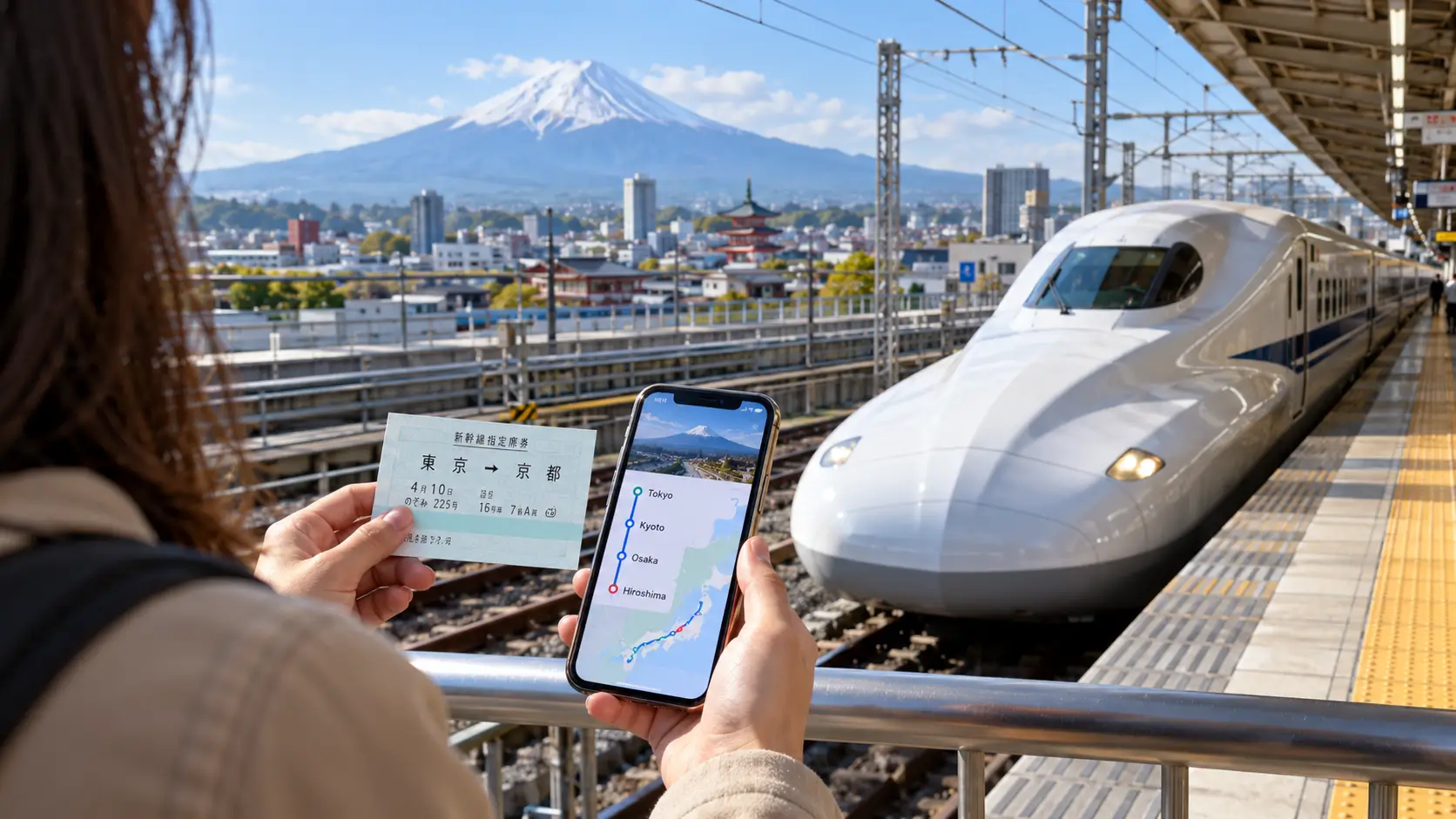

The Japan Rail Pass is worth it in 2026 for some Japan trips, but not for everyone.
It works best when you take several expensive, long-distance JR trains within 7, 14, or 21 consecutive days.
However, many first-time visitors can save money with individual train tickets instead.
For example, a simple Tokyo, Kyoto, and Osaka trip usually does not include enough expensive rail travel to make the nationwide pass worthwhile.
The JR Pass becomes more useful when you add places such as Hiroshima, Fukuoka, Tohoku, or several distant regions.
The best way to decide is simple. Compare the JR Pass price with the cost of your exact train journeys.
This guide explains the current JR Pass price, coverage, break-even point, Shinkansen rules, regional alternatives, and common Japan itineraries.
Key Takeaways
- 7-day Ordinary pass: ¥50,000 on the official JR site. Overseas agencies charge ¥53,000 from October 1, 2026.
- Tokyo, Kyoto and Osaka only? Usually not worth it. Buy individual Shinkansen tickets.
- Worth comparing when you add Hiroshima, Fukuoka or Tohoku inside the same 7-day window.
- Nozomi and Mizuho need an extra ticket (¥4,960 Tokyo–Kyoto).
- Activate the pass when your long-distance travel starts, not when you land.
- Staying in one region? A regional pass is often far cheaper.
Part of our Japan Travel Guide
First time in Japan? Start with our complete Japan travel guide for first-time visitors.
Japan Rail Pass Worth It? Quick Answer
The Japan Rail Pass is usually worth considering if you take several expensive JR journeys within a short period.
Usually worth checking:
You plan several long-distance Shinkansen trips within 7, 14, or 21 consecutive days.
Usually not worth it:
You are only visiting Tokyo, Kyoto, and Osaka.
Check a regional pass first:
Most of your trip stays within Kansai, Kyushu, Hokkaido, Tohoku, or another single region.
Do not buy the JR Pass just because you are traveling around Japan.
Build your itinerary first. Then compare the costs.
Should You Buy the JR Pass?
1. Does most of your trip stay inside one region (Kansai, Kyushu, Hokkaido, Tohoku)?
2. Are you only visiting Tokyo, Kyoto and Osaka?
3. Do your long JR trips fit inside 7, 14 or 21 consecutive days?
4. Do those fares clearly add up to more than the pass price?
What Is the Japan Rail Pass?
The Japan Rail Pass, often called the JR Pass, is a nationwide rail pass for eligible visitors to Japan.
It allows unlimited travel on many trains operated by the Japan Railways Group during a fixed period.
The pass covers many Shinkansen bullet trains, limited express trains, rapid trains, and local JR trains.
It also covers some JR buses, the Tokyo Monorail, and the JR-WEST Miyajima Ferry.
However, it does not cover every train, subway, or bus in Japan.
The major price increase in 2023 also changed how useful the pass is. Today, travelers need more long-distance train travel before the nationwide pass starts to save money.
Japan Rail Pass Cost in 2026
The Japan Rail Pass comes in Ordinary and Green Car versions.
As of September 2026, official online prices are:
| Pass Duration | Ordinary Adult | Ordinary Child | Green Adult | Green Child |
| 7 days | ¥50,000 | ¥25,000 | ¥70,000 | ¥35,000 |
| 14 days | ¥80,000 | ¥40,000 | ¥110,000 | ¥55,000 |
| 21 days | ¥100,000 | ¥50,000 | ¥140,000 | ¥70,000 |
Children are generally classed as ages 6 to 11 for JR Pass pricing.
There is also an important change for overseas agency purchases.
From October 1, 2026, prices through overseas JR-designated agencies rise to:
| Pass Duration | Ordinary Adult | Green Adult |
| 7 days | ¥53,000 | ¥74,000 |
| 14 days | ¥84,000 | ¥116,000 |
| 21 days | ¥105,000 | ¥147,000 |
As of September 1, 2026, the official JR online prices remain ¥50,000, ¥80,000, and ¥100,000 for Ordinary Class.
Prices and sales rules can change. Check the official Japan Rail Pass website before buying.
Japan Rail Pass Validity
The nationwide JR Pass is available for:
- 7 consecutive days
- 14 consecutive days
- 21 consecutive days
The word consecutive is important.
A 7-day pass does not give you seven travel days that you can use whenever you want.
Once the pass starts, all seven calendar days run continuously.
You cannot pause the pass during days when you stay in one city.
For this reason, the date you activate your JR Pass can have a major effect on its value.
Who Is Eligible for the Japan Rail Pass?
The Japan Rail Pass is mainly designed for international tourists visiting Japan.
Foreign tourists generally need to enter Japan for sightseeing with Temporary Visitor status.
Having an Exchange Order or buying the pass online does not remove this requirement.
Your eligibility is checked when you collect or exchange the pass. You also need your passport.
Japanese nationals living abroad may also qualify under separate rules if they meet specific overseas residence requirements.
However, Japanese citizens living overseas cannot use the official online purchasing system in the same way as eligible foreign tourists.
Check your eligibility before paying for the pass.
Green Car vs Ordinary Japan Rail Pass
Most travelers will be comfortable with the Ordinary JR Pass.
Ordinary Shinkansen seats already offer good legroom and a comfortable ride.
Green Car is the premium option.
It usually offers larger seats, more space, and a quieter environment.
However, it costs much more.
For example, the official online 7-day Green Car pass costs ¥70,000 compared with ¥50,000 for Ordinary Class.
If saving money is your main goal, Ordinary Class is usually the better choice.
Green Car makes more sense if comfort is more important than getting the lowest possible price.
Japan Rail Pass vs Individual Train Tickets
This is the most important comparison to make.
A regular one-way Shinkansen ticket from Tokyo to Kyoto costs ¥13,320 for a non-reserved seat or around ¥14,000 for a reserved seat.
Tokyo to Shin-Osaka costs ¥13,870 for a non-reserved seat or around ¥14,500 for a reserved seat.
Compare those fares with the ¥50,000 price of a 7-day Ordinary JR Pass.
A traveler going from Tokyo to Kyoto and then Osaka will not come close to the JR Pass price.
Even traveling from Tokyo to Osaka and back costs around ¥28,000 to ¥29,000 using regular Shinkansen fares.
This is why the classic Tokyo, Kyoto, and Osaka itinerary usually does not make the nationwide JR Pass worth it.
What Is the JR Pass Break-Even Point?
The break-even point is where the value of your covered individual train tickets reaches the price of the pass.
For example, the 7-day Ordinary JR Pass costs ¥50,000.
If your covered train tickets would cost only ¥30,000, buying the pass makes little financial sense.
If they cost around ¥50,000, the decision becomes much closer.
If they clearly exceed ¥50,000, the JR Pass becomes more attractive.
However, saving ¥500 or ¥1,000 does not automatically make the pass the best choice.
JR Pass Break-Even Point
Total individual fares compared with the 7-day pass (¥50,000)
Grey = individual tickets cheaper. Green = JR Pass saves money. Fares approximate, reserved seats.
A Practical JR Pass Rule of Thumb
Use this simple method:
Far below the pass price:
Buy individual tickets.
Close to the pass price:
Compare convenience, train options, and regional passes.
Clearly above the pass price:
The JR Pass is worth serious consideration.
This is a practical travel rule, not an official JR policy.
Real JR Pass Cost Examples by Itinerary
Route shape matters more than the number of cities you visit.
Here is a simple starting point:
| Itinerary | Individual fares (approx.) | vs pass | Verdict |
|---|---|---|---|
| Tokyo → Kyoto | ¥14,000 | ¥36,000 less | Skip the pass |
| Tokyo → Kyoto → Osaka (fly home from Osaka) | ¥14,600 | ¥35,400 less | Skip the pass |
| Tokyo → Kyoto → Osaka → Tokyo | ¥29,100 | ¥20,900 less | Skip the pass |
| Tokyo → Kyoto → Hiroshima → Tokyo | ¥44,000 | ¥6,000 less | Close; tickets still cheaper |
| Tokyo → Kyoto → Hiroshima → Fukuoka → Tokyo | ¥58,000 | ¥8,000 more | JR Pass saves money |
Approximate one-way reserved-seat fares on Hikari/Sakura trains: Tokyo–Kyoto ¥14,000, Kyoto–Osaka ~¥600 (JR local), Shin-Osaka–Tokyo ¥14,500, Kyoto–Hiroshima ~¥11,000, Hiroshima–Fukuoka ~¥9,500, Hiroshima–Tokyo ~¥19,000, Fukuoka–Tokyo ~¥23,500. Nozomi fares are slightly higher. Check exact fares before booking.
| Example Itinerary | General Verdict |
| Tokyo only | JR Pass not worth it |
| Tokyo → Kyoto | Individual ticket is better |
| Tokyo → Kyoto → Osaka | Usually not worth it |
| Tokyo → Kyoto → Osaka → fly home from Osaka | Usually not worth it |
| Tokyo → Kyoto → Osaka → Tokyo | Usually individual tickets are cheaper |
| Tokyo → Kyoto → Hiroshima → Tokyo | Usually below the 7-day pass price without extra trips |
| Tokyo → Kyoto → Hiroshima → Fukuoka → Tokyo | JR Pass is worth comparing |
| Osaka → Hiroshima → Fukuoka | Check regional passes first |
| Several Tohoku cities from Tokyo | National or regional pass may work |
| Travel mainly within Kansai | Regional pass is often better |
These are general examples.
Train type, seat type, discounts, and extra day trips can change the final result.
Always calculate your exact itinerary.
Is the JR Pass Worth It for Tokyo, Kyoto and Osaka?
For most travelers, no.
Tokyo, Kyoto, and Osaka are the most common first-time Japan route.
However, the nationwide pass normally costs much more than the required train tickets.
Tokyo to Kyoto costs around ¥13,000 to ¥14,000 one way.
Tokyo to Shin-Osaka costs around ¥14,000 one way.
Travel between Kyoto and Osaka is much cheaper because the cities are close together.
If you fly home from Osaka instead of returning to Tokyo, the JR Pass becomes even harder to justify.
Individual tickets are usually the better option for this itinerary.
Round Trip vs Open-Jaw Japan Itineraries
Your international flights can change the JR Pass calculation.
A round-trip itinerary may look like:
Tokyo → Kyoto → Osaka → Tokyo
An open-jaw itinerary may look like:
Tokyo → Kyoto → Osaka → fly home from Osaka
Both travelers visit the same destinations.
However, the second traveler does not need the expensive Osaka to Tokyo return journey.
This reduces total rail spending.
If you have not booked your flights yet, compare both travel styles.
An open-jaw flight may save more time and money than buying a nationwide rail pass.
How Many Shinkansen Trips Make the JR Pass Worth It?
There is no fixed number.
A short Shinkansen journey costs much less than a long one.
Tokyo to Kyoto costs about ¥13,000 to ¥14,000 one way.
Tokyo to Hiroshima costs ¥18,380 for a non-reserved seat, around ¥19,000 on a reserved Hikari or Sakura service, and around ¥19,500 on a reserved Nozomi.
This means counting train rides is not enough.
Instead, add the cost of all covered trips that fall inside your JR Pass period.
That total gives you a much better answer.
Will Getting a JR Pass Pay Off?
The JR Pass works best when several expensive journeys are packed into a short travel window.
Imagine a traveler going:
Tokyo → Kyoto → Hiroshima → Fukuoka → Tokyo
This trip includes several long Shinkansen journeys.
That makes the nationwide pass much more competitive than it would be for Tokyo, Kyoto, and Osaka alone.
By comparison, a slow traveler who takes one long-distance train every five or six days may struggle to fit enough travel inside one pass period.
Fast multi-city travel favors the JR Pass.
Slow regional travel often favors individual tickets or regional passes.
Japan Rail Pass Calculator: Should You Use One?
A JR Pass calculator is useful.
However, it should be a starting point, not your final answer.
Some calculators simply add train fares.
They may not consider:
- whether every trip fits inside the same 7-day window
- regional rail passes
- tourist ticket discounts
- private railway options
- open-jaw flights
- domestic flights
- your exact activation date
Build your trip by date first.
Then calculate the journeys that actually fall inside your pass period.
After that, compare the nationwide pass with regional passes and individual tickets.
When Should You Activate Your JR Pass?
Do not automatically activate your JR Pass on the day you land in Japan.
Start it when your expensive train travel begins.
For example, imagine a 14-day trip.
You spend four days in Tokyo.
Then you travel:
Tokyo → Kyoto → Hiroshima → Osaka → Tokyo
If those journeys fit inside seven consecutive days, you may only need to compare a 7-day pass.
Your holiday length does not decide which JR Pass you need.
Your long-distance travel window does.
Can You Use a 7-Day JR Pass on a 14-Day Japan Trip?
Yes.
Your JR Pass does not need to cover your entire holiday.
You might spend the first four days exploring Tokyo with an IC card.
Then you could activate a 7-day JR Pass when your long-distance travel starts.
After the pass expires, return to individual tickets or local IC-card travel.
Example: 7-Day Pass on a 14-Day Trip
A 14-day holiday does not automatically require a 14-day JR Pass.
The same idea works for 10-day, 18-day, or 21-day trips.
What Does the Japan Rail Pass Cover?
The Japan Rail Pass covers a large part of the JR network.
It includes many:
- Shinkansen trains
- limited express trains
- rapid trains
- local JR trains
- JR local bus services
- Tokyo Monorail services
- JR-WEST Miyajima Ferry trips
The Miyajima Ferry is covered, but travelers must still pay the separate ¥100 Miyajima Visitor Tax.
The nationwide pass is useful because the JR network covers many parts of Japan.
However, JR is not the only transport company in the country.
What Does the Japan Rail Pass Not Cover?
The Japan Rail Pass does not cover every form of transport.
It generally does not cover:
- Tokyo Metro
- Osaka Metro
- most private railway companies
- most non-JR city buses
- JR highway and express bus routes
- private sections of certain through-train services
- Nozomi and Mizuho without the required special ticket
Official JR rules state that JR express bus routes and some other JR bus services are excluded.
This means even JR Pass holders may still need an IC card.
Does the JR Pass Cover Nozomi and Mizuho?
Not automatically.
The normal JR Pass does not provide unlimited Nozomi or Mizuho travel by itself.
However, JR Pass holders can use these trains if they buy a separate special Nozomi Mizuho ticket.
For example, the Nozomi supplement between Tokyo and Kyoto is currently ¥4,960.
Tokyo to Hiroshima requires a ¥6,500 Nozomi supplement.
Without the extra ticket, pass holders can use covered alternatives.
On the Tokaido Shinkansen, this includes Hikari and Kodama services.
Nozomi trains are faster because they make fewer stops.
Decide whether the time saving is worth the extra cost.
Do You Need a Seat Reservation With the Japan Rail Pass?
Not on every train.
Many trains have reserved and non-reserved seats.
However, some services require reservations.
Seat reservations are also useful when:
- traveling during busy periods
- traveling as a family or group
- carrying oversized luggage
- you want a specific seat
- your schedule is fixed
Travelers who buy the JR Pass through the official online system can reserve eligible Shinkansen and limited express seats online after purchase.
Book popular trains early during peak travel periods.
Can You Use the JR Pass at Automatic Ticket Gates?
Yes.
Current JR Pass tickets can be used at compatible automatic ticket gates.
You can also use a staffed gate when needed.
Keep the pass after passing through the gate because you will need it again when you leave the station.
You should also carry your passport while using the JR Pass.
Railway staff may ask to check it.
Is the JR Pass Worth It During Peak Travel Season?
The financial calculation does not change just because you travel during a busy season.
However, seat planning becomes more important.
Popular trains can fill quickly during major holidays and peak domestic travel periods.
A JR Pass gives you travel flexibility.
It does not guarantee that your preferred train or reserved seat will always be available.
If you know your travel date, reserve important long-distance journeys as early as possible.
Shinkansen Oversized Luggage Rules
Large suitcases can affect your train booking.
On the Tokaido, Sanyo, Kyushu, and Nishi-Kyushu Shinkansen, luggage with total dimensions between 161 cm and 250 cm requires a seat reservation with an oversized baggage area.
Baggage larger than 250 cm in total dimensions cannot be brought onto these Shinkansen services.
If you bring qualifying oversized luggage without the required reservation, a ¥1,000 baggage fee may apply.
Sports equipment, wheelchairs, strollers, and some other special items can have different rules.
Measure large suitcases before traveling.
Luggage forwarding is also worth considering if you are moving between several cities.
JR Pass vs Suica, PASMO and ICOCA
The JR Pass and an IC card do different jobs.
The JR Pass is mainly a rail travel product.
Suica, PASMO, and ICOCA are stored-value cards used to pay for transport and other small purchases.
You may use an IC card for:
- Tokyo Metro
- local trains
- buses
- private railways
- short city journeys
A traveler can buy individual Shinkansen tickets and use Suica for local travel.
A JR Pass holder can also carry a Suica, PASMO, or ICOCA card for transport that the pass does not cover.
Therefore, an IC card is not a direct replacement for the JR Pass.
Many travelers use both.
JR Pass vs Regional Rail Pass
A regional JR pass can offer better value when most of your journey stays in one part of Japan.
Regional passes are available for areas including:
- Kansai
- Hiroshima
- Kyushu
- Tohoku
- Hokkaido
- Hokuriku
For example, someone focusing on Osaka, Kyoto, Hiroshima, and nearby destinations should compare regional JR West passes before buying the nationwide pass.
A traveler exploring Tohoku from Tokyo should also compare JR East regional products.
The nationwide pass is built for travel across several regions.
A regional pass is often better for concentrated travel.
| Pass | Validity | Adult price | Best for |
|---|---|---|---|
| Nationwide JR Pass | 7 / 14 / 21 days | ¥50,000 / ¥80,000 / ¥100,000 | Fast trips across several regions |
| JR Kansai Wide Area Pass | 5 days | ¥12,000 | Kyoto, Osaka, Nara, Himeji, Okayama, Kinosaki |
| JR-WEST All Area Pass | 7 days | ¥26,000 | Kansai, Hiroshima, Fukuoka (Hakata), Kanazawa |
| JR Kyushu Rail Pass (All Kyushu) | 3 / 5 / 7 days | ¥22,000 / ¥24,000 / ¥26,000 | Fukuoka, Nagasaki, Kumamoto, Kagoshima |
| JR Kyushu Rail Pass (Northern) | 3 / 5 days | ¥15,000 / ¥17,000 | Fukuoka, Nagasaki, Kumamoto, Beppu, Yufuin |
| JR EAST PASS | 5 / 10 days | ¥35,000 / ¥50,000 | Tokyo plus Tohoku, Nagano and Niigata |
| Hokkaido Rail Pass | 5 / 7 / 10 days | ¥22,000 / ¥28,000 / ¥37,000 | Sapporo, Hakodate, Furano, Asahikawa |
Prices checked September 2026. Regional passes do not cover the Tokaido Shinkansen (Tokyo–Kyoto–Osaka). Kyushu prices shown are station/agency prices; JR Kyushu’s online booking is cheaper. Hokkaido prices are pre-purchase rates and exclude the Hokkaido Shinkansen.
A Hybrid Rail Strategy Can Save More
You do not need one transport product for your entire Japan trip.
A mixed approach may cost less.
For example:
Tokyo → Kyoto: individual Shinkansen ticket
Kansai and Hiroshima: regional rail pass
Local city travel: Suica or ICOCA
This can cost less than buying a nationwide JR Pass.
It also gives you more freedom to use private railway companies and special tourist tickets.
Always compare combinations before making your final decision.
JR Pass Alternatives to Consider
If the nationwide Japan Rail Pass does not fit your trip, you still have several options.
Individual Shinkansen Tickets
Best for travelers taking only a few long-distance journeys.
Regional Rail Passes
Best for trips focused on one area of Japan.
IC Cards
Useful for local trains, subways, and buses.
Domestic Flights
Flights can compete with trains on very long journeys, especially between Tokyo and areas such as Kyushu or Hokkaido.
Highway Buses
Long-distance buses can cost much less than the Shinkansen.
However, journey times are much longer.
Tourist Train Discounts
Foreign visitors can sometimes access discounted railway tickets that cost less than standard fares.
Do not compare the JR Pass only with the most expensive possible individual ticket.
Check current tourist offers too.
Is the Japan Rail Pass Worth It for Families?
Families should use the same route-based calculation.
Children generally receive lower JR Pass prices.
However, buying several passes can still create a large transport bill.
For example, two adults and two children buying nationwide passes will spend far more than one solo traveler.
Families should compare:
- JR Pass costs
- individual ticket prices
- child fares
- seat reservations
- luggage needs
- regional passes
If you are traveling slowly and staying several nights in each city, individual tickets may still be better.
What About Airport Trains?
Airport train travel can add some value to a JR Pass.
However, one airport transfer is not enough reason to buy a ¥50,000 nationwide pass.
The value depends on your airport.
JR services may be useful for travel from Narita Airport and Kansai Airport.
The Tokyo Monorail is also included in the JR Pass.
Treat airport transport as a small bonus in your calculation.
Your expensive intercity journeys should still decide whether the pass is worth it.
What Are the Main Benefits of the Japan Rail Pass?
The JR Pass is not only about saving money.
Its main benefits include:
- flexible travel across the JR network
- many covered Shinkansen services
- easier multi-city travel
- useful seat reservations
- freedom to add some spontaneous JR trips
- one pass for several regions
Convenience can have value.
However, convenience should not hide a large price difference.
If individual tickets save you ¥15,000 or ¥20,000, buying the JR Pass only because it feels easier may not make sense.
Pros and Cons of the Japan Rail Pass
| Advantages | Disadvantages |
| Unlimited travel on many JR services | High starting price |
| Useful for fast multi-city trips | Poor value for many simple itineraries |
| Covers many Shinkansen trains | Does not cover every railway |
| Good travel flexibility | Valid for consecutive days |
| Useful seat reservations | Nozomi and Mizuho need an extra ticket |
| Works across several JR regions | Regional passes may cost less |
| Can simplify long-distance travel | Local city transport may still cost extra |
The main benefit is flexibility.
The main weakness is price.
This is why every traveler should calculate the pass before buying.
Where to Buy a Japan Rail Pass
There are two main ways to buy the nationwide JR Pass.
Buy From the Official JR Pass Website
Eligible foreign tourists can buy the pass online.
After buying it, you can reserve eligible Shinkansen and limited express seats through the same system.
You then collect the pass in Japan using your passport and required travel documents.
Buy Through an Overseas JR-Designated Agency
Travelers can also buy through approved overseas travel agencies.
Depending on the purchase method, you may receive an Exchange Order that must be exchanged after you arrive in Japan.
From October 1, 2026, overseas agency prices increase, while the official online price table currently remains at the existing level.
Check both options before buying.
Should You Activate the JR Pass at the Airport?
Not always.
Imagine that you arrive in Tokyo and stay there for four days before taking your first Shinkansen.
If you activate a 7-day pass immediately at the airport, four valuable pass days may disappear while you are only using local transport.
Instead, start the pass when your expensive travel begins.
If your airport journey fits inside the same useful travel window, it can add extra value.
If not, buy the airport ticket separately.
When Is the Japan Rail Pass Not Worth It?
The Japan Rail Pass is usually not worth it when:
- you stay mainly in Tokyo
- you travel only from Tokyo to Kyoto
- you visit Tokyo, Kyoto, and Osaka only
- you fly into Tokyo and fly home from Osaka
- your trip stays mainly in one region
- you take only one or two long-distance trains
- your expensive journeys are spread too far apart
- individual tickets cost much less than the pass
Slow travelers should be especially careful.
If you stay five or six days in each destination, it can be difficult to fit enough long-distance travel into one consecutive pass period.
When Is the Japan Rail Pass Worth It?
The nationwide JR Pass is most useful for travelers taking many expensive JR journeys across different regions within a short period.
Examples may include fast trips connecting:
Tokyo
Kyoto
Hiroshima
Fukuoka
Tohoku
other distant JR destinations
The pass may also work for travelers taking several expensive day trips.
However, there is no route where you should automatically buy the JR Pass without checking current fares.
Calculate first.
Buy second.
How to Decide if the Japan Rail Pass Is Worth It
Follow these steps.
First, build your complete Japan itinerary.
Next, write down every long-distance train journey.
Add the date for each journey.
Then check the normal ticket price.
After that, see whether your expensive trips fit inside a 7-day, 14-day, or 21-day period.
Compare the total with the JR Pass price.
Next, check regional passes and tourist discounts.
Finally, think about convenience and flexibility.
If the JR Pass clearly saves money and fits your route, buy it.
If individual tickets cost much less, skip it.
If both options are close, choose the one that makes your trip easier.
Japan Rail Pass FAQs
Is the Japan Rail Pass worth it in 2026?
It depends on your itinerary. It is usually not worth it for a simple Tokyo, Kyoto, and Osaka trip. It becomes more useful when several expensive long-distance JR journeys fit inside the same pass period.
Is a 7-day JR Pass worth it?
It can be. Your covered train fares should ideally exceed the ¥50,000 official online Ordinary Pass price by a useful amount.
Is a 14-day JR Pass worth it?
Only if you have enough expensive JR travel during those 14 consecutive days. A 14-day Japan trip does not automatically require a 14-day JR Pass.
Is a 21-day JR Pass worth it?
It may work for travelers moving frequently across several regions. Slow travelers should compare individual tickets and regional passes first.
Is the JR Pass worth it for Tokyo and Kyoto?
Usually not. A one-way Tokyo to Kyoto Shinkansen journey costs ¥13,320 for a non-reserved seat or around ¥14,000 reserved.
Is the JR Pass worth it for Tokyo, Kyoto, and Osaka?
Usually not for those cities alone. Individual tickets generally cost much less than the nationwide pass.
Does the JR Pass cover Shinkansen trains?
Yes. It covers many Shinkansen services. However, Nozomi and Mizuho require an additional special ticket.
Does the JR Pass cover Tokyo Metro?
No. Tokyo Metro is not part of the JR network.
Does the JR Pass cover Osaka Metro?
No. Osaka Metro services are not covered by the nationwide JR Pass.
Can I use Suica with a JR Pass?
Yes. Many JR Pass holders also use Suica, PASMO, or ICOCA for local transport outside the JR Pass network.
Can I use the JR Pass at automatic ticket gates?
Yes. Current JR Pass tickets can be used at compatible automatic ticket gates.
Who can buy the Japan Rail Pass?
Eligible foreign tourists generally need to enter Japan for sightseeing under Temporary Visitor status. Some Japanese nationals living overseas can also qualify under separate requirements.
Are regional JR passes better than the nationwide pass?
Sometimes. If most of your trip stays inside one region, a regional pass can offer much better value.
Final Verdict: Is the Japan Rail Pass Worth It?
So, is the Japan Rail Pass worth it in 2026?
For many first-time visitors, the answer is no.
A simple Tokyo, Kyoto, and Osaka itinerary usually does not include enough expensive rail travel to justify the nationwide pass.
Individual tickets are often cheaper.
However, the JR Pass can still offer good value for travelers moving quickly across several distant parts of Japan.
It becomes more attractive when your normal JR fares clearly exceed the pass price and those journeys fit inside the same 7-day, 14-day, or 21-day window.
Do not start by asking whether the Japan Rail Pass is good value in general.
Ask:
Is the Japan Rail Pass worth it for my exact itinerary?
Build your route first.
Calculate the train fares.
Check regional passes.
Choose your activation dates.
Then buy the option that gives you the best balance of cost, speed, and convenience.