
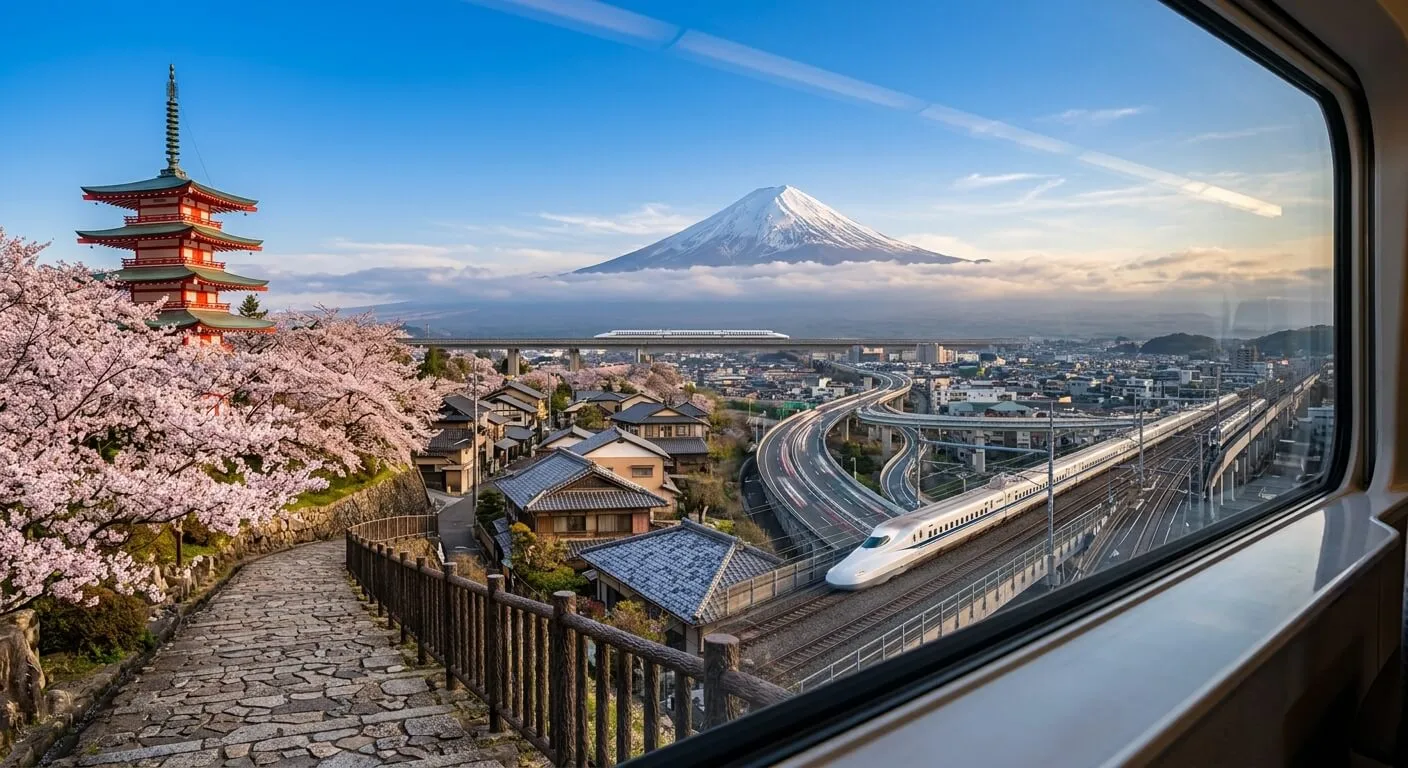

A good Japan 10 day itinerary for first-time visitors is Tokyo → Hakone → Kyoto → Nara → Osaka.
Spend three days in Tokyo. Then spend one night in Hakone, followed by three days around Kyoto. Visit Nara as a day trip before finishing in Osaka.
This route gives you modern cities, temples, Japanese food, nature, and a chance to see Mount Fuji. It also avoids too many long travel days.
Ten days will not let you see all of Japan. That is fine. A good trip is about choosing the right places, not visiting the most places.
This guide covers the complete route. It also explains transportation, hotels, food, luggage, costs, seasons, and useful travel tips for first-time visitors.
Getting a Tourist Visa for Japan
U.S. passport holders currently do not need a visa for a short tourism visit of less than 90 days, as long as they are not doing paid work in Japan.
Travelers with other passports should check the rules for their nationality. Japan’s visa waiver rules are based on nationality, not U.S. residence status.
Your passport should remain valid for your full stay.
Always check the latest entry rules before your trip. Visa and immigration requirements can change.
For a full budget for this trip, read our Japan trip cost guide with 10-day estimates for solo travelers and couples.
Before You Arrive: Visit Japan Web
You can also prepare some arrival procedures through Visit Japan Web before your flight.
The official service allows travelers to register information used for immigration and customs procedures.
Complete the information before departure if you plan to use the service.
It can make your arrival process easier after a long international flight.
How to Reach Japan
From the US
Most first-time travelers from the United States arrive in Tokyo.
Tokyo has two major international airports:
- Haneda Airport, or HND
- Narita International Airport, or NRT
Haneda is much closer to central Tokyo.
The Keikyu Line takes about 20 minutes between Haneda Airport and Shinagawa Station.
Narita is farther from central Tokyo. However, trains and airport buses connect it with the city.
When comparing flights, also look at an open-jaw route.
For example:
United States → Tokyo
Then:
Osaka → United States
This can save you from traveling back to Tokyo at the end of your vacation.
However, compare the total airfare first. An open-jaw ticket is not always cheaper.
If the Osaka departure costs much more, returning to Tokyo may still make sense.
How to Stay Connected in Japan
Internet access makes traveling around Japan easier.
You will probably use your phone for:
- Google Maps
- train directions
- restaurant searches
- translation
- attraction tickets
- hotel directions
- weather forecasts
You have several options.
You can use:
- an eSIM
- a physical SIM
- international roaming
- pocket Wi-Fi
Public Wi-Fi is also available in many hotels, stations, cafes, and tourist areas.
However, do not depend only on free public Wi-Fi.
Having your own internet connection is much easier when you are trying to find the right train platform or hotel.
Japan Itinerary in Brief
Here is the full Japan 10 day itinerary at a glance.
| Day | Destination | Main Plan |
| Day 1 | Tokyo | Meiji Jingu, Harajuku and Shibuya |
| Day 2 | Tokyo | Asakusa, Sensoji and east Tokyo |
| Day 3 | Tokyo | Flexible Tokyo sightseeing |
| Day 4 | Hakone | Mt. Fuji views, lake and hot springs |
| Day 5 | Kyoto | Fushimi Inari, Gion and Higashiyama |
| Day 6 | Kyoto | Arashiyama and Pontocho |
| Day 7 | Kyoto | Extra Kyoto sightseeing |
| Day 8 | Nara | Nara Park and temples |
| Day 9 | Osaka | Food, shopping and nightlife |
| Day 10 | Osaka | Final sightseeing and departure |
This route works well because it moves mainly from east to west.
Tokyo gives you Japan’s huge modern-city experience.
Hakone gives you nature and hot springs.
Kyoto adds temples, shrines, old streets, and traditional culture.
Nara gives you ancient history.
Finally, Osaka adds food and nightlife.
Hiroshima can replace one of the later days if it is a major priority for you.
Does This Japan Itinerary Cover 10 Days or 10 Nights?
This itinerary covers 10 calendar days.
For many travelers, that means nine nights.
However, there is an important difference between 10 calendar days and 10 full sightseeing days.
Suppose your flight arrives in Tokyo at 7:00 p.m. on Day 1.
You technically have a 10-day trip, but you do not have 10 sightseeing days.
If you want 10 complete sightseeing days, you may need 11 or 12 calendar days in Japan.
Your arrival and departure days can then act mainly as travel days.
This matters even more for travelers coming from the United States. Long flights and jet lag can make an ambitious first day difficult.
If You Arrive Late in Tokyo
Adjust Day 1 based on your flight.
Morning arrival: Leave your bags at the hotel and follow the normal itinerary.
Afternoon arrival: Choose one area, such as Shibuya or Shinjuku.
Evening arrival: Check in, eat near your hotel, and start sightseeing the next morning.
Do not force several attractions into your arrival day.
A slower first evening can make the rest of your trip much easier.
How to Spend 10 Days in Japan
Tokyo
Spend your first three days in Tokyo.
Tokyo can feel overwhelming at first. It is huge, busy, and full of things to see.
For this reason, avoid crossing the city several times in one day.
Group nearby neighborhoods together instead.
Meiji Jingu Shrine, Shibuya & Shinjuku
Start your first full sightseeing day around Meiji Jingu.
The shrine is beside Harajuku, so these two stops are easy to combine.
Take some time to walk around the shrine grounds.
Then explore Harajuku.
After Harajuku, walk toward Cat Street and Shibuya.
Visit Shibuya Crossing and explore the surrounding streets.
If you want a high city view, you can also book Shibuya Sky.
In the evening, continue to Shinjuku.
Shinjuku is known for bright streets, restaurants, entertainment, and nightlife.
However, keep this first day flexible.
Jet lag may affect how much you want to do.
Teahouse, Ghibli Clock, Asakusa & Asahi Sky Room
Use your second Tokyo day for the eastern side of the city.
You can start around Hamarikyu Gardens if you enjoy gardens and tea.
Then travel toward Asakusa.
Visit Sensoji Temple and explore the surrounding streets.
After that, spend some time near the Sumida River.
This route is slower than your Shibuya and Shinjuku day.
Your third Tokyo day should remain flexible.
Possible choices include:
- Ueno
- Akihabara
- Ginza
- teamLab
- another Tokyo neighborhood
- a theme park
Do not automatically use this day for another long trip.
Tokyo itself can easily fill several days.
Where to Stay in Tokyo
Stay near a useful train or subway station.
Good areas for first-time visitors include:
- Shinjuku
- Shibuya
- Ueno
- Asakusa
- Tokyo Station area
Choose Shinjuku or Shibuya if nightlife is important.
Choose Asakusa if you prefer a more traditional setting.
Ueno offers useful train connections.
The Tokyo Station area can be convenient before traveling west on the Shinkansen.
Location matters more than having the fanciest hotel.
A hotel far from useful transport can waste time every morning and evening.
Where to Eat in Tokyo
Tokyo has food options for almost every budget.
Try a mix of:
- ramen
- sushi
- soba
- udon
- tempura
- yakitori
- Japanese curry
- convenience store snacks
You do not need expensive restaurants for every meal.
Small restaurants can be one of the best parts of visiting Japan.
Tipping is also generally not expected in Japan.
Offbeat Things to Do in Tokyo
Tokyo has much more than famous crossings and observation decks.
If you have extra time, explore quieter neighborhoods.
Yanaka is one option.
You can also visit local shopping streets, gardens, museums, or smaller cafes.
Do not spend your entire Tokyo visit moving from one famous photo spot to another.
Leave some time to walk without a strict schedule.
Mt. Fuji / Hakone
Hakone fits well between Tokyo and Kyoto.
It is known for hot springs, Lake Ashi, mountain scenery, and views of Mount Fuji.
However, a Fuji view is never guaranteed.
Clouds can hide the mountain even on days when the rest of the weather looks good.
Treat Mount Fuji as a bonus rather than the only reason for visiting Hakone.
How to Get to Hakone
Hakone-Yumoto is the main gateway to the area.
From Shinjuku, the Odakyu route takes about 90 minutes.
Another option is to take the Tokaido Shinkansen from Tokyo to Odawara and continue to Hakone-Yumoto. That trip can take around 55 minutes before local sightseeing transfers.
Travel with a small overnight bag if possible.
You can forward your larger suitcase to your next hotel and carry only what you need for Hakone.
However, luggage delivery times vary.
Do not assume your suitcase will always arrive the same day.
Confirm the delivery time before sending it.
Where to Stay in Hakone
Hakone is a good place to experience a ryokan.
A ryokan is a traditional Japanese inn.
Many properties in the area also have onsen baths.
If you stay for only one night, choose accommodation with easy transport access.
A remote hotel can be beautiful, but it may also take extra time to reach.
Where to Eat in Hakone
Check whether your ryokan includes dinner and breakfast.
Many traditional stays offer meals as part of the experience.
If meals are not included, Hakone-Yumoto has restaurants and food shops.
Check opening times before going out for dinner.
Some resort areas become quiet earlier than Tokyo.
Offbeat Things to Do in Hakone
Popular Hakone experiences include:
- Lake Ashi
- hot springs
- Owakudani
- Hakone Open-Air Museum
- ropeway rides
Do not fill every hour.
Hakone works best as a slower break between Tokyo and Kyoto.
Kyoto
Kyoto deserves at least two full sightseeing days.
Three days is even better if temples and traditional culture are a major reason for your Japan trip.
The main challenge in Kyoto is distance.
Popular sights are spread across different parts of the city.
Group nearby attractions together.
Fushimi Inari Hike, Gion & Sunset at Kiyomizu-dera
Start early at Fushimi Inari.
It is famous for the paths lined with red torii gates.
Early morning is useful if you want fewer crowds.
Afterward, move toward eastern Kyoto.
Spend time around Gion and Higashiyama.
Walk through the old streets and visit temples along the way.
Later, continue toward Kiyomizu-dera.
Do not try to visit every temple you pass.
Kyoto becomes tiring if you treat it like a checklist.
Choose the places that interest you most.
Hozugawa River Adventure, Arashiyama Moss Temples & Pontocho Alley
Use another day for western Kyoto.
Start around Arashiyama.
Explore the bamboo area, riverside, temples, and surrounding streets.
Arrive early if you want a quieter experience.
After Arashiyama, return toward central Kyoto.
Spend your evening around Pontocho or nearby downtown streets.
If you have a third Kyoto day, keep it flexible.
You can visit attractions you missed or simply explore at a slower pace.
You can also use this day for Nara.
Nara
Nara is an easy addition to a Kyoto and Osaka itinerary.
The city is known for Nara Park, temples, Buddhist history, and free-roaming deer.
For most first-time visitors, a day trip is enough.
How to Get to Nara
You can reach Nara from Kyoto or Osaka.
Depending on the train used, trips from Kyoto can take roughly 35 to 50 minutes.
Kintetsu Nara Station is particularly convenient for Nara Park.
The park is only a short walk from the station.
Leave in the morning.
Spend your day around Nara Park and nearby temples.
Then return to Kyoto or continue toward Osaka.
Where to Stay in Nara
You do not need to stay overnight in Nara on this route.
A day trip keeps your Japan 10 day itinerary simpler.
An overnight stay can work if you want a quiet evening after many day visitors leave.
However, staying in Kyoto or Osaka usually means one less hotel change.
Where to Eat in Nara
You will find restaurants between the station, shopping streets, and Nara Park.
Try local sweets and simple Japanese meals.
Keep your food plan flexible.
Most visitors come to Nara mainly for the temples, park, and history.
Offbeat Things to Do in Nara
Do not stop after taking a few deer photos.
Walk deeper into the park.
Visit the temple areas.
Nara’s history is much more interesting than its famous deer alone.
Osaka
Osaka works well as the final city.
It offers food, shopping, entertainment, and nightlife.
It also feels different from both Tokyo and Kyoto.
Spend your first evening around Namba and Dotonbori.
Try Osaka foods such as:
- takoyaki
- okonomiyaki
- kushikatsu
Walk around Dotonbori after dark.
If you have more time, visit Osaka Castle or another neighborhood.
Staying in Osaka also makes sense if you will fly home from Kansai International Airport.
Hiroshima
Hiroshima is worth visiting, but it makes a 10-day route busier.
Do not simply add it on top of everything else.
Replace another stop if Hiroshima is important to you.
Major places include:
- Peace Memorial Park
- Atomic Bomb Dome
- Hiroshima Peace Memorial Museum
- Miyajima
- Itsukushima Shrine
How to Get to Hiroshima
Hiroshima is connected with Osaka by Shinkansen.
The train journey from Osaka takes about 90 minutes.
However, train time is not your total travel time.
You still need to reach the station, find the platform, arrive in Hiroshima, and travel to your first attraction.
If you also want Miyajima, an overnight stay can make the trip much easier.
Where to Stay in Hiroshima
Stay near Hiroshima Station if easy transportation is your priority.
You can also stay closer to central Hiroshima if you want easier evening sightseeing.
One night is much more comfortable than trying to fit Hiroshima and Miyajima into a rushed day trip.
Where to Eat in Hiroshima
Try Hiroshima-style okonomiyaki.
The local version usually combines layers of ingredients, often including noodles and cabbage.
Seafood is another popular choice.
What to Do in Hiroshima
Focus on a few meaningful places.
Peace Memorial Park and the museum deserve enough time.
If you also visit Miyajima, allow extra travel time for the local train and ferry.
Do not rush these places just to say you visited them.
Train Time vs Real Travel Time in Japan
A common itinerary mistake is planning around train time alone.
If Google Maps says a train takes two hours, that does not mean only two hours disappear from your day.
You also need time for:
- checking out
- reaching the station
- finding your platform
- waiting for your train
- arriving at the next station
- reaching the new hotel
- leaving your luggage
Use this table as a planning guide.
| Journey | Typical Train Time | Time to Block |
| Tokyo to Kyoto | About 2 hours 10 to 15 minutes | Around 3 to 4 hours |
| Tokyo to Hakone | About 1 to 1.5 hours | Around 2 to 3 hours |
| Kyoto to Nara | About 35 to 50 minutes | Around 1 to 1.5 hours |
| Kyoto to Osaka | About 15 to 50 minutes depending on train | Around 1 hour |
| Osaka to Hiroshima | About 1.5 hours | Around 2 to 2.5 hours |
The fastest Shinkansen journey from Tokyo to Kyoto is about 2 hours and 15 minutes.
These larger planning blocks are not official train schedules.
They are realistic amounts of itinerary time to protect.
What Should You Skip With Only 10 Days in Japan?
Ten days is enough for an excellent trip.
It is not enough to see every famous place.
For most first-time visitors, Tokyo and Kyoto deserve the highest priority.
Then choose optional destinations based on your interests.
Choose Osaka if you enjoy food, nightlife, shopping, and busy streets.
Choose Nara for temples, deer, and ancient history.
Choose Hakone for hot springs, nature, and possible Mount Fuji views.
Choose Hiroshima for modern history and Miyajima.
Do not try to squeeze Tokyo, Kyoto, Osaka, Nara, Hakone, Hiroshima, Miyajima, and several other day trips into the same 10 days.
You will spend too much time moving.
Nara vs Hakone vs Hiroshima: Which One Should You Add?
If you cannot fit every destination, compare what each one gives you.
| Destination | Best For | Time Needed | Main Trade-Off |
| Nara | Temples, deer and history | Half to full day | Similar cultural focus to Kyoto |
| Hakone | Nature, onsen and Fuji views | One day or night | Fuji views depend on weather |
| Hiroshima | Modern history and Miyajima | One to two days | Adds more long-distance travel |
| Osaka | Food, nightlife and entertainment | One to two days | Less traditional than Kyoto |
For the easiest addition, choose Nara.
For nature and a slower night, choose Hakone.
For history, choose Hiroshima.
For food and nightlife, give Osaka more time.
Want More Countryside and Less City Time?
Not everyone wants a trip built mainly around large cities.
If you prefer mountains, traditional towns, and a slower pace, you can replace some Osaka or Nara time with the countryside.
Takayama and the Hida region are good examples.
They offer traditional streets, mountain scenery, local food, and a quieter atmosphere.
However, these places add more travel time.
On a 10-day itinerary, use the countryside as a replacement, not another extra stop.
Adjust This 10-Day Japan Itinerary to Your Travel Style
There is no single itinerary that works for everyone.
Families
Reduce the number of hotel changes.
Keep more rest time.
You can replace a general sightseeing day with a theme park, aquarium, or family-focused attraction.
Food Lovers
Give Osaka more time.
Tokyo is also worth extra time if food is a major part of your trip.
Explore ramen, sushi, izakaya, markets, cafes, and regional dishes.
Nature Lovers
Keep Hakone.
You could also reduce Osaka time and add a countryside stay.
History Lovers
Give Kyoto more time.
Keep Nara.
Consider replacing another day with Hiroshima.
The best route depends on what you actually enjoy.
Best Time to Visit Japan
There is no single best month for everyone.
Your choice depends on:
- weather
- crowds
- prices
- flowers
- fall colors
- festivals
Japan also has busy domestic travel periods.
Hotels and transport can become much harder to book during major holidays.
Cusp of Winter and Spring
Late winter and early spring can be a good time for city travel.
Temperatures start to rise.
Spring flowers also begin appearing in different parts of the country.
Cherry blossom dates change every year.
They also vary by city.
Do not assume one exact week will guarantee full bloom.
Spring is a very popular season, so book hotels early.
Autumn
October and November are popular travel months.
However, autumn colors do not peak everywhere at the same time.
Northern areas and higher elevations often change first.
Tokyo, Kyoto, and other warmer regions usually see their stronger fall colors later.
JNTO notes that travelers often need to wait until November for the best colors in Tokyo and Kyoto, with Kyoto’s foliage season often starting around mid-November.
Winter
Winter can be a good time for a city-focused trip.
Tokyo is often cold and relatively dry.
Kyoto can feel colder, especially early in the morning.
Bring layers and comfortable shoes.
You will walk a lot.
Summer is also possible.
However, much of Japan can become hot and humid.
Build more breaks into your sightseeing days if you visit in summer.
How to Get Around in Japan
You do not need a rental car for this route.
Public transport connects Tokyo, Hakone, Kyoto, Nara, Osaka, and Hiroshima.
You will use a mix of:
- subway trains
- local trains
- buses
- Shinkansen
- walking
IC cards are useful for many local journeys.
However, they do not replace every long-distance ticket.
Traveling With Large Luggage
Pack lighter than you think you need.
Large suitcases make station transfers harder.
On the Tokaido-Sanyo-Kyushu Shinkansen, baggage with total dimensions from 160 cm to 250 cm requires a reservation for an oversized baggage space.
Very large luggage can also face additional restrictions.
Check the rules before traveling if you have a large suitcase.
Luggage forwarding is another useful option.
You can send larger bags to your next hotel and travel with a small overnight bag.
Confirm delivery times before sending anything.
Japan Rail Pass
Do not automatically buy the nationwide Japan Rail Pass.
First, calculate the price of the journeys you actually plan to take.
As of August 2026, an ordinary adult seven-day Japan Rail Pass costs ¥50,000 through the current official pricing.
For Exchange Orders purchased through overseas designated agencies, the official price rises to ¥53,000 for purchases made from October 1, 2026.
That does not mean every traveler should buy one.
For a simple Tokyo, Kyoto, Nara, and Osaka trip, individual tickets may cost less.
A pass becomes more interesting when your itinerary includes several long-distance rail journeys.
Also remember that using a Japan Rail Pass on the fastest Nozomi service requires an additional special Nozomi/Mizuho ticket.
Always calculate first.
Hakone Free Pass
The Hakone Free Pass can make local transportation around Hakone easier.
Whether it saves money depends on your exact route.
Compare the pass with the individual fares for the transport you plan to use.
Do not buy a travel pass simply because another itinerary tells you to.
Japan 10 Day Budget at a Glance
Your total cost depends heavily on your hotel dates, food choices, attractions, and travel style.
International airfare is best kept separate because prices from the United States change greatly by departure city and season.
The numbers below are rough planning ranges for one traveler, excluding international flights and major shopping.
| Travel Style | Accommodation | Food | Transport & Activities | Rough 10-Day Total |
| Budget | Hostels and simple stays | Casual meals | Public transport and lower-cost attractions | About ¥100,000 to ¥160,000 |
| Mid-range | Business and mid-range hotels | Mix of casual and better meals | Shinkansen and paid attractions | About ¥180,000 to ¥300,000 |
| Comfortable | Better hotels and ryokan | More premium dining | More paid experiences | About ¥350,000+ |
Treat these as planning figures, not fixed prices.
Accommodation can become much more expensive during:
- cherry blossom season
- autumn foliage season
- Golden Week
- major Japanese holidays
Build your budget in Japanese yen.
If you want the total in U.S. dollars, convert it using the exchange rate near your travel date.
FAQs
How many days in Japan are enough?
For many first-time visitors, 10 to 14 days is a useful starting point.
You can see several major destinations without needing a very long vacation.
However, Japan can easily fill several weeks.
If you only have ten days, focus on one main region and route.
Are 10 days enough for Japan?
Yes.
Ten days are enough for a first trip if you keep your route realistic.
A good Japan 10 day itinerary can include Tokyo, Hakone, Kyoto, Nara, and Osaka.
The key is not adding too many distant destinations.
Can you visit Tokyo, Kyoto and Osaka in 10 days?
Yes.
Tokyo, Kyoto, and Osaka are one of the easiest combinations for a first visit.
Fast rail connections make the route practical.
You can also add Nara as a day trip.
How many days should I spend in Tokyo?
Three full days is a good starting point for a 10-day trip.
Spend more time in Tokyo if you enjoy shopping, food, nightlife, museums, or modern city experiences.
How many days should I spend in Kyoto?
Plan at least two full sightseeing days.
Three days is better if temples, shrines, gardens, and traditional neighborhoods are important to you.
Is Kyoto or Osaka better for first-time visitors?
Choose Kyoto if traditional culture, temples, and historic streets are your priority.
Choose Osaka if food, nightlife, entertainment, and a busy city atmosphere interest you more.
Most first-time visitors benefit from seeing both, but Kyoto usually needs more sightseeing time.
Can I include Mount Fuji in a 10-day Japan itinerary?
Yes.
Hakone is one way to add nature and possible Mount Fuji views between Tokyo and Kyoto.
However, weather can block the mountain.
Do not build your whole day around a guaranteed Fuji view.
Can I visit Hiroshima in 10 days?
Yes, but it will make your trip faster.
If Hiroshima is important, replace another destination instead of adding it to an already full itinerary.
One overnight stay is better if you also want to visit Miyajima.
What places should I skip in Japan?
Skip destinations that do not fit your interests.
If you prefer history, keep Kyoto and Nara.
If you prefer nature, keep Hakone.
If you prefer food and nightlife, keep Osaka.
If Hiroshima is a major personal priority, give it enough time.
The goal is not to visit every famous place.
Is it worth learning Japanese?
You do not need fluent Japanese for a 10-day trip.
However, basic words are useful.
Learn simple phrases for:
- hello
- thank you
- excuse me
- please
- yes
- no
Translation apps can help with more difficult conversations.
Save your hotel addresses on your phone as well.
How much does a 10-day trip to Japan cost?
A rough budget depends on your travel style.
A budget traveler might plan around ¥100,000 to ¥160,000 before international flights.
A mid-range traveler may spend around ¥180,000 to ¥300,000.
A comfortable trip can reach ¥350,000 or more.
Hotel dates and long-distance transport can change these totals greatly.
Final Thoughts on This Japan 10 Day Itinerary
A Japan 10 day itinerary works best when you accept that you cannot see everything.
Start with Tokyo.
Slow down in Hakone.
Give Kyoto enough time.
Visit Nara if its temples and history interest you.
Then finish with Osaka’s food and nightlife.
If Hiroshima is more important, replace another stop rather than creating another packed day.
The same rule applies to countryside destinations.
Choose what fits your interests.
Leave enough time to enjoy each place.
That will give you a much better first trip than rushing through as many Japanese cities as possible.

1 Comment
Pingback: Japan 7 Day Itinerary for First-Time Visitors