
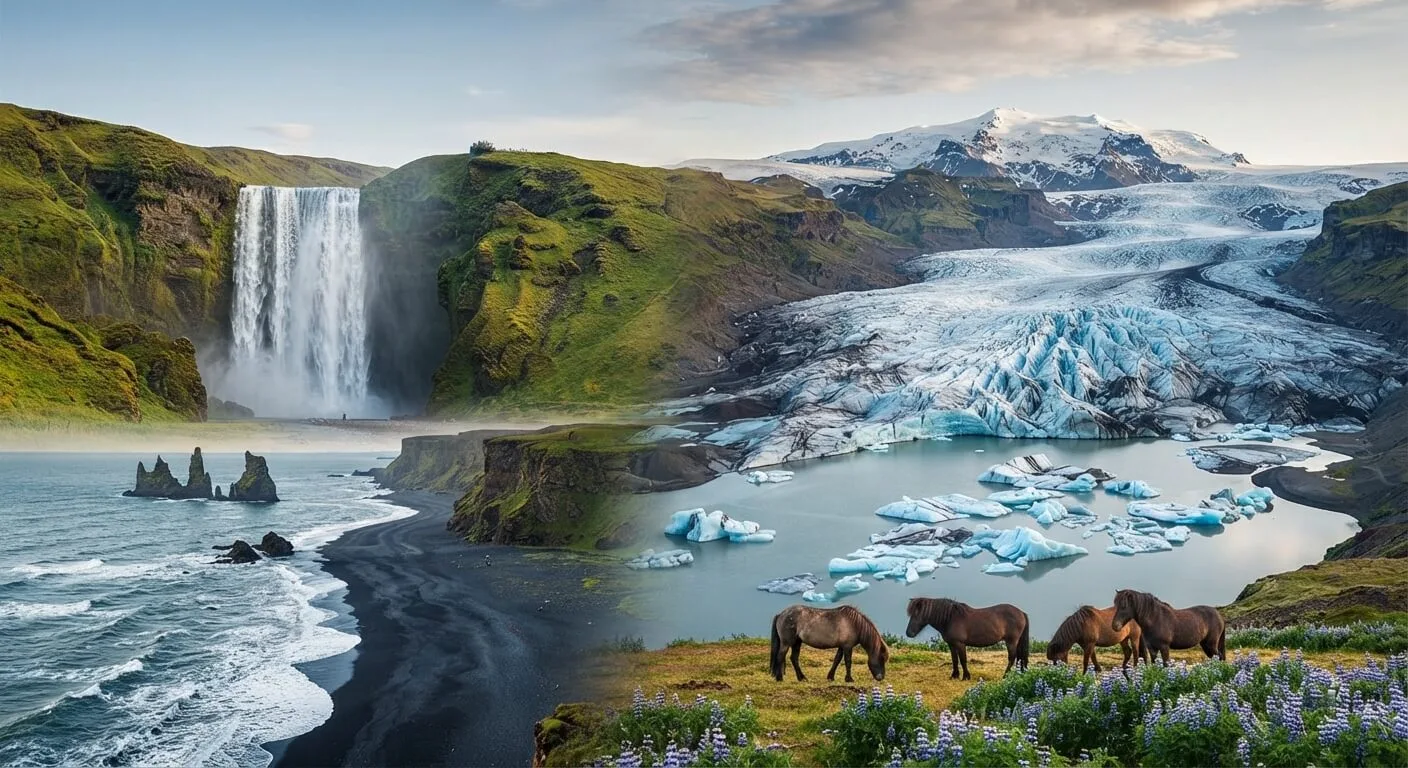

The best things to do in Iceland include exploring Reykjavik, driving the Golden Circle, seeing powerful waterfalls, walking on black sand beaches, and visiting glacier lagoons. You can also soak in geothermal water, ride an Icelandic horse, hike on a glacier, or search for the Northern Lights.
Iceland may look small on a map. However, its attractions are spread across a large area. Therefore, choosing the right places matters.
First-time visitors should focus on a few key regions. Reykjavik, the Golden Circle, and the South Coast are good starting points. Travelers with more time can continue toward Jökulsárlón, Snæfellsnes, the Westman Islands, or the Ring Road.
Here is a quick comparison of some of Iceland’s top experiences.
| Experience | Best For | Time Needed | Best Season | Tour Needed? |
| Reykjavik | Food and culture | 1–2 days | Year-round | No |
| Golden Circle | First-time visitors | Full day | Year-round | Optional |
| Silfra | Adventure | 2–4 hours | Year-round | Yes |
| South Coast | Nature | Full day or more | Year-round | Optional |
| Reynisfjara | Landscapes | 30–60 minutes | Year-round | No |
| Jökulsárlón | Nature and photography | 1–3 hours | Year-round | No |
| Geothermal spa | Relaxation | 2–4 hours | Year-round | No |
| Northern Lights | Bucket-list experience | Several hours | Darker months | Optional |
| Icelandic horse riding | Families and couples | 1–3 hours | Year-round | Yes |
| Glacier hiking | Adventure | Several hours | Depends on tour | Yes |
Opening times, road access, weather, and tour schedules can change. Always check current conditions before traveling.
Best Things to Do in Iceland for First-Time Visitors
If this is your first trip, you do not need to see everything.
Focus on Iceland’s most famous landscapes and experiences first.
The best choices for most first-time visitors include:
- Explore Reykjavik
- Drive the Golden Circle
- Visit Seljalandsfoss
- See Skógafoss
- Walk along Reynisfjara
- Visit Jökulsárlón Glacier Lagoon
- See Diamond Beach
- Soak in geothermal water
- Join a glacier experience
- Search for the Northern Lights in the right season
Travelers with three or four days should focus on Reykjavik, the Golden Circle, and part of the South Coast.
If you have a week, you can travel farther toward Jökulsárlón.
The best first trip is not the one with the most stops. It is the one that gives you enough time to enjoy each place.
What to Do in Reykjavik
Reykjavik is Iceland’s capital and the starting point for many trips.
The city is compact and easy to explore on foot.
You do not need several days here. However, one full day gives you time for food, culture, shopping, and major landmarks.
Reykjavik also works well as a base if you prefer guided day tours instead of driving.
Wander Through Downtown Reykjavik
Walking around central Reykjavik is one of the easiest things to do when you arrive in Iceland.
Explore colorful streets, small cafés, shops, public art, and the waterfront.
Laugavegur is one of the city’s best-known streets. It has restaurants, cafés, bars, and shops.
You can also walk toward Harpa Concert Hall and continue along the waterfront to the Sun Voyager sculpture.
Downtown Reykjavik is especially good for first-time visitors, couples, solo travelers, and food lovers.
Allow at least two or three hours for a quick visit.
Visit Hallgrímskirkja Church
Hallgrímskirkja is one of Reykjavik’s most famous landmarks.
Its tall design was inspired by Iceland’s natural landscape.
Visitors can explore the church and usually visit the tower when access is available.
The tower offers wide views across Reykjavik.
It is also easy to combine Hallgrímskirkja with a walk through the city center.
Eat an Icelandic Hot Dog
Food is part of the Iceland travel experience.
An Icelandic hot dog is a simple and popular choice.
It is often served with onions and several sauces.
This is also an easy way to try local food without paying the price of a full restaurant meal.
However, Icelandic food goes far beyond hot dogs.
Look for seafood, lamb dishes, rye bread, pastries, and modern Nordic food.
Visit Iceland and Taste the Saga
Iceland has much more than waterfalls and glaciers.
Its history includes Viking settlement, medieval sagas, fishing communities, and a strong storytelling tradition.
Add at least one cultural experience to your trip.
You could visit a museum, learn about Iceland’s settlement, or explore a historic site.
Cultural attractions are also useful when bad weather changes your outdoor plans.
Where to Stay in Reykjavik
Central Reykjavik is convenient for first-time visitors.
It gives you easy access to restaurants, shops, and major attractions.
Tour pickup points are also easier to reach.
However, central accommodation may cost more.
Travelers with a rental car may prefer staying slightly outside the busiest streets. Check parking before booking.
What to Do in the Golden Circle
The Golden Circle is one of Iceland’s most popular sightseeing routes.
It is ideal for first-time visitors because several famous attractions sit on the same route.
The three main stops are Þingvellir National Park, the Geysir Geothermal Area, and Gullfoss.
You can also add Kerið and Brúarfoss.
The route can be explored by rental car or guided tour.
Visit Kerið Volcano Crater
Kerið is a volcanic crater with a lake inside it.
Its red and dark volcanic rock creates a strong contrast with the water.
A walking path circles the top of the crater. Another path leads closer to the lake.
Kerið is easier to visit than many remote volcanic areas.
Around 30 to 60 minutes is enough for most visitors.
See Gullfoss Waterfall
Gullfoss is one of Iceland’s most famous waterfalls.
The water drops through a dramatic canyon in two main stages.
Several viewpoints give you different views.
Gullfoss is a good first-time attraction because it combines easily with the rest of the Golden Circle.
You do not need a difficult hike.
However, paths may become wet, icy, or slippery.
Allow around 45 to 90 minutes.
Explore the Geysir Geothermal Area
The Geysir Geothermal Area shows Iceland’s geothermal power.
The Great Geysir gave the English language the word “geyser.”
However, Strokkur is the geyser that visitors usually wait to see erupt.
The area also contains steaming ground, hot pools, and other geothermal features.
Stay on marked paths. The water and ground can be extremely hot.
Watch Strokkur Erupt
Watching Strokkur erupt is one of the most unusual things to do in Iceland.
Give yourself time to watch more than one eruption.
Keep your camera ready. However, never leave safe paths for a better picture.
Visit Brúarfoss Waterfall
Brúarfoss is known for its striking blue water.
It is smaller than Gullfoss, but many travelers enjoy its quieter setting.
It can work as an extra Golden Circle stop if you have enough time.
Check current parking and trail access before visiting.
Explore Þingvellir National Park
Þingvellir National Park is important for both nature and Icelandic history.
It sits in a rift zone between tectonic plates.
The area also played a major role in Iceland’s early political history.
Visitors can follow walking paths, see dramatic rock formations, and learn about Iceland’s past.
A quick visit may take one or two hours. However, you can stay longer if you enjoy walking.
Wear suitable shoes because paths can become wet or icy.
Go Snorkeling or Diving in Silfra
Silfra is a famous fissure inside Þingvellir National Park.
Its water is known for very high visibility.
Visitors can snorkel or dive between dramatic rock walls.
This is not a casual swimming spot.
Join an approved guided activity with the correct equipment and safety instructions.
Diving also has stricter requirements than snorkeling.
Silfra is best for travelers who want adventure rather than simple sightseeing.
Where to Stay in the Golden Circle
You do not need to return to Reykjavik after exploring the Golden Circle.
Staying along the route can save time if you are continuing toward the South Coast.
Selfoss and nearby areas provide shops, restaurants, and services.
Countryside stays may offer a quieter experience.
What to Do on the South Coast of Iceland
The South Coast is one of the best areas for a first trip to Iceland.
It combines waterfalls, glaciers, beaches, cliffs, and small towns.
Many travelers visit on a long day trip from Reykjavik.
However, staying overnight gives you more time and reduces rushing.
Major stops include Seljalandsfoss, Skógafoss, Sólheimajökull, Dyrhólaey, Reynisfjara, and Vík.
Walk Behind Seljalandsfoss
Seljalandsfoss offers a special waterfall experience.
When conditions allow, a path leads behind the falling water.
You will probably get wet.
Wear a waterproof jacket and protect your camera or phone.
The path can become slippery and may close when conditions are unsafe.
Nearby, you can also visit Gljúfrabúi, another waterfall partly hidden inside a narrow canyon.
See Skógafoss Waterfall
Skógafoss is one of Iceland’s most famous waterfalls.
It sits close to Route 1, so it is easy to add to a South Coast road trip.
The waterfall is about 60 meters high.
You can enjoy the main view from ground level or climb the staircase beside it for a higher viewpoint.
Expect strong spray near the base.
A hiking trail continues beyond the top of the waterfall, but you do not need to hike far to enjoy the main attraction.
Best for: First-time visitors and photographers
Time needed: Around 45 to 90 minutes
Tour needed: No
Combine with: Seljalandsfoss, Sólheimajökull, and Reynisfjara
See Sólheimajökull Glacier
Sólheimajökull gives visitors a close view of Iceland’s glacial landscape.
You can visit the designated viewing areas or join a guided glacier activity.
Do not walk onto the glacier by yourself.
Glacier ice can contain deep cracks and unstable areas.
Conditions around the glacier can also change.
Stay in marked visitor areas and check current warnings before visiting.
Go Glacier Hiking
Walking on a glacier is one of Iceland’s best adventure activities.
Popular glacier areas include Sólheimajökull and parts of the Vatnajökull region.
Glacier walking should be done with a qualified guide and proper safety equipment.
Guided tours normally provide helmets, crampons, and instructions.
Some tours are suitable for beginners. Others require more fitness.
Check age, health, and experience requirements before booking.
Where to Stay on Iceland’s South Coast
The best place to stay depends on how far east you plan to travel.
Areas around Hvolsvöllur and Skógar work well for the western South Coast.
Vík is a useful base farther east.
Staying on the South Coast also allows you to visit popular places earlier or later in the day.
What to Do in Vík í Mýrdal
Vík is a small village on Iceland’s South Coast.
Its location makes it useful for road trips.
Nearby attractions include Reynisfjara, Dyrhólaey, cliffs, beaches, and mountain views.
Vík also has fuel, food, and accommodation.
Walk on Reynisfjara Black Sand Beach
Reynisfjara is one of Iceland’s most famous black sand beaches.
Dark volcanic sand, sea stacks, cliffs, and basalt columns create a dramatic landscape.
However, the beach can be dangerous.
Powerful sneaker waves can travel much farther up the beach than expected.
Never turn your back on the ocean.
Follow warning lights, barriers, and local instructions.
Stay well away from the water when conditions are rough.
Visit Fjaðrárgljúfur Canyon
Fjaðrárgljúfur is a dramatic canyon in South Iceland.
Its steep walls create a landscape that feels different from the nearby beaches and waterfalls.
Walking paths and viewpoints provide views from above.
The stop can fit easily into a South Coast road trip.
Stay on marked paths to protect the fragile environment.
Where to Stay in Vík í Mýrdal
Vík is a practical overnight stop.
It gives you easy access to Reynisfjara and other South Coast attractions.
It also helps break up the long drive toward southeast Iceland.
Book early during busy periods because accommodation can fill quickly.
What to Do in Southeast Iceland: Jökulsárlón and Diamond Beach
Southeast Iceland contains some of the country’s most impressive glacier scenery.
Jökulsárlón, Diamond Beach, Skaftafell, Fjallsárlón, and Vatnajökull are major highlights.
These places take time to reach from Reykjavik.
Therefore, they work best as part of a longer South Coast trip.
Visit Jökulsárlón Glacier Lagoon
Jökulsárlón is one of the most impressive places in Iceland.
Large pieces of ice break away from the glacier and float through the lagoon.
The number, shape, and size of icebergs change constantly.
You can walk beside the lagoon and watch the ice move through the water.
Seals can sometimes be seen here as well.
Boat trips may operate when seasonal and weather conditions allow.
However, you do not need a boat trip to enjoy the lagoon.
Diamond Beach is directly nearby, so visit both places together.
Best for: Nature lovers and photographers
Time needed: Around one to three hours
Tour needed: No for general sightseeing
Combine with: Diamond Beach, Fjallsárlón, and Skaftafell
See Glacier Ice on Diamond Beach
Diamond Beach gets its nickname from pieces of glacier ice resting on black volcanic sand.
The amount and size of the ice change constantly.
Therefore, the beach never looks exactly the same.
Take photos and enjoy the contrast between dark sand and clear ice.
However, stay aware of the ocean.
Do not climb onto unstable ice or stand too close to strong waves.
Stop at Fjallsárlón Glacier Lagoon
Fjallsárlón is another glacier lagoon in southeast Iceland.
It sits close to Jökulsárlón.
The glacier can appear much closer from some viewpoints.
Fjallsárlón works well as an extra stop if you already plan to visit the area.
You do not need to choose between the two lagoons if you have enough time.
Explore Skaftafell
Skaftafell is part of Vatnajökull National Park.
It is a strong stop for travelers who enjoy hiking and mountain scenery.
The area has walking routes with different lengths and difficulty levels.
One well-known destination is Svartifoss, a waterfall surrounded by dark basalt columns.
Skaftafell also gives visitors views of glaciers and mountains.
Allow a few hours or most of the day, depending on your route.
Explore an Ice Cave
Ice caves are among Iceland’s most unusual natural experiences.
Some form in or around glaciers and change from season to season.
Conditions decide which caves are safe to visit.
Natural ice cave experiences should be guided.
Availability can change because of weather, temperature, and glacier movement.
Many natural ice cave tours operate during the colder part of the year.
Check current availability before building your trip around a specific cave.
Where to Stay Near Jökulsárlón and Diamond Beach
Accommodation is more limited here than in Reykjavik or Vík.
Book early if southeast Iceland is an important part of your trip.
You can stay west toward Skaftafell or farther east toward Höfn.
Choose based on the direction of your road trip.
What to Do on the Snæfellsnes Peninsula
The Snæfellsnes Peninsula is often described as a compact version of Iceland.
It has mountains, lava fields, beaches, fishing villages, cliffs, and volcanic scenery.
Kirkjufell is one of its most photographed mountains.
However, the peninsula offers much more.
Other stops can include:
- Búðakirkja
- Arnarstapi
- Djúpalónssandur
- Lóndrangar
- Ytri Tunga
- Saxhóll
- Snæfellsjökull
- Kirkjufellsfoss
- Grundarfjörður
- Stykkishólmur
You do not need to visit every attraction in one day.
Choose stops based on your interests and available daylight.
Snæfellsnes can be visited as a long day trip from Reykjavik. However, staying overnight gives you much more freedom.
Where to Stay on the Snæfellsnes Peninsula
Grundarfjörður and Stykkishólmur are useful bases.
Smaller towns and countryside guesthouses are also available.
Choose accommodation based on your road-trip direction.
Check nearby restaurants, fuel stations, and driving times before booking.
Visit the Blue Lagoon
The Blue Lagoon is Iceland’s best-known geothermal spa.
It sits on the Reykjanes Peninsula, close to the route between Reykjavik and Keflavík International Airport.
The experience focuses on warm geothermal water and relaxation.
For some first-time visitors, it is a bucket-list attraction.
However, Iceland has many other geothermal bathing options.
Travelers looking for a different atmosphere can consider another lagoon or a local swimming pool.
Always check current opening, access, and safety information before traveling to the Reykjanes Peninsula.
Best for: Couples, first-time visitors, and relaxation
Time needed: Around two to four hours
Book ahead: Recommended
Skip if: You prefer a cheaper or more local bathing experience
Spot the Northern Lights
Seeing the Northern Lights is one of the most famous things to do in Iceland.
However, the aurora is a natural event.
No tour can guarantee that you will see it.
You need dark skies, suitable solar activity, and breaks in the cloud cover.
Give yourself several possible nights instead of relying on one evening.
You can search independently or join a guided tour.
Tours can be useful if you do not want to drive at night.
Bright summer nights are not suitable for normal Northern Lights viewing.
If the aurora is important to your trip, visit during the darker part of the year.
Ride an Icelandic Horse
The Icelandic horse is an important part of Icelandic culture.
Although it is smaller than many other horse breeds, it is considered a horse, not a pony.
Horse-riding tours are available in several parts of Iceland.
Many operators have experiences for beginners.
However, always check age, weight, health, and riding requirements before booking.
This activity works well for couples, families, animal lovers, and travelers who want a cultural experience.
See Puffins in the Westman Islands
The Westman Islands are a strong choice for wildlife lovers.
They sit off Iceland’s South Coast.
The islands are known for dramatic cliffs, volcanic scenery, and seabirds.
Puffins visit Iceland mainly during the breeding season in the warmer months.
Therefore, do not expect the same wildlife experience during winter.
Heimaey is the largest and only permanently inhabited island in the group.
You can reach it by ferry or air.
The Westman Islands work best for travelers with more than a few days in Iceland.
Take an Iceland Road Trip
A road trip is one of the best ways to experience Iceland.
Driving gives you more control over your stops and schedule.
However, Icelandic roads and weather require careful planning.
A short trip can focus on the Golden Circle and South Coast.
With more time, you can add Snæfellsnes or drive more of the Ring Road.
Longer trips may include North Iceland and the Eastfjords.
Do not try to cover the whole country simply because Iceland looks small on a map.
Driving distances can be long.
Weather can also slow your plans.
Check road and weather conditions each day.
Highland roads need even more planning. Some routes require suitable vehicles and only open when conditions allow.
Best Things to Do in Iceland in Summer
Summer offers very long daylight hours.
That makes it easier to drive, hike, and spend more time outdoors.
Some of the best summer activities include:
- Driving the Ring Road
- Exploring the South Coast
- Hiking
- Visiting the Highlands when roads are open
- Seeing puffins
- Whale watching
- Exploring Snæfellsnes
- Visiting waterfalls
- Taking scenic road trips
- Experiencing the Midnight Sun
Summer is also a busy travel period.
Popular accommodation, rental cars, and tours can fill up.
Book important parts of your trip early.
Best Things to Do in Iceland in Winter
Winter gives Iceland a very different atmosphere.
Days are shorter, but snow and low light can create dramatic landscapes.
Popular winter activities include:
- Searching for the Northern Lights
- Joining suitable ice cave tours
- Soaking in geothermal water
- Exploring Reykjavik
- Visiting the Golden Circle
- Seeing winter waterfalls
- Joining guided winter activities
Winter driving can be difficult.
Snow, wind, ice, and road closures may change your plans.
Keep your itinerary flexible.
Best Things to Do in Iceland by Trip Length
Your trip length should decide how far you travel.
If You Have 3 Days
Focus on:
- Reykjavik
- Golden Circle
- Geothermal bathing
- A short South Coast trip if time allows
Do not try to drive the Ring Road.
If You Have 5 Days
Add:
- Seljalandsfoss
- Skógafoss
- Reynisfjara
- Vík
You may also have time for a glacier activity.
If You Have 7 Days
Add:
- Jökulsárlón
- Diamond Beach
- Skaftafell
- More South Coast stops
Seven days gives you more time to travel without rushing.
If You Have 10 Days or More
Consider adding:
- Snæfellsnes
- More of the Ring Road
- North Iceland
- Eastfjords
- Westman Islands
Leave room for weather changes and unplanned stops.
Eight-Day Iceland Itinerary
Eight days gives first-time visitors enough time to see more than Reykjavik and the Golden Circle.
A simple route could look like this:
Day 1: Reykjavik
Day 2: Golden Circle
Day 3: Seljalandsfoss, Skógafoss, and South Coast
Day 4: Vík and nearby attractions
Day 5: Jökulsárlón and Diamond Beach
Day 6: Skaftafell and additional South Coast stops
Day 7: Snæfellsnes or another day trip
Day 8: Reykjavik or geothermal bathing before departure
Do not treat this as a fixed schedule.
Weather, daylight, and road conditions can change what is realistic.
Free and Paid Things to Do in Iceland
You do not need to pay for every great Iceland experience.
Many natural attractions can be enjoyed without booking a tour.
Free or Low-Cost Experiences
These may include:
- Waterfalls
- Beaches
- Scenic viewpoints
- Hiking areas
- Reykjavik walks
- Northern Lights viewing on your own
- Glacier lagoon viewpoints
Parking or access fees may apply at some locations.
Check current information before visiting.
Paid Experiences
Common paid activities include:
- Geothermal spas
- Glacier hiking
- Ice cave tours
- Silfra snorkeling
- Horse riding
- Whale watching
- Boat tours
Choose paid activities that give you an experience you cannot safely or easily do by yourself.
Self-Drive or Guided Tour in Iceland?
Both options can work well.
Your best choice depends on your budget, confidence, season, and travel style.
Self-Drive Is Good For
- Golden Circle
- South Coast
- Snæfellsnes
- Jökulsárlón
- Diamond Beach
- Many roadside waterfalls
Driving gives you more freedom.
You can stop when you want and travel at your own pace.
However, road and weather conditions can change quickly.
Guided Tours Are Better For
- Glacier hiking
- Ice caves
- Silfra snorkeling or diving
- Activities needing specialist equipment
- Travelers who do not want to drive in winter
Guided day tours from Reykjavik are also useful if you do not plan to rent a car.
What’s Missing?
A list of Iceland attractions is useful. However, the best trip depends on your time, season, budget, and interests.
For a short trip, prioritize Reykjavik, the Golden Circle, the South Coast, and one geothermal experience.
If you have five to seven days, consider adding Vík, Jökulsárlón, Diamond Beach, and a glacier activity.
With eight to ten days or more, you can consider Snæfellsnes, Westman Islands, North Iceland, or more of the Ring Road.
Season also matters.
Summer works well for long daylight, road trips, many hiking routes, and puffin viewing.
The darker months offer better conditions for Northern Lights hunting.
Some glacier and ice experiences need guides.
Never assume an attraction is accessible simply because it appears in a travel article.
You should also have a weather backup.
Museums, Reykjavik food experiences, local swimming pools, and geothermal bathing can work when outdoor plans change.
Most importantly, do not try to see every famous place.
Choose experiences that match your travel style.
For nature: South Coast and Jökulsárlón
For adventure: Silfra or glacier hiking
For relaxation: Geothermal bathing
For culture: Reykjavik
For wildlife: Westman Islands in the right season
For photography: Waterfalls, Reynisfjara, Jökulsárlón, and Snæfellsnes
What’s Budget?
Iceland can be expensive.
However, many of its best natural attractions do not require an expensive tour.
Waterfalls, beaches, viewpoints, and scenic drives may cost little beyond transport and possible parking or access charges.
Your main costs may include:
- Accommodation
- Rental car
- Fuel
- Restaurant meals
- Guided activities
- Geothermal spas
You can save money by choosing only a few paid experiences.
For example, you might pay for one glacier tour and one geothermal spa. Then spend the rest of your trip exploring natural attractions.
Buying some food from supermarkets can also help control costs.
A rental car may offer good value for two or more travelers. However, compare rental, fuel, insurance, and tour costs before deciding.
Do not choose the cheapest option if it creates safety problems.
Frequently Asked Questions About Things to Do in Iceland
What should you not miss in Iceland?
First-time visitors should try to see the Golden Circle, South Coast, at least one major waterfall, Reynisfjara, and a geothermal bathing experience. If you have enough time, add Jökulsárlón and Diamond Beach.
How many days do you need in Iceland?
Five to seven days works well for many first-time visitors. This gives you time for Reykjavik, the Golden Circle, and the South Coast without rushing too much.
What is the best thing to do in Iceland for first-time visitors?
There is no single best activity for everyone. However, the Golden Circle and South Coast offer several of Iceland’s most famous landscapes on practical routes.
Is the Golden Circle worth visiting?
Yes, especially on a first trip. It combines Þingvellir, Gullfoss, and the Geysir Geothermal Area in one sightseeing route.
Is the Blue Lagoon worth visiting?
It can be worth visiting if you want Iceland’s most famous geothermal spa experience. Travelers looking for something quieter or more local may prefer another lagoon or swimming pool.
Can you visit Iceland without a car?
Yes. Reykjavik has guided tours to the Golden Circle, South Coast, Northern Lights viewing areas, and other major attractions.
However, renting a car gives you more freedom.
What are the best free things to do in Iceland?
Waterfalls, beaches, viewpoints, walking areas, and many natural landscapes can be visited without buying an activity tour. Parking or access fees may still apply.
What are the best things to do in Iceland in winter?
Popular winter experiences include Northern Lights hunting, geothermal bathing, selected ice cave tours, Reykjavik sightseeing, and guided winter adventures.
When can you see the Northern Lights in Iceland?
You need dark skies and suitable weather conditions. Therefore, the darker part of the year gives you a much better chance than Iceland’s bright summer months.
Final Thoughts
The best things to do in Iceland depend on your season, trip length, budget, and travel style.
First-time visitors should focus on Reykjavik, the Golden Circle, and the South Coast before trying to cover the whole country.
With more time, add Jökulsárlón, Skaftafell, Snæfellsnes, the Westman Islands, or parts of the Ring Road.
Most importantly, leave some flexibility in your itinerary.
Iceland’s weather and road conditions can change quickly.
A flexible trip with fewer well-chosen stops is often better than a rushed schedule packed with attractions.

3 Comments
Pingback: Iceland 10 Day Road Trip: The Ultimate Ring Road Itinerary
Pingback: Iceland 7 Day Itinerary: Perfect One-Week Road Trip
Pingback: celand 5 Day Itinerary: The Perfect First-Time Road Trip