
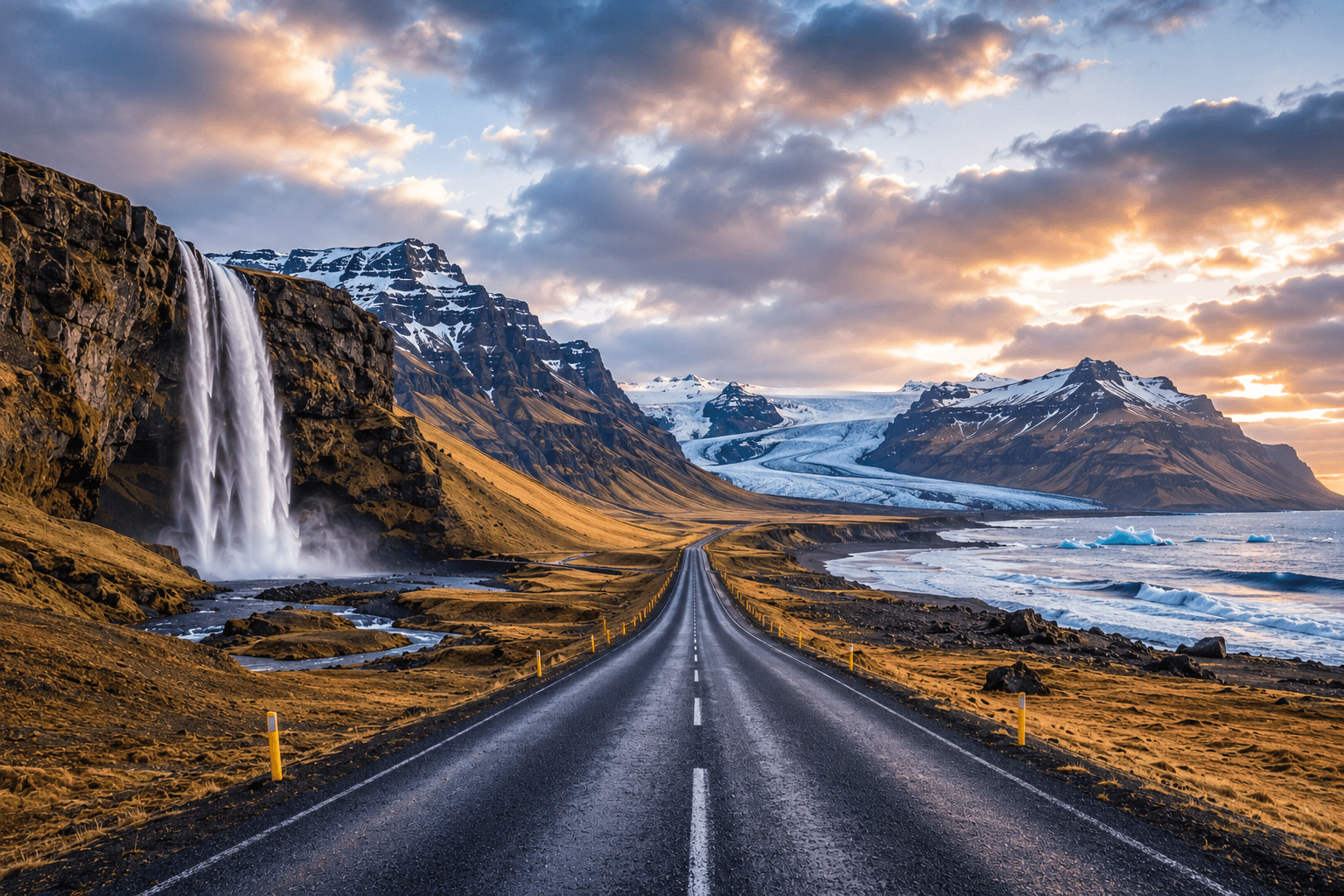

An Iceland 10 Day Road Trip gives you enough time to see many of the country’s best landscapes without limiting your trip to Reykjavík and the South Coast.
You can visit waterfalls, black sand beaches, glaciers, geothermal areas, small towns, and remote coastal landscapes. You can also explore parts of East and North Iceland that many short trips miss.
Iceland’s Ring Road, also called Route 1, is about 1,322 km or 820 miles long. It circles most of the country and connects many major regions. Your full trip will be longer once you add the Golden Circle, Snæfellsnes, Dettifoss, and other detours. Browse all our Iceland travel guides for more road trip ideas.
This itinerary travels mostly counter-clockwise. It begins near Keflavík and Reykjavík. It then follows the Golden Circle, South Coast, Southeast Iceland, Eastfjords, North Iceland, and Snæfellsnes before returning toward Keflavík. Planning a different trip length? See our Iceland 5 day itinerary.
The aim is simple. See the major highlights without trying to visit every attraction in Iceland.
Should I Drive Iceland’s Ring Road?
Yes. The Ring Road is one of the best choices if you have around 10 days and want to explore several regions of Iceland.
A self-drive trip gives you more freedom than staying only in Reykjavík. You can stop at viewpoints, waterfalls, beaches, and small towns along the way.
However, Iceland is not a destination where you should follow a fixed schedule at all costs.
Weather and road conditions can change quickly. SafeTravel recommends checking conditions before driving and several times during the day.
Think of this itinerary as a strong route plan, not a schedule that must be followed no matter what.
How Long Do You Need for a Ring Road Road Trip?
Ten days is a good amount of time for a first Ring Road trip.
It is possible to travel around Iceland faster. However, a shorter trip means more driving and less time at each stop.
One experienced competitor recommends at least 8 to 9 days and considers 10 to 12 days more comfortable for the major Ring Road highlights.
Ten days still includes some busy days.
Remember that driving time is not the same as total sightseeing time.
A three-hour drive can easily become a seven or eight-hour day once you add:
- walks
- meals
- parking
- photography
- fuel stops
- viewpoints
- weather delays
For this reason, keep some attractions optional.
Does This 10-Day Iceland Itinerary Include Travel Days?
Yes.
This itinerary counts:
Day 1 as your arrival day
and
Day 10 as your departure day
That makes it suitable for travelers who have exactly 10 calendar days in Iceland.
Your flight times still matter.
If you land late on Day 1, keep Reykjavík sightseeing short. If your Day 10 flight leaves early, skip the final spa stop and travel directly toward Keflavík.
If you actually have 10 full sightseeing days plus separate flight days, you can slow this itinerary down. You could add another night in North Iceland, Snæfellsnes, or use an extra day as a weather buffer.
When to Take an Iceland Road Trip
Late spring, summer, and early autumn are easier for most first-time Ring Road travelers.
Longer daylight gives you more time for sightseeing. Summer also makes a fast-moving itinerary easier to manage.
However, Iceland’s weather remains unpredictable even during the warmer months. Current road-trip competitors also stress the need to keep your schedule flexible.
Winter is different.
Snow, ice, strong wind, shorter daylight, and closures can make a 10-day fixed Ring Road plan much harder.
If you travel outside summer, check:
- SafeTravel
- Umferðin road conditions
- Icelandic Meteorological Office forecasts
before leaving each morning.
Quick Look: 10 Day Iceland Road Trip Itinerary
Driving distances are approximate. Your exact total will depend on accommodation, detours, road conditions, and sightseeing choices.
| Day | Route | Approx. Driving | Main Highlight | Overnight |
| 1 | Keflavík to Reykjavík | 50 km / 45 min | Reykjavík | Reykjavík |
| 2 | Golden Circle | About 230 km / 3 hrs | Gullfoss and Geysir | Selfoss/Hella |
| 3 | South Coast to Vík | About 140–190 km | Waterfalls and Reynisfjara | Vík |
| 4 | Vík to Höfn | About 280 km / 4 hrs | Jökulsárlón | Höfn |
| 5 | Höfn to East Iceland | About 260 km / 4 hrs | Eastfjords | Egilsstaðir |
| 6 | Egilsstaðir to Mývatn | About 240–260 km with detours | Dettifoss and Mývatn | Mývatn |
| 7 | Mývatn to Akureyri | About 90 km | Goðafoss | Akureyri |
| 8 | Akureyri to Snæfellsnes | About 390 km / 5 hrs | Scenic drive west | Snæfellsnes |
| 9 | Snæfellsnes Peninsula | About 150 km / 2–3 hrs | Kirkjufell | Snæfellsnes/Borgarnes |
| 10 | Snæfellsnes to Keflavík | About 220 km / 3 hrs | Blue Lagoon optional | Departure |
The baseline distances for the main route are similar to those used by current 10-day competitor itineraries. Day 6 and Day 7 have been adjusted here to place Dettifoss on the east-to-Mývatn journey rather than creating unnecessary backtracking the next day.
Should You Drive Iceland’s Ring Road Clockwise or Counter-Clockwise?
Both directions work.
This itinerary goes counter-clockwise.
That means you visit the Golden Circle and South Coast first. You then continue through the Eastfjords and North Iceland before finishing in the west.
A counter-clockwise trip works well for first-time visitors because many famous sights appear early.
A clockwise route has its own advantage. It lets you begin with quieter parts of West and North Iceland.
There is no need to treat one direction as a strict rule. Even experienced Ring Road writers note that either direction can work.
Your weather forecast may be more important than your preferred direction.
How to Plan Your Iceland Road Trip
Plan the main parts before arriving.
Book your:
- rental car or campervan
- key accommodation
- important tours
- geothermal lagoon visits
- major guided activities
At the same time, leave space in your schedule.
Do not fill every hour.
Iceland’s road conditions and weather can change. A sightseeing stop may also take much longer than expected.
A Note on Renting a Car in Iceland
Choose your vehicle based on your route and season.
A normal rental car can work for a summer Ring Road trip if you stay on regular roads.
A 4×4 becomes more important when your route or conditions require it.
Do not confuse the Ring Road with Iceland’s Highland F-roads.
Highland driving can involve rough terrain, narrow roads, changing conditions, and river crossings. SafeTravel also warns that not every 4×4 is suitable for every Highland route.
What Kind of Car Should I Rent in Iceland?
For a normal summer Ring Road trip, a small or medium rental car may be enough.
Choose a larger vehicle if you want more luggage space or comfort.
Before booking, check:
- automatic or manual transmission
- insurance
- gravel coverage
- wind-related damage terms
- mileage rules
- road restrictions
- 2026 road-charge handling
Iceland introduced a kilometer-based road fee in 2026. The official rate for cars and SUVs up to 3.5 tonnes is 6.95 ISK per kilometer. Rental companies may handle this cost differently, so check how it appears in your rental agreement.
Should You Hire a Car or a Campervan?
Both can work.
A rental car plus hotels gives you more comfort.
A campervan gives you more flexibility and may make simple meals easier.
However, campervan travel does not mean you can park and sleep anywhere.
Follow Iceland’s current camping and overnight rules. Use legal camping areas and respect local restrictions.
Choose a car if comfort matters most.
Choose a campervan if flexibility matters more.
The Perfect 10-Day Iceland Road Trip Itinerary
Day 1: Arrive in Keflavík and Explore Reykjavík
Approximate driving: 50 km
Pure driving time: About 45 minutes
Driving level: Easy
Stay: Reykjavík
Keep your first day simple.
Collect your rental vehicle at Keflavík International Airport and travel toward Reykjavík.
Do not start your holiday with a long drive if you are tired after an overnight flight.
Spend the rest of your day walking around the capital.
Stop 1: Harpa Concert Hall
Start near the waterfront.
Harpa is an easy first stop because it places you close to central Reykjavík.
Walk around the harbor before continuing into the city.
Stop 2: Hallgrímskirkja Church
Visit Hallgrímskirkja, one of Reykjavík’s best-known landmarks.
It is a parish church and national sanctuary, not a cathedral.
Explore the nearby streets after your visit.
Stop 3: Reykjavík Museums or Waterfront
If you still have energy, add a museum or another short city walk.
Do not try to turn Day 1 into a full sightseeing marathon.
Optional: Sky Lagoon
A geothermal spa can be a relaxing way to finish your arrival day.
However, skip it if your flight arrives late or you feel tired.
Must see: Central Reykjavík and Hallgrímskirkja
Optional: Museum or geothermal spa
Skip first if late: Extra city attractions
Day 2: The Golden Circle
Approximate driving: 230 km
Pure driving time: About 3 hours
Driving level: Moderate
Stay: Selfoss, Hella, or nearby
The Golden Circle is a good first full day.
It combines history, geothermal activity, and waterfalls. A similar daily distance is used in current 10-day Ring Road planning guides.
Stop 1: Þingvellir National Park
Start at Þingvellir.
Give yourself time to walk rather than making it only a photo stop.
Stop 2: Kerið Crater
Kerið is an easy additional stop.
Treat it as optional if your day starts running late.
Stop 3: Geysir Geothermal Area
Continue to the geothermal area.
Stay on marked paths and follow local safety signs.
Stop 4: Gullfoss Waterfall
Finish the main Golden Circle attractions at Gullfoss.
Afterward, continue toward your South Iceland accommodation rather than returning to central Reykjavík.
This makes Day 3 easier.
Must see: Þingvellir, Geysir, Gullfoss
Optional: Kerið
Skip first if late: Extra geothermal stops
Day 3: South Coast Waterfalls and Reynisfjara
Approximate driving: About 140–190 km depending on your overnight base
Pure driving time: Around 2–3 hours
Driving level: Moderate
Stay: Vík
Today brings some of Iceland’s classic South Coast scenery.
Stop 1: Seljalandsfoss Waterfall
Start at Seljalandsfoss.
Wear waterproof clothing because the area around large waterfalls can be wet.
Stop 2: Skógafoss Waterfall
Continue to Skógafoss.
You can enjoy the lower view or use the stairs if you want a different perspective.
Stop 3: Sólheimasandur Plane Wreck
This is optional.
The plane wreck takes extra time because you cannot simply park beside it.
If you want a slower day, skip it.
Stop 4: Reynisfjara Black Sand Beach
Finish near Reynisfjara.
This beach requires serious caution.
SafeTravel warns about dangerous sneaker waves and falling rock. Visitors should stay well back from the water, never turn their back on the sea, and obey closures and warning systems.
Stay overnight in Vík.
Must see: Seljalandsfoss, Skógafoss, Reynisfjara
Optional: Plane wreck
Skip first if late: Longer detours
Day 4: Skaftafell, Jökulsárlón and Diamond Beach
Approximate driving: 280 km
Pure driving time: About 4 hours
Driving level: Long sightseeing day
Stay: Höfn area
Leave Vík early.
This is one of the strongest days of the entire trip.
Stop 1: Fjaðrárgljúfur Canyon
If conditions and access allow, stop at the canyon.
Stay on marked routes and respect closures.
Stop 2: Skaftafell and Skaftafellsjökull
Use Skaftafell rather than treating Svínafellsjökull as a normal glacier stop.
Civil Protection has advised against travel on Svínafellsjökull because of landslide danger.
Skaftafell offers a safer, established visitor option.
Vatnajökull National Park has a marked glacier trail that ends near Skaftafellsjökull and provides glacier views.
Do not walk onto a glacier without proper guidance.
Stop 3: Jökulsárlón Glacier Lagoon
Give Jökulsárlón plenty of time.
This should be one of your priority stops rather than something squeezed into the end of the day.
Cross the road afterward for Diamond Beach.
Continue to Höfn for the night.
Must see: Jökulsárlón and Diamond Beach
Worth it: Skaftafell
Optional: Canyon stop
Skip first if late: Secondary roadside viewpoints
Day 5: Eastfjords and Stokksnes
Approximate driving: Around 260 km
Pure driving time: About 4 hours
Driving level: Moderate to long
Stay: Egilsstaðir area
Leave the Höfn area and head toward Stokksnes.
Stop 1: Vestrahorn and Stokksnes
Spend some time enjoying the mountain and coastal landscape.
Afterward, continue toward the Eastfjords.
Stop 2: Eastfjords Scenic Drive
Today is less about collecting attractions.
Enjoy the road, coastal scenery, and small communities.
Current competitor itineraries also treat the Eastfjords as a day where the drive itself is a major part of the experience.
You can stop in places such as Djúpivogur if your schedule allows.
End the day around Egilsstaðir.
Must see: Eastfjords scenery
Worth it: Vestrahorn
Optional: Smaller village stops
Skip first if late: Long coastal detours
Day 6: Stuðlagil, Dettifoss and Lake Mývatn
Approximate driving: Around 240–260 km with the major detours
Driving level: Long
Stay: Lake Mývatn
This day has been adjusted from several competitor routes.
Instead of visiting Dettifoss on Day 7 and then driving back west, visit it while traveling from East Iceland toward Mývatn.
A route from Egilsstaðir through Stuðlagil and Dettifoss to Mývatn can total roughly 245 km before other local sightseeing.
Stop 1: Stuðlagil Canyon
Visit Stuðlagil if you have enough time.
Check your access route before leaving because different viewpoints can affect the time required.
Stop 2: Dettifoss
Continue toward Dettifoss.
Check current road conditions before taking the detour. Umferðin provides live road-condition information for Iceland.
Stop 3: Lake Mývatn Region
Spend the rest of the day around Mývatn.
Choose a few geothermal or volcanic attractions rather than trying to see everything.
Optional: Earth Lagoon Mývatn
If you finish sightseeing with enough time, consider a geothermal soak.
Earth Lagoon Mývatn is the redeveloped site formerly known as Mývatn Nature Baths and is operating in its new 2026 phase.
Must see: Mývatn region
Worth it: Dettifoss
Optional: Stuðlagil and Earth Lagoon
Skip first if late: Extra geothermal stops
Day 7: Lake Mývatn, Goðafoss and Akureyri
Approximate driving: Around 90 km depending on local stops
Driving level: Easy to moderate
Stay: Akureyri
This day is intentionally easier after Day 6.
A Mývatn to Akureyri route with Goðafoss is roughly in the 75–90 km range depending on stops.
Stop 1: Mývatn Morning Stops
Use the morning for any Mývatn attractions you missed yesterday.
Possible short stops include geothermal or volcanic areas.
Stop 2: Goðafoss Waterfall
Continue west to Goðafoss.
Take your time because today’s driving schedule is much lighter.
Stop 3: Akureyri
Finish the day in Akureyri.
Use the evening for food, a walk, and rest before tomorrow’s long drive.
Must see: Goðafoss
Worth it: Akureyri
Optional: Extra Mývatn stops
Skip first if late: Nothing major, this is intentionally a lighter day
Day 8: Akureyri to Snæfellsnes Peninsula
Approximate driving: Around 390 km
Pure driving time: About 5 hours
Driving level: Long
Stay: Snæfellsnes Peninsula
This is one of the longest driving days.
Current route estimates place the Akureyri to Snæfellsnes journey at roughly 390 km, with about five hours of pure driving before sightseeing stops.
Leave early.
Do not overload the day with large detours.
Use safe rest areas for breaks and food.
SafeTravel advises drivers to stop safely rather than continuing when tired.
Try to reach Snæfellsnes with enough daylight to settle into your accommodation.
Must do: Reach Snæfellsnes safely
Optional: Short roadside viewpoints
Skip first if late: Large detours
Day 9: Snæfellsjökull and Kirkjufell
Approximate driving: Around 150 km
Pure driving time: Around 2–3 hours
Driving level: Moderate
Stay: Snæfellsnes or Borgarnes
Spend a full day exploring the peninsula.
Current 10-day competitor routes also dedicate roughly 150 km and two to three hours of pure driving to this day.
Possible stops include:
- Arnarstapi
- coastal viewpoints
- Snæfellsjökull National Park area
- Djúpalónssandur
- Kirkjufell
Do not stop your vehicle in unsafe places for photos.
SafeTravel recommends finding a proper safe place before taking pictures.
Finish near Kirkjufell, then stay on the peninsula or continue toward Borgarnes.
Must see: Snæfellsjökull area and Kirkjufell
Worth it: Arnarstapi
Optional: Smaller coastal stops
Skip first if late: Extra viewpoints
Day 10: Blue Lagoon and Departure
Approximate driving: Around 220 km if starting on Snæfellsnes
Pure driving time: Around 3 hours
Driving level: Moderate
Destination: Keflavík International Airport
Your flight time controls Day 10.
If you have an early flight, travel directly toward Keflavík.
If you have a later departure, you can add one final geothermal experience.
Optional: Blue Lagoon
The Blue Lagoon can fit before departure if your schedule allows.
However, the Reykjanes Peninsula remains an area where volcanic and seismic conditions can affect access. SafeTravel continues to provide current Reykjanes alerts.
Always check current opening and access information before visiting.
Leave plenty of time to:
- return your rental vehicle
- reach the terminal
- check in
- pass airport security
Do not risk missing your flight for one more attraction.
Must do: Reach Keflavík with a safe time buffer
Optional: Blue Lagoon
Skip first if late: Everything except airport travel
What If Bad Weather Changes Your Iceland Road Trip?
Bad weather should change your itinerary.
Your itinerary should never make you ignore official warnings.
Use this simple system.
Normal Conditions
Follow the planned route.
Visit your main stops and add optional attractions when time allows.
Poor Conditions
Remove optional detours.
Drive more slowly.
Allow more time.
Do not rush because your hotel is several hours away.
Road Closure or Serious Warning
Do not continue on a closed or unsafe road.
Stay where you are or change your route.
SafeTravel recommends checking weather and roads in the morning and several times during the day because conditions can change quickly.
Use Umferðin for road conditions and the Icelandic Meteorological Office for forecasts and warnings.
How Much Does a 10 Day Iceland Road Trip Cost?
Iceland road-trip costs depend heavily on season, vehicle type, accommodation, food, and paid activities.
A current 2026 cost guide estimates daily land costs of roughly:
| Travel Style | Estimated Daily Cost Per Person | Rough 10-Day Planning Range |
| Budget | 18,000–25,000 ISK | 180,000–250,000 ISK |
| Mid-range | 35,000–55,000 ISK | 350,000–550,000 ISK |
| Comfort | 70,000–110,000+ ISK | 700,000–1,100,000+ ISK |
These 10-day figures are simple planning estimates based on the current daily ranges, not fixed package prices. They exclude international flights and can rise sharply during high-demand periods.
Your main costs will usually include:
- car rental and insurance
- accommodation
- fuel
- food
- activities
- parking
- road-related charges
Remember the 2026 kilometer fee of 6.95 ISK per km for cars and SUVs up to 3.5 tonnes. Check how your rental provider passes this cost on to customers.
How to Save Money
Book early.
Use groceries for some breakfasts and lunches.
Carry snacks on long driving days.
Choose your paid activities carefully.
Many of Iceland’s major landscapes can be enjoyed without booking an expensive tour.
What Should You Book Before Your Iceland Road Trip?
Some things are better reserved before your flight.
Rental Car or Campervan
Book early if you travel during the busy season.
Check the rental terms before paying.
Accommodation
Reserve important overnight bases.
This is especially useful because your hotel location directly affects the next day’s driving.
Glacier Activities
Use qualified operators for glacier activities.
Do not walk onto a glacier simply because it looks accessible.
Geothermal Lagoons
Book ahead if a lagoon visit is one of your must-do experiences.
This is especially important if you need a specific time near your arrival or departure flight.
Whale Watching
Book in advance if whale watching is important to you.
Still, allow for weather-related changes.
The best strategy is to pre-book the experiences you would be disappointed to miss and leave smaller stops flexible.
Food and Grocery Planning on the Ring Road
Buying some groceries can save money and make long driving days easier.
Stock up when you are in larger towns.
Keep simple food in the vehicle, such as:
- breakfast items
- sandwiches
- fruit
- snacks
- water
Do not assume you will find a restaurant beside every attraction.
Current Ring Road competitors also recommend groceries and snacks as an easy way to control costs.
Staying Connected During Your Iceland Road Trip
Mobile data is useful for:
- navigation
- weather updates
- accommodation messages
- booking changes
- safety alerts
You can compare:
- US carrier roaming
- eSIM plans
- local SIM cards
- rental Wi-Fi devices
Download offline maps before leaving larger towns.
However, do not use a navigation app as your only source for road safety.
Use official road-condition information as well.
A Few Practical Tips Before You Go
Check conditions daily. Use SafeTravel, Umferðin, and the Icelandic Meteorological Office.
Use headlights and taillights. Icelandic law requires them while driving throughout the year.
Know the common speed limits. SafeTravel lists 50 km/h in urban areas, 80 km/h on rural gravel roads, and 90 km/h on rural paved roads unless signs say otherwise.
Slow down at single-lane bridges. These exist on and off the Ring Road.
Watch for sheep. Animals may enter rural roads with little warning.
Never stop in the road for a photograph. Find a safe parking area first.
Fill up before you urgently need fuel. This reduces stress during remote driving days.
Read your rental insurance. Know what is included and what is excluded.
For American visitors, remember that Iceland uses kilometers. Road design and driving conditions may also feel different from the United States.
Do not drive exhausted after an overnight flight. Rest before starting a long route.
Iceland Road Trip Emergency and Safety Information
Save these details before leaving.
Emergency number: 112
SafeTravel currently also advises travelers to save 599-0112 as a backup if a 112 call cannot connect properly during Iceland’s 2G/3G network changes.
For planning, use:
SafeTravel: alerts and traveler safety
Umferðin: current roads and closures
Icelandic Meteorological Office: weather and warnings
Do not continue driving because an online itinerary says you should.
Official warnings come first.
What to Pack for an Iceland Road Trip
Iceland’s conditions can change quickly.
Pack layers instead of depending on one heavy coat.
Bring:
- waterproof jacket
- waterproof or water-resistant pants
- warm base layers
- fleece or mid-layer
- walking shoes
- waterproof hiking shoes if needed
- warm socks
- gloves
- warm hat
- sunglasses
- sunscreen
- reusable water bottle
- phone charger
- car charger
- power bank
- small backpack
- basic first-aid supplies
- swimwear
- quick-dry towel
- snacks
Also keep waterproof layers easy to reach.
Do not bury them under all your luggage.
Have More Time in Iceland?
Ten days works well for the main highlights.
Extra days make the journey easier.
1. Extra Day to Explore Tröllaskagi
Add another day in North Iceland.
This breaks up the long move toward Snæfellsnes and gives you more time for coastal scenery.
2. Extra Day Around North or East Iceland
Use an extra day around Mývatn, Akureyri, or the Eastfjords.
It can also act as a useful weather buffer.
3. Add the Westman Islands
The Westman Islands can be added to the South Coast section.
However, do not squeeze the islands into the standard 10-day schedule.
Give them a separate day.
FAQs
Is 10 Days Enough for Iceland?
Yes.
Ten days is enough for a strong Ring Road highlights trip. However, you should expect to drive on most days.
If you prefer slower travel, 12 to 14 days is better.
Can You Drive Around Iceland in 10 Days?
Yes.
The main Ring Road is around 1,322 km or 820 miles, and 10 days gives you time to complete it while adding important detours.
Is a 10-Day Iceland Road Trip Too Rushed?
Not if you prioritize.
Keep your main attractions fixed and make smaller stops optional.
Do I Need a 4×4 for Iceland’s Ring Road?
Not always.
A normal rental vehicle can work for many summer Ring Road trips.
Your season, weather, road conditions, and detours should decide the vehicle.
Highland F-roads are a separate issue and require much more care.
Should I Drive Iceland Clockwise or Counter-Clockwise?
Either direction works.
This itinerary uses counter-clockwise travel because it places the Golden Circle and South Coast near the beginning.
Check the forecast before deciding.
Is Driving in Iceland Difficult?
Many visitors can drive safely with preparation.
However, you may face strong wind, gravel sections, single-lane bridges, animals, changing weather, or winter road conditions. SafeTravel provides specific driving guidance for visitors.
What Is the Best Time for an Iceland Road Trip?
The warmer months are easier for most first-time Ring Road travelers because of longer daylight and generally simpler road-trip conditions.
Travel outside summer requires more flexibility.
Should I Rent a Car or Campervan?
Choose a car for greater comfort.
Choose a campervan for greater flexibility.
In either case, follow current road and camping rules.
Where Should I Stay on Iceland’s Ring Road?
Useful bases on this route include:
Reykjavík, South Iceland, Vík, Höfn, Egilsstaðir, Lake Mývatn, Akureyri, and Snæfellsnes.
Can I Follow This Route in Winter?
A full winter Ring Road trip requires much more caution.
Conditions can change quickly, and road closures can affect your route.
Check official information every day.
Final Thoughts on This Iceland 10 Day Road Trip
An Iceland 10 Day Road Trip is long enough to show you much more than the country’s most famous tourist stops.
You can walk beside South Coast waterfalls, see ice at Jökulsárlón, travel through the Eastfjords, explore volcanic North Iceland, and finish among the dramatic landscapes of Snæfellsnes.
The secret is not adding more stops.
It is choosing the right ones.
Keep your must-see attractions clear. Treat smaller stops as optional. Give long driving days enough time. Check weather and roads every morning.
Most importantly, change your plans when conditions require it.
The best Iceland road trip is not the itinerary with the most attractions.
It is the one that gives you enough time to enjoy the journey safely.