
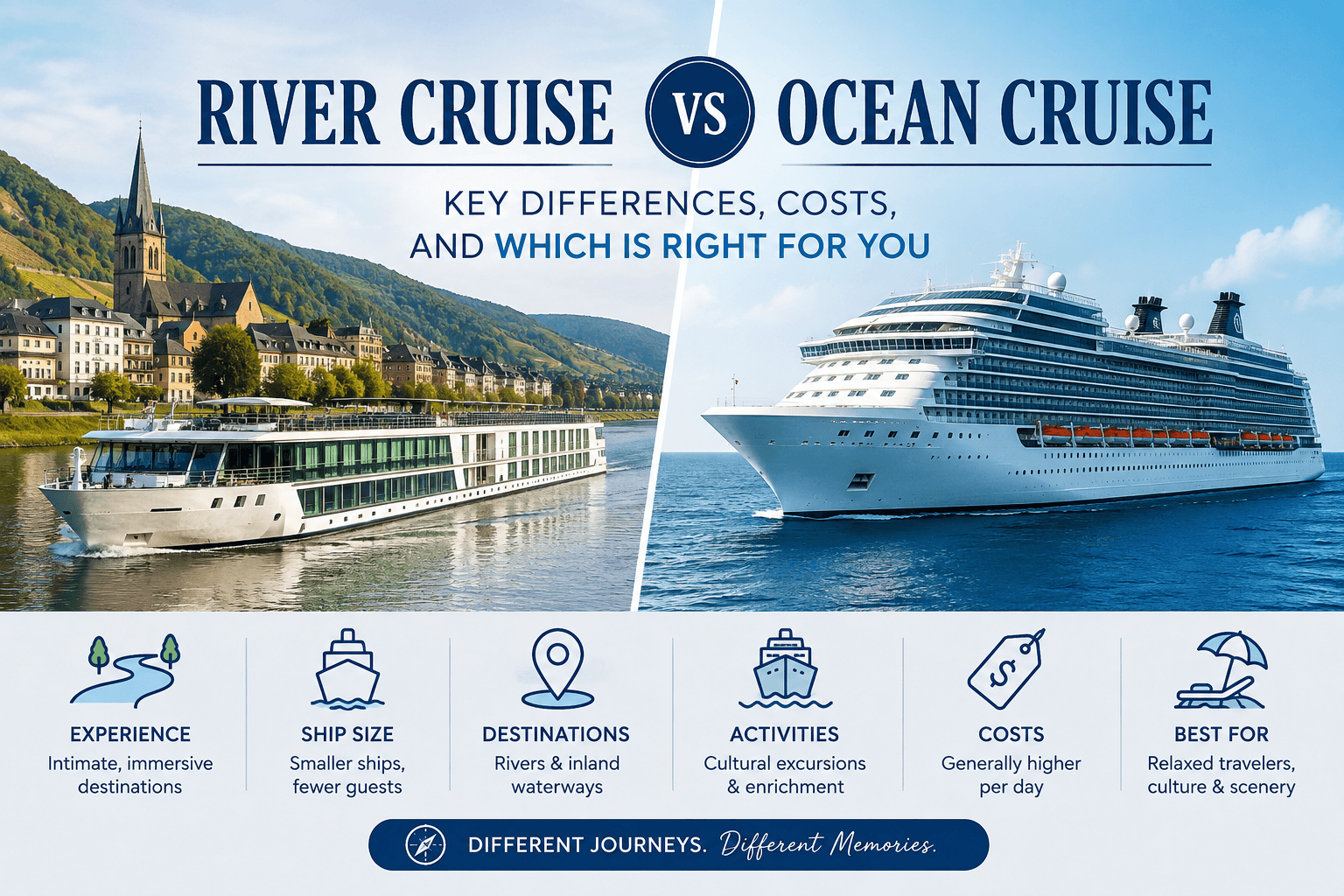

Choosing between a river cruise vs ocean cruise can be difficult. Both offer comfortable travel, great food, and exciting destinations. However, the experience can feel very different.
River cruises focus more on destinations, culture, and smaller ships. Ocean cruises usually offer larger ships, more entertainment, and a wider choice of activities.
Neither option is better for everyone. The right choice depends on your budget, travel style, destination, and what you want to do each day.
This guide compares river cruises and ocean cruises in detail. It covers ships, cabins, dining, excursions, costs, accessibility, and traveler types. By the end, you should have a clearer idea of which cruise style fits your next vacation. Browse all our cruise travel guides for first-time cruisers.
Key Takeaways
River cruises use smaller ships and usually carry fewer passengers. They often visit several towns or cities during one trip.
Ocean cruises are much larger. They may include pools, theaters, casinos, kids’ clubs, sports areas, and many restaurants.
River cruises often cost more at first. However, some fares include excursions, Wi-Fi, drinks, or other extras.
Ocean cruises may have a lower starting price. Still, drinks, specialty dining, Wi-Fi, excursions, and gratuities can increase the final cost.
River cruises are a strong choice for travelers who value culture and easy access to destinations. Ocean cruises often suit families and travelers who want more onboard activities.
Motion is usually gentler on a river. However, low or high water levels can affect some river itineraries.
Ocean ships can face rough seas and bad weather. Many modern ocean ships use stabilizers to reduce motion.
Therefore, you should compare the whole vacation experience, not only the cruise fare.
River Cruises
River cruises travel along inland waterways such as the Danube, Rhine, Rhône, Douro, and Mississippi.
The ship is usually a smaller part of the vacation. Instead, the destinations often become the main focus.
Passengers may wake up in a new town almost every day. They can then join walking tours, visit historic sites, explore markets, or enjoy local food.
River cruising can work well for couples, mature travelers, history lovers, and people who prefer a slower atmosphere onboard.
However, river cruising is not only for older travelers. Younger adults may also enjoy it if they value food, culture, scenery, and smaller groups.
Families should check the rules of each cruise line before booking. Some river cruise companies welcome children, while others have age limits or few activities for kids.
Accessibility also needs careful thought. Smaller river ships may have narrow gangways or limited elevator access. Some tours may include stairs, hills, and cobblestone streets.
Therefore, travelers with mobility needs should check the ship and excursion details before paying a deposit.
Ocean Cruises
Ocean cruises travel across seas and oceans. They visit coastal cities, islands, and major ports around the world.
Ocean ships range from small luxury vessels to huge floating resorts.
Large ocean ships can carry thousands of passengers. As a result, they often provide far more onboard choices.
You may find swimming pools, water slides, theaters, casinos, spas, fitness centers, sports courts, kids’ clubs, and live music.
Ocean cruising often works well for families. Children and teens can have activities while adults enjoy other parts of the ship.
It can also be a good option for first-time cruisers. Travelers can choose from many cruise lines, ship sizes, cabin types, and price levels.
Ocean cruises also offer more choices for solo travelers. Some ships have solo cabins, social events, and large public spaces.
However, large ships can feel crowded. Elevators, buffets, pools, and boarding areas may become busy during peak times.
So, travelers who dislike crowds may prefer a smaller ocean ship or a river cruise.
River Ships are Smaller than Ocean Vessels
Ship size is one of the biggest differences in a river cruise vs ocean cruise comparison.
River ships must travel through narrow waterways, locks, and under bridges. For that reason, their size is limited.
Most river ships carry far fewer passengers than major ocean ships.
This creates a quieter and more personal atmosphere. Passengers may recognize the crew and other guests after only a few days.
Smaller ships can also create a more social setting. It may be easier to meet other passengers during meals, excursions, and evening activities.
Ocean ships can be much larger. Some are designed like resorts rather than traditional ships.
Their size allows cruise lines to add more pools, restaurants, bars, theaters, shops, and entertainment areas.
However, bigger is not always better.
Choose a river cruise if you prefer a smaller setting and fewer crowds.
Choose a large ocean cruise if you want more activities and entertainment choices.
River Cabins also Tend to be Smaller
Cabins are another important difference.
River ships have limited space because they must fit within river locks and waterways. Therefore, cabins can be smaller than those on many ocean ships.
However, cabin design varies by cruise line and ship.
Some river cabins include large windows or French balconies. Others offer full step-out balconies.
Ocean ships usually offer more cabin categories.
You may find inside cabins, ocean-view cabins, balcony cabins, suites, family rooms, and luxury accommodations.
Large suites on ocean ships can offer much more space.
Still, travelers should not compare only cabin size.
On a river cruise, you may spend much of the day exploring towns and cities. Therefore, a smaller cabin may not matter as much.
On an ocean cruise with several sea days, cabin space can become more important.
There are More Buffets and Fewer Restaurants
Dining styles can differ greatly between river and ocean cruises.
River ships usually have fewer restaurants because the ships are smaller.
Breakfast and lunch may include buffet choices. Dinner is often served in a main dining room.
Some river cruise lines also offer specialty or alternative dining options. However, the number of venues is usually limited.
Ocean ships can have many more places to eat.
Large ships may offer main dining rooms, buffets, cafés, pizza shops, burger restaurants, steak houses, seafood venues, and specialty restaurants.
Some options are included in the cruise fare. Others cost extra.
Therefore, ocean cruising usually wins if restaurant variety is your main priority.
River cruising may suit travelers who prefer a simpler dining experience and a smaller number of venues.
Food quality depends on the cruise line, ship, and fare level. So, more restaurants do not always mean better food.
Entertainment is Low Key on River Cruise Ships
River cruise entertainment is usually quieter than entertainment on large ocean ships.
You may find live music, local performers, lectures, cooking demonstrations, or small evening shows.
The main attraction is often the destination rather than the nightlife.
This can be perfect for travelers who enjoy busy sightseeing days followed by relaxed evenings.
However, people who want casinos, nightclubs, Broadway-style shows, or large production performances may find river cruises too quiet.
Ocean ships usually offer much more evening entertainment.
Depending on the ship, you may find stage shows, comedy, live music, casinos, nightclubs, movies, game shows, and themed events.
Families may also find children’s programs and teen activities.
Therefore, your ideal choice depends on how you want to spend your evenings.
River Cruise Itineraries are Port-Intensive
River cruises usually focus heavily on destinations.
A ship may stop in a different town or city almost every day. Some itineraries even visit more than one place during the same day.
This gives travelers plenty of time to explore.
Ocean cruises can also include many ports. However, longer distances between destinations may create sea days.
Sea days are not always a disadvantage.
Some travelers love relaxing by the pool, visiting the spa, watching shows, or enjoying the ship.
Others prefer to spend almost every day exploring a destination.
Therefore, ask yourself one simple question.
Do you want the ship to be part of the vacation, or do you want the destinations to be the main experience?
Your answer can make the river cruise vs ocean cruise choice much easier.
Shore Tours are More Limited and Culturally Focused
River cruise excursions often focus on history, culture, food, architecture, and local life.
Walking tours are common because many river ships dock close to towns.
You may visit castles, museums, vineyards, historic districts, markets, or small villages.
Some river cruise fares include one basic excursion in many ports. However, this depends on the cruise line and fare.
Ocean cruises usually offer a wider range of shore excursions.
Options may include beach trips, snorkeling, wildlife tours, adventure activities, sightseeing, food tours, shopping, and private experiences.
However, many ocean cruise excursions cost extra.
Physical ability also matters.
River cruise walking tours may involve uneven streets, stairs, hills, and long periods on foot.
Travelers with mobility concerns should check the activity level before booking an excursion.
Therefore, river cruises often suit travelers who want cultural depth. Ocean cruises may suit travelers who want a wider variety of activities.
There are Few “Sea” Days; Most River Cruise Sailing is Done at Night
Traditional sea days are rare on most river cruises.
Ships often travel between destinations during the evening, overnight, or during shorter periods in the day.
As a result, passengers can spend more daytime hours exploring.
However, some scenic river sections are best enjoyed during daylight.
Passengers may sit on the sun deck and watch castles, vineyards, villages, hills, and bridges pass by.
River ships also pass through locks on many waterways. Watching the ship rise or fall inside a lock can be an interesting part of the journey for first-time river cruisers.
Ocean cruises can include full days at sea.
These days allow travelers to enjoy the ship without rushing to a port.
For some people, that sounds relaxing.
For others, a full day without visiting a destination may feel slow.
Therefore, river cruises often suit travelers who want a packed sightseeing schedule. Ocean cruises may appeal more to people who enjoy a mix of sightseeing and resort-style relaxation.
Smooth Sailing
Motion sickness is a common concern for first-time cruisers.
River cruises usually experience less wave movement because they travel on inland waterways.
Therefore, people who worry about seasickness may feel more comfortable on a river.
However, no type of travel is completely free from movement.
Ocean ships travel in open water, where waves and weather can cause more motion.
Many modern ocean ships use stabilizers to reduce motion. Still, rough conditions can happen.
Cabin location may also make a difference. A cabin near the middle of an ocean ship and on a lower deck can sometimes feel more stable.
River cruises have another type of travel risk.
Low or high river levels can sometimes affect sailing. Ships may need to adjust an itinerary, change docking points, use buses, or make other changes.
Ocean cruises can also change routes because of storms, strong winds, or unsafe port conditions.
Therefore, both cruise types can face itinerary changes. The reasons are simply different.
Easy on and Easy Off
Getting on and off the ship can feel very different.
River ships are smaller. This can make boarding and leaving the vessel feel faster.
You may also avoid the large cruise terminals used by major ocean ships.
However, river cruising can still create accessibility challenges.
Sometimes river ships dock next to each other. Passengers may need to walk through another ship to reach land.
Gangways may also be steep depending on the water level and docking location.
Ocean ships usually use large terminals with more formal security and boarding systems.
The process can take longer because thousands of passengers may be getting on or off.
Some ocean ports also require tender boats. These smaller boats carry passengers between the ship and shore.
Tendering may be difficult for travelers with limited mobility.
Therefore, travelers with accessibility needs should research each itinerary carefully rather than assuming one cruise type will always be easier.
You’ll Dock Right in Town
One of the biggest benefits of river cruising is destination access.
River ships can often dock close to the center of a town or city.
In some places, you may step off the ship and start exploring within minutes.
This can save travel time.
Ocean ships need deeper water and larger port facilities. Therefore, some cruise terminals are farther from major attractions.
Passengers may need a shuttle, taxi, train, or tour bus.
However, river ships do not always dock in the center.
Port locations can change because of traffic, local rules, water levels, and available docking space.
Still, river cruising often provides easier access to smaller inland destinations that large ocean ships cannot reach.
This is especially important in Europe.
A river cruise can take you through inland cities along the Rhine, Danube, Rhône, or Douro.
An ocean cruise is better for coastal areas, Mediterranean ports, islands, Alaska, the Caribbean, and destinations separated by large stretches of sea.
Distances Between Ports are Shorter
River destinations are often closer together.
This allows the ship to visit several towns and cities during one itinerary.
Shorter distances also mean less time is needed to travel between stops.
Ocean cruises may cover much greater distances.
For example, an ocean itinerary may travel between countries, islands, or different regions.
This can create more time at sea.
Neither style is automatically better.
River cruising gives travelers more frequent destination stops.
Ocean cruising gives travelers access to places that inland ships cannot reach.
Your choice should depend on where you want to go.
More Items are Included in the Fare
Price is one of the most important parts of the river cruise vs ocean cruise decision.
River cruises often have a higher starting fare than mainstream ocean cruises.
However, the fare may include more services.
Depending on the cruise line, this may include Wi-Fi, guided excursions, drinks with meals, specialty dining, or other extras.
Ocean cruises often advertise lower starting prices.
However, the final vacation cost can increase after adding extras.
These may include:
- Shore excursions
- Drink packages
- Wi-Fi
- Specialty restaurants
- Gratuities
- Spa treatments
- Transfers
- Premium activities
For this reason, travelers should compare total costs rather than the base fare alone.
For example, imagine an ocean cruise costs less at booking. You then add excursions, drinks, Wi-Fi, and specialty dining.
A river cruise may cost more at first but include several of those items.
In that case, the price difference may become smaller.
However, inclusions vary widely.
Always check what your specific cruise fare covers before making a decision.
You’ll Wake up Early
River cruises can have busy schedules.
Walking tours and excursions may begin in the morning. Some travelers enjoy this because they can see more during the day.
Others may prefer a slower vacation.
You do not always have to join every activity.
Skipping an excursion and exploring alone can sometimes create a more relaxed experience.
Ocean cruises often provide more flexibility.
On a sea day, you may sleep late and choose activities whenever you want.
Port days may still start early, especially when the ship has limited time in a destination.
Therefore, the difference is mostly about travel pace.
River cruises often feel like a sightseeing trip with a floating hotel.
Ocean cruises can feel more like a resort vacation that also visits different destinations.
River Cruise vs Ocean Cruise Cost: Which Is More Expensive?
River cruises often have a higher starting fare than mainstream ocean cruises. However, the starting price does not tell the whole story.
River cruise fares may include more services. Depending on the cruise line, these may include guided excursions, Wi-Fi, drinks with meals, or specialty dining.
Ocean cruises can have lower starting fares. However, extra costs may include:
- Drink packages
- Wi-Fi
- Shore excursions
- Specialty dining
- Gratuities
- Spa treatments
- Transfers
- Premium onboard activities
Therefore, compare the total vacation cost, not only the advertised cruise fare.
A cheaper ocean cruise may become more expensive after you add several extras. A river cruise may cost more at first but include more in the fare.
Always check the exact inclusions before booking.
What Is a Typical Day Like on a River Cruise vs Ocean Cruise?
A typical day can help you understand the biggest difference between these two travel styles.
On a river cruise, you may have breakfast early and join a guided walking tour in the morning. After lunch, you might visit another town, museum, castle, or vineyard.
The evening may include dinner, scenic sailing, and light entertainment.
An ocean cruise port day may start with breakfast followed by a shore excursion.
After returning to the ship, you may enjoy dinner, a stage show, live music, or nightlife.
A sea day can feel very different.
You may spend time at the pool, spa, gym, restaurants, shops, or entertainment venues.
These schedules are only examples. Actual activities depend on the ship and itinerary.
However, the main difference is simple. River cruises often focus on sightseeing, while ocean cruises can offer more time to enjoy the ship itself.
River Cruise vs Ocean Cruise for First-Time Cruisers
Both cruise types can work well for first-time cruisers.
A river cruise may be a better starting choice if you prefer smaller ships, fewer passengers, cultural sightseeing, and less open-ocean motion.
It can also feel easier to learn your way around a smaller ship.
An ocean cruise may be better if you want more price choices, entertainment, restaurants, activities, and cabin options.
First-time cruisers who enjoy resort vacations may feel more comfortable on an ocean ship.
On the other hand, travelers who normally prefer guided land tours may enjoy a river cruise more.
Think about your normal vacation style before choosing.
Which Is More Accessible: River Cruise or Ocean Cruise?
Accessibility can vary greatly between ships and itineraries.
River ships are smaller, but that does not always make them easier for travelers with limited mobility.
River cruise passengers may face steep gangways, stairs, cobblestone streets, and long walking tours.
Ships may also dock beside one another, which can require passengers to walk through another vessel.
Ocean ships are usually larger and may have more elevators, accessible cabins, and wider public areas.
However, some ocean ports use tender boats. These smaller boats may be difficult for travelers with certain mobility needs.
Large ports can also require longer walking distances.
Neither cruise type is always more accessible.
Check the exact ship, cabin, port, and excursion requirements before booking.
River Cruise vs Ocean Cruise for Seniors
Many seniors enjoy both river and ocean cruises.
River cruises may appeal to travelers who enjoy history, cultural tours, smaller ships, and quieter evenings.
However, river itineraries can include early mornings and plenty of walking.
Historic towns may have stairs, hills, and uneven streets.
Ocean cruises may provide more onboard activities and more time to relax.
Larger ships may also offer a wider choice of accessible cabins and facilities.
However, long walking distances on large ships can be tiring for some travelers.
Motion can also be an important factor. River cruises usually experience less open-water movement.
The best choice for seniors depends more on mobility, interests, and preferred pace than age alone.
River Cruise vs Ocean Cruise for Families
Both cruise types can work for families, but ocean cruises usually offer more family-focused facilities.
Large ocean ships may have kids’ clubs, teen spaces, pools, water slides, sports areas, family cabins, and daily activities.
River cruises are often quieter and more focused on sightseeing.
Some river cruise companies welcome children. Others have minimum age rules or offer few child-specific activities.
Families with older children who enjoy history, food, culture, and guided tours may still enjoy a river cruise.
Before booking, check the cruise line’s age policy, cabin setup, excursions, and onboard activities.
River Cruise vs Ocean Cruise for Solo Travelers
Solo travelers can enjoy both cruise styles.
Some ocean cruise ships have dedicated solo cabins, social events, and lounges designed for people traveling alone.
They may also offer more nightlife and a larger number of passengers to meet.
River ships have fewer passengers. However, their smaller size can make it easier to see the same people during meals, tours, and activities.
This can create a friendly social atmosphere.
Price is another important issue.
Some cruise fares charge a single supplement when one person books a cabin designed for two.
Compare solo cabin prices and single supplements before choosing either cruise type.
River Cruise vs Ocean Cruise in Europe
Both river and ocean cruises are popular ways to explore Europe, but they reach very different places.
River cruises travel through inland waterways such as the Rhine, Danube, Douro, and Rhône.
They can bring travelers close to historic towns, villages, castles, vineyards, and inland cities.
Ocean cruises focus more on coastal destinations and islands.
A Mediterranean ocean cruise, for example, may visit ports in Italy, Greece, Spain, France, Croatia, or nearby regions.
Choose a river cruise if your main interest is inland Europe and cultural sightseeing.
Choose an ocean cruise if you want coastal cities, islands, beaches, and a wider geographic area.
The best choice depends on the destinations you most want to visit.
Who Should Choose a River Cruise?
A river cruise may be a good choice if you:
- Prefer smaller ships
- Dislike large crowds
- Enjoy history and culture
- Want frequent port visits
- Prefer guided walking tours
- Want easy access to inland towns
- Like quiet evenings
- Worry about open-ocean motion
- Want the destination to be the main part of the vacation
A river cruise may be less suitable if you want large shows, casinos, waterparks, many restaurants, or busy nightlife.
Who Should Choose an Ocean Cruise?
An ocean cruise may be a good choice if you:
- Enjoy large ships
- Want many dining choices
- Like shows and nightlife
- Travel with children or teens
- Want pools and water activities
- Enjoy relaxing sea days
- Want more cabin categories
- Prefer a wide choice of itineraries
- Want the ship itself to be part of the vacation
An ocean cruise may be less suitable if you strongly dislike crowds, sea days, or open-water motion.
River Cruise vs Ocean Cruise Pros and Cons
River Cruise Pros
- Smaller ships
- Fewer passengers
- Frequent destination stops
- Easy access to many inland towns
- Cultural excursions
- Less open-ocean motion
- Often more included services
- Quiet and relaxed atmosphere
River Cruise Cons
- Fewer restaurants
- Less nightlife
- Smaller cabins on many ships
- Limited children’s activities
- Busy sightseeing schedules
- Possible water-level disruptions
- Accessibility can be challenging on some itineraries
Ocean Cruise Pros
- More entertainment
- More restaurant choices
- More cabin categories
- Better family facilities on many ships
- Pools, sports, shows, and nightlife
- Wider destination choices
- More activities during sea days
Ocean Cruise Cons
- Large ships can feel crowded
- More open-water motion
- Some ports are far from city centers
- Extra costs can increase the final price
- Large terminals may take longer to navigate
- Sea days may not appeal to destination-focused travelers
Summary
The river cruise vs ocean cruise choice depends on the experience you want.
River cruises usually offer smaller ships, fewer passengers, cultural excursions, frequent port stops, and easy access to inland destinations.
Ocean cruises usually offer larger ships, more entertainment, more dining choices, family activities, and a wider range of destinations.
River cruising may suit you if you enjoy history, culture, smaller groups, and destination-focused travel.
Ocean cruising may suit you if you enjoy entertainment, large ships, pools, nightlife, family activities, and more onboard choices.
| Your Priority | Better Starting Choice |
| Smaller ships | River cruise |
| Fewer passengers | River cruise |
| Culture and history | River cruise |
| Frequent port visits | River cruise |
| Less open-sea motion | River cruise |
| Large entertainment shows | Ocean cruise |
| More restaurants | Ocean cruise |
| Kids’ activities | Usually ocean cruise |
| Pools and water activities | Ocean cruise |
| Sea days | Ocean cruise |
| Nightlife | Ocean cruise |
| Lower starting fare | Usually ocean cruise |
| More included excursions | Often river cruise |
| Easy inland city access | Often river cruise |
| More cabin choices | Ocean cruise |
There is no single winner.
A river cruise may be better for one traveler, while an ocean cruise may be perfect for another.
Before you book, compare the itinerary, ship size, total cost, inclusions, accessibility, and daily schedule.
Most importantly, choose the cruise that matches the way you actually like to travel.
Frequently Asked Questions About River Cruise vs Ocean Cruise
Are river cruises more expensive than ocean cruises?
River cruises often have higher starting fares than mainstream ocean cruises. However, they may include more services, such as excursions, Wi-Fi, or drinks. Compare the total cost before deciding.
Are river cruises worth the extra cost?
They can be worth it for travelers who value smaller ships, cultural excursions, frequent port visits, and more included services. Value depends on what matters most to you.
Do you get seasick on a river cruise?
River cruises usually have less wave movement because they travel on inland waterways. Travelers who are sensitive to open-ocean motion may find river cruising more comfortable.
Are river cruises good for first-time cruisers?
Yes. They can be a good choice for first-time cruisers who prefer smaller ships, cultural sightseeing, and a quieter atmosphere.
Are river cruises good for families?
Some are, but family policies vary by cruise line. Many ocean ships provide more children’s activities, kids’ clubs, pools, and family entertainment.
Are river cruises only for older travelers?
No. River cruises attract many mature travelers, but younger adults can also enjoy them, especially if they are interested in culture, food, history, and destination-focused travel.
Which cruise is better for Europe?
River cruises are strong for inland European cities and towns. Ocean cruises are better for coastal destinations, Mediterranean ports, and islands.
Are river cruises all-inclusive?
Not always. Some river cruise fares include many extras, but inclusions vary by company and fare type. Always check what is included before booking.
Which cruise has better food?
Food quality depends on the cruise line and ship. River cruises usually have fewer dining venues, while large ocean ships normally provide more restaurant choices.
Which cruise has larger cabins?
Ocean ships usually offer a wider range of cabin sizes and categories. River cabins can be smaller because the ships must fit through locks and narrow waterways.
Do river cruises have entertainment?
Yes, but entertainment is usually more low-key. It may include live music, local performers, lectures, or cultural programs.
Which cruise is better for solo travelers?
Both can work well. Ocean ships may offer more solo cabins and social activities, while smaller river ships can make it easier to meet other passengers. Always compare solo supplements before booking.