
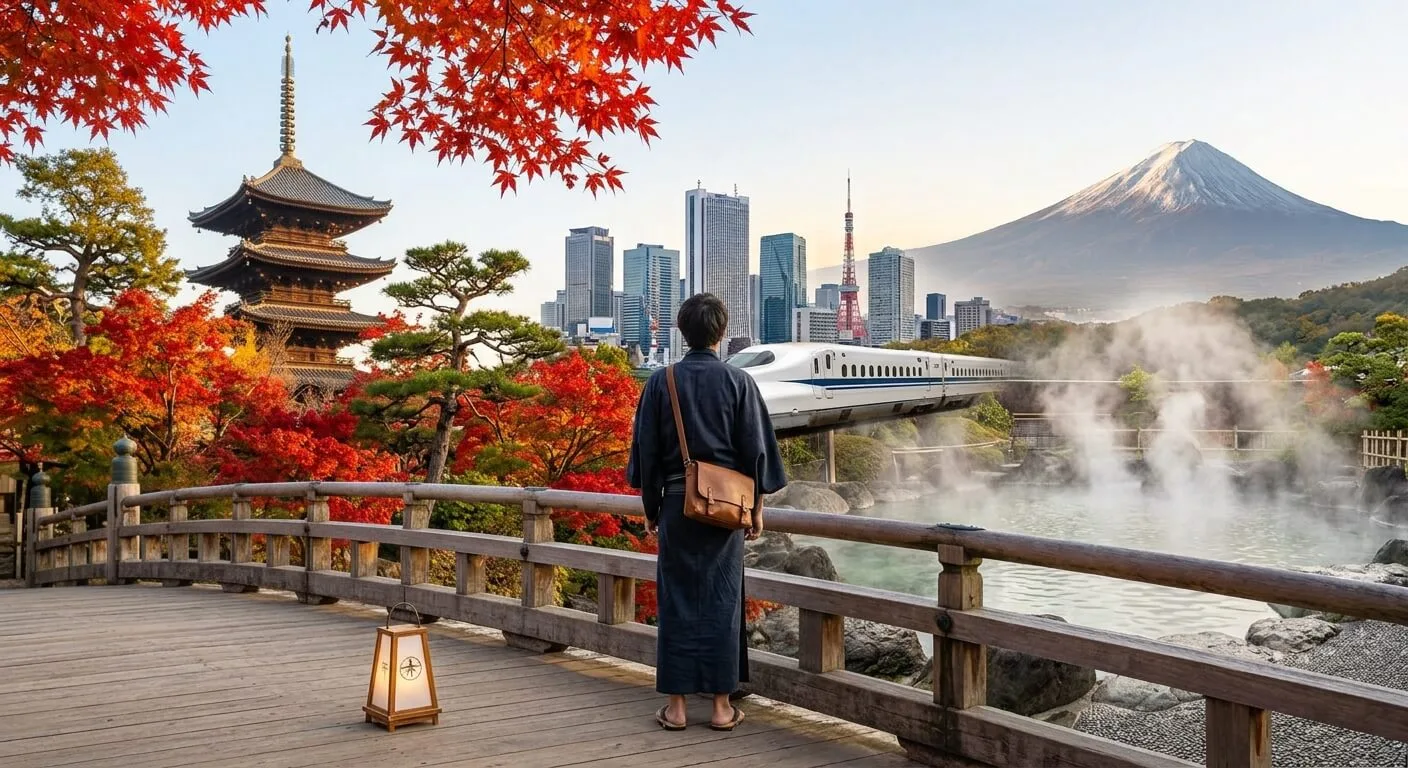

Planning a Japan 7 day itinerary can feel difficult at first. Japan has famous cities, temples, food spots and natural sights spread across the country.
However, one week is enough for an excellent first trip if you keep your route simple.
This itinerary focuses on Tokyo, Kyoto and Hakone. You will experience modern cities, traditional culture and mountain scenery. You will also ride the Shinkansen, visit famous temples and have the option to stay in a traditional ryokan.
The goal is simple: experience several sides of Japan without spending most of your vacation changing hotels and sitting on trains.
7 Day Japan Itinerary Overview
Here is the route at a glance.
| Day | Sleep In | Main Area | Main Focus |
| Day 1 | Tokyo | Central and East Tokyo | Markets, temples and city sights |
| Day 2 | Tokyo | West Tokyo | Meiji, Harajuku, Shibuya and Shinjuku |
| Day 3 | Kyoto | Tokyo to Kyoto | Shinkansen and Kyoto evening |
| Day 4 | Kyoto | Fushimi and Higashiyama | Shrines, temples and old streets |
| Day 5 | Kyoto | North and West Kyoto | Culture, nature and food |
| Day 6 | Hakone | Kyoto to Hakone | Ryokan and onsen |
| Day 7 | Departure | Hakone to Tokyo | Return to Tokyo and departure |
This route works well for first-time visitors because it limits unnecessary hotel changes.
You will not see all of Japan in seven days.
That should not be the goal.
Instead, choose a few places and enjoy them properly.
Planning your budget for this route? See our full breakdown of how much a 7-day Japan trip costs, including flights, hotels, food and trains.
Is 7 Days Enough for Japan?
Yes. Seven days is enough for a good first trip to Japan.
However, you need to keep the itinerary realistic.
Trying to visit Tokyo, Kyoto, Osaka, Hiroshima, Nara, Hakone and Mount Fuji in one week can make the trip stressful.
For most first-time travelers, two main cities and one extra destination work better.
Tokyo gives you modern Japan.
Kyoto gives you temples, shrines and traditional neighborhoods.
Hakone adds nature, hot springs and a slower travel experience.
If you prefer food and nightlife, you can replace Hakone with Osaka. If history is more important, you can choose Nara instead.
Does This Itinerary Mean 7 Full Days in Japan?
Before following this route, check how many full sightseeing days you really have.
Seven calendar days do not always mean seven full days.
If you arrive in Tokyo late on Day 1 and fly home early on Day 7, you may only have about five useful sightseeing days.
In that case, simplify the trip.
A shorter version could be:
- 2 to 3 days in Tokyo
- 2 to 3 days in Kyoto
- final day for departure
Skip Hakone, Osaka or Nara if adding another destination makes the trip feel rushed.
If you have seven full sightseeing days plus separate arrival and departure days, the full Tokyo, Kyoto and Hakone route will be much easier.
How Many Places Should You Visit in 7 Days?
Try to use no more than three main bases.
Changing hotels takes time. You need to pack, check out, travel, find your next hotel and check in again.
That can easily take several hours.
For a one-week Japan itinerary, a simple route is usually better.
A useful rule is:
- 2 to 3 days in Tokyo
- 2 to 3 days in Kyoto
- 1 day in Hakone, Nara or Osaka
This gives you variety without making every day feel rushed.
Before You Fly to Japan
A little preparation can make your arrival much easier.
U.S. travelers visiting Japan for short tourism stays should check the latest entry requirements before departure.
Japan also offers Visit Japan Web, which can be used to prepare immigration and customs information before arrival.
Before leaving home, check:
- passport and current entry rules
- hotel address
- mobile data, eSIM or SIM options
- travel insurance
- airport-to-hotel transportation
- prescription medication rules
- copies of major reservations
Keep important booking details available offline in case you cannot connect to the internet after landing.
Important Note on Medications
Japan has strict rules for some prescription and over-the-counter medicines.
Do not assume that a medicine that is legal in your home country can automatically be brought into Japan.
Rules can depend on the active ingredient, amount and type of medicine.
Some controlled medicines require permission before travel, while some substances cannot be imported.
Check your exact medication with Japan’s Ministry of Health before flying.
Do this well before your trip if you take prescription medicine every day.
Where to Stay
Hotel location matters during a short Japan trip.
A cheaper hotel far from public transport may save money, but it can cost you valuable sightseeing time.
Try to stay close to a major train or subway station.
Where to Stay in Tokyo
Good areas for first-time visitors include:
Shinjuku: Good for nightlife, restaurants and transport.
Shibuya: Great for shopping, younger travelers and nightlife.
Asakusa: Better for traditional streets and a quieter atmosphere.
Tokyo Station area: Useful if you plan to take the Shinkansen to Kyoto.
Choose your area based on what you want to do in the evening.
Where to Stay in Kyoto
Popular areas include:
Kyoto Station: Best for easy transport and day trips.
Gion: Great for traditional streets and evening walks.
Downtown Kyoto: Good for restaurants, shopping and nightlife.
For a first trip, Kyoto Station is one of the easiest bases.
Day 1: Tokyo Central and East
Your first day should not be too busy.
If you have just arrived after a long international flight, jet lag may affect your energy.
Start slowly.
Tsukiji Outer Market
Begin around Tsukiji Outer Market.
It is a good place to try Japanese seafood, snacks and local dishes.
Visit earlier in the day because many businesses become quieter later.
Walk around before choosing what to eat rather than stopping at the first busy stall.
Senso-ji Temple
Next, travel to Asakusa.
Senso-ji is one of Tokyo’s best-known temples.
Walk through Kaminarimon Gate and continue toward the temple.
The surrounding streets also have small shops, snacks and souvenirs.
Visit early in the morning or later in the day if you want lighter crowds.
Ginza
Later, head toward Ginza.
Ginza is known for department stores, restaurants and modern architecture.
Even if luxury shopping is not your main interest, the neighborhood is still worth walking through.
teamLab Borderless
If digital art interests you, continue to Azabudai Hills for teamLab Borderless.
Book popular timed-entry attractions before your trip when possible.
First-Day Tip
Keep your first evening simple.
Have dinner near your hotel and get some rest.
You have a full day ahead tomorrow.
Day 2: Tokyo West
Your second day focuses on western Tokyo.
Several famous neighborhoods sit close together, which helps reduce travel time.
Meiji Shrine
Start your morning at Meiji Shrine.
The wooded entrance feels very different from the busy city around it.
It is a peaceful place to begin the day.
Visit early if possible.
Takeshita Street
Walk toward Harajuku.
Takeshita Street is famous for youth fashion, snacks and small shops.
It can become crowded.
You do not need to spend several hours here unless shopping is a major part of your trip.
Omotesando
Continue toward Omotesando.
The area has modern architecture, cafés and shops.
It also creates a natural route toward Shibuya.
Shibuya
Continue to Shibuya.
See the famous crossing, explore nearby streets and visit a few shops or cafés.
Shibuya works especially well in the late afternoon and evening.
Shibuya Sky
For city views, consider Shibuya Sky.
Sunset is popular, so advance booking can be useful.
If tickets are unavailable, do not build your whole day around it. Tokyo has many other viewpoints.
Shinjuku
Finish the evening in Shinjuku.
The neighborhood is filled with restaurants, bars, bright signs and busy streets.
Have dinner here before returning to your hotel.
Getting Around Tokyo
Tokyo’s transport system can look confusing at first, but it becomes much easier after a few trips.
Visitors normally use a mix of:
- JR trains
- subway lines
- private railway lines
- buses
- taxis
An IC card such as Suica or PASMO can make local transport easier.
You normally tap in when entering a station and tap out when leaving.
An IC card is not the same as a JR Pass.
Use a navigation app to check train lines, platforms and directions before boarding.
Tokyo Must-Sees
If you have extra time, other popular Tokyo sights include:
- Tokyo Skytree
- Ueno
- Akihabara
- Imperial Palace area
- Roppongi
- Odaiba
- Tokyo Tower
Do not try to add all of them.
Choose attractions that match your interests.
Day 3: Take the Shinkansen to Kyoto
Today you leave Tokyo and travel to Kyoto.
The Shinkansen is one of Japan’s most famous transport experiences.
The fastest Tokyo to Kyoto services take a little over two hours, but you should also allow time to reach the station and travel from Kyoto Station to your hotel.
Try to leave Tokyo in the morning.
Before Leaving Tokyo
Check out of your hotel and keep your travel bag easy to carry.
Large luggage can make train travel harder.
Japan also has luggage-forwarding services that can send your suitcase between hotels.
This can be useful if you want to travel with only a smaller bag.
Arriving in Kyoto
After arriving, check into your hotel or leave your luggage at reception.
Do not plan a huge sightseeing day.
Use the afternoon and evening to get familiar with Kyoto.
Pontocho
Pontocho is a good place for an evening walk.
The narrow street has restaurants and a traditional atmosphere.
The nearby Kamo River area is also pleasant in the evening.
Have dinner and rest.
Tomorrow includes more walking.
Getting Around Kyoto
Kyoto has a smaller subway network than Tokyo.
Visitors often use several types of transport.
These include:
- buses
- trains
- subway lines
- taxis
- bicycles
- walking
Walking is a major part of sightseeing in Kyoto.
Comfortable shoes are important.
You can also save time by grouping attractions in the same part of the city.
Day 4: Shrines, Temples and Historic Kyoto
Today focuses on some of Kyoto’s best-known cultural sights.
Start early.
Popular temples and shrines can become crowded later in the morning.
Fushimi Inari Shrine
Begin at Fushimi Inari.
The shrine is famous for its long paths of red torii gates.
You do not need to walk all the way to the top unless you want a longer hike.
Many visitors explore the lower paths and continue with their day.
Arriving early usually gives you a quieter experience.
Higashiyama
Next, explore the historic Higashiyama area.
Walk slowly through its traditional streets.
You will find shops, cafés, temples and older buildings.
This area is best explored on foot.
Kiyomizu-dera
Kiyomizu-dera is one of Kyoto’s major temples.
The temple also offers views across part of the city.
Allow time to explore the surrounding streets.
Gion
Finish around Gion.
It is one of Kyoto’s best-known traditional districts.
Walk respectfully because many streets are also residential areas.
Do not block roads or private entrances while taking photos.
Day 5: Cultural Kyoto and Local Food
Use your second full Kyoto day to explore another part of the city.
Kinkaku-ji
Start at Kinkaku-ji, also called the Golden Pavilion.
The temple is famous for its gold-covered exterior.
It is one of Kyoto’s most recognized sights.
The visit itself does not need half a day.
Plan your next stop before arriving.
Adashino Nenbutsuji
Adashino Nenbutsuji offers a quieter cultural experience.
It sits in the wider Arashiyama area.
The temple is known for its stone statues and peaceful setting.
Arashiyama
While you are in this part of Kyoto, explore Arashiyama.
The area has bamboo paths, temples, shops and river scenery.
It can become busy, so earlier visits usually feel calmer.
Nishiki Market
Later, return toward central Kyoto.
Nishiki Market is a good place to see local foods and small shops.
Try a few snacks rather than treating the market like one large restaurant.
Hanamikoji Street
Finish around Hanamikoji Street and the surrounding Gion area.
Evening is a good time for a relaxed walk before dinner.
Kyoto Must-Sees
Other popular Kyoto attractions include:
- Nijo Castle
- Arashiyama Bamboo Grove
- Kyoto Imperial Palace
- Sanjusangen-do
- Philosopher’s Path
- temples around Higashiyama
You do not need to visit every temple.
After several temple visits, many travelers start to feel tired.
Choose fewer places and spend more time enjoying them.
Day 6: Travel to Hakone for a Ryokan Stay
Leave Kyoto and travel toward Hakone.
The easiest general route is:
Kyoto → Odawara by Tokaido Shinkansen → Hakone by local train or bus
Odawara is the main rail gateway to the Hakone area.
Today should be slower than your Tokyo and Kyoto days.
Stay in a Japanese Ryokan
A ryokan is a traditional Japanese inn.
Many ryokans offer tatami rooms, Japanese meals and hot-spring baths.
This can become one of the most memorable parts of the trip.
Try to arrive early enough to enjoy the property.
Enjoy an Onsen
Hakone is famous for hot springs.
An onsen is a Japanese hot-spring bath.
Rules may be different from what first-time visitors expect, so check the instructions at your accommodation.
Some properties also offer private baths.
Hakone Open-Air Museum
If you arrive with enough time, consider visiting the Hakone Open-Air Museum.
It combines art with outdoor scenery.
However, do not make Day 6 too busy.
Your ryokan stay is part of the experience.
Hakone or Mount Fuji: Which Should You Choose?
Many first-time travelers are unsure whether to choose Hakone or the Fuji Five Lakes area.
Choose Hakone if you want:
- hot springs
- a ryokan
- mountain scenery
- a slower overnight stay
Choose Kawaguchiko or the Fuji Five Lakes if your main goal is:
- closer Mount Fuji views
- photography
- lakeside scenery
Mount Fuji is not always visible.
Clouds can cover the mountain even when the weather feels pleasant.
Keep your schedule flexible if seeing Fuji is one of your main priorities.
Day 7: Return to Tokyo
Travel back toward Tokyo.
Your final schedule depends on your flight time.
If you have a late flight, you may still have several hours to explore.
Last-Minute Tokyo Ideas
Use your final hours for something simple.
You could:
- shop for souvenirs
- return to a favorite neighborhood
- have one final Japanese meal
- visit something you missed
- relax at a café
Do not travel far across the city if you have a flight later that day.
Leave enough time to collect your luggage and reach the airport.
Travel Time and Pace Guide
A seven-day Japan trip includes plenty of walking and several transport days.
| Day | Pace | Walking | Hotel Change | Advance Booking |
| Day 1 | Easy to moderate | Moderate | No | teamLab recommended |
| Day 2 | Busy | High | No | Shibuya Sky recommended |
| Day 3 | Moderate | Light to moderate | Yes | Shinkansen recommended |
| Day 4 | Busy | High | No | Usually limited |
| Day 5 | Busy | High | No | Depends on activities |
| Day 6 | Relaxed | Light | Yes | Ryokan strongly recommended |
| Day 7 | Flexible | Light | Yes | Depends on flight |
Remember that train time is not the same as total travel time.
You also need time for hotel checkout, station transfers, finding platforms and reaching your next hotel.
What to Prioritize If You Fall Behind Schedule
You do not need to complete every attraction in this Japan 7 day itinerary.
If you are tired or running late, protect the experiences that matter most.
Tokyo
Prioritize: Senso-ji, Meiji Shrine and Shibuya.
Optional: Ginza, Takeshita Street or an observation deck.
Kyoto
Prioritize: Fushimi Inari, one major temple and time in the historic streets.
Optional: Extra temples or attractions far across the city.
Hakone
Prioritize: Your ryokan and onsen experience.
Optional: Extra sightseeing if you arrive late.
It is better to see fewer places properly than spend the whole day checking the time.
Nara Option
If you prefer temples and historic sights over Hakone, replace the Hakone overnight stay with Nara.
Nara works well as a day trip from Kyoto.
Getting Around Nara
Many major attractions are within walking distance of each other.
You can also use local buses when needed.
Wear comfortable shoes.
Nara Deer Park
Nara Park is famous for its free-roaming deer.
Remember that they are still wild animals.
Follow local instructions when feeding or approaching them.
Todai-ji
Todai-ji is one of Nara’s most famous temples.
It is known for its large Buddha statue and huge wooden hall.
Kasuga Taisha
Kasuga Taisha is another major cultural site.
Its paths and lanterns offer a very different atmosphere from Tokyo or central Kyoto.
Is Nara Worth Adding to a 7-Day Japan Itinerary?
Yes, if traditional culture is one of your main interests.
However, you do not need both Nara and Hakone during such a short trip.
Choose Nara for temples and history.
Choose Hakone for nature, onsen and a slower day.
Other Japan 7-Day Itinerary Options
There is no single route that works for every traveler.
Tokyo and Kyoto
This is the simplest option.
Spend about three days in Tokyo and three days in Kyoto.
Use the final day for travel.
This route is best if you dislike changing hotels.
Tokyo, Hakone and Kyoto
This is the route used in this guide.
It combines modern city life, traditional culture and nature.
Tokyo, Kyoto and Osaka
Choose this option if food, nightlife and city energy matter more than hot springs.
Osaka can also work as a day trip from Kyoto.
Tokyo, Kyoto and Hiroshima
This route is possible but faster.
You will spend more time traveling.
Choose it only if Hiroshima is a major priority.
Tokyo, Mount Fuji and Kyoto
Choose a Fuji-area stay instead of Hakone if seeing Mount Fuji is one of your biggest travel goals.
Cherry Blossom Route
During cherry blossom season, your exact schedule may depend on bloom timing.
Tokyo and Kyoto both have famous blossom areas.
Expect more visitors and higher demand for hotels.
Book early.
Family Route
Families may want fewer temples and more interactive attractions.
Allow more rest time and avoid filling every hour of the day.
Is the JR Pass Worth It for This 7-Day Japan Itinerary?
Do not buy the nationwide JR Pass automatically.
As of August 2026, the ordinary 7-day nationwide JR Pass is priced at ¥50,000.
Compare that price with the individual long-distance journeys you actually plan to take.
For a route mainly covering Tokyo, Kyoto and Hakone, individual Shinkansen tickets plus an IC card for local travel may be more practical.
The JR Pass is more useful when your trip includes several expensive long-distance journeys.
Also remember that not every subway or private railway trip is included.
JR Pass users who want to take certain faster Nozomi services may also need an additional ticket.
Check current prices before buying because railway fares and pass rules can change.
Oversized Luggage on the Shinkansen
Luggage forwarding is useful, but you should also understand the Shinkansen rules if you keep your suitcase with you.
On relevant Tokaido Shinkansen services, baggage with combined dimensions of more than 160 cm and up to 250 cm requires a reservation for an oversized baggage area or designated storage arrangement.
Measure large suitcases before your trip.
If your bag is difficult to carry, luggage forwarding may be easier than moving it through busy train stations.
How Much Does a 7-Day Japan Trip Cost?
Your total cost depends on your accommodation, food choices and activities.
Current official Japan travel guidance gives examples such as budget rooms starting around ¥6,000 per night, mid-range double rooms starting around ¥10,000, and some ryokan stays with meals starting around ¥10,000 per person per night.
These are starting points, not fixed prices.
Popular dates and central locations can cost much more.
Budget separately for:
| Expense | What to Include |
| Accommodation | 6 to 7 nights |
| Food | Breakfast, lunch, dinner and snacks |
| Long-distance transport | Tokyo, Kyoto and Hakone transfers |
| Local transport | Trains, subway and buses |
| Attractions | Museums, viewpoints and paid experiences |
| Ryokan | Overnight stay and meals if included |
| Shopping | Souvenirs and personal spending |
Simple restaurant meals can be affordable, while specialty restaurants and fine dining can raise your budget quickly.
Keep international flights separate because airfare varies greatly by departure city and season.
What Should You Book Before Your Japan Trip?
Some parts of your itinerary are easier when booked early.
Consider booking ahead for:
- hotels
- popular ryokans
- Shinkansen seats when useful
- popular observation decks
- teamLab Borderless
- special restaurants
- theme parks
- limited-seat experiences
You do not need to reserve every meal and attraction.
Leave some time for spontaneous exploring.
What to Do With Your Luggage
Luggage can become annoying when moving between Tokyo, Kyoto and Hakone.
Pack lighter if possible.
Japan has luggage-delivery services that can send bags between hotels.
This can be useful on your Tokyo-to-Kyoto or Kyoto-to-Hakone travel days.
Travel with a smaller overnight bag while your main suitcase moves separately.
Check delivery times with your hotel because bags may not always arrive the same day.
What Not to Add to a 7-Day Japan Trip
One of the biggest mistakes is trying to see too much.
Avoid building a route like:
Tokyo → Hakone → Kyoto → Osaka → Nara → Hiroshima → Tokyo
You may technically reach all these places.
However, much of your trip will be spent checking into hotels and riding trains.
A seven-day Japan trip should feel like a vacation, not a transport challenge.
Pick your priorities.
Common First-Time Japan Itinerary Mistakes
Planning Too Many Attractions
You do not need ten attractions every day.
Three or four main experiences are often enough.
Ignoring Travel Time
A two-hour train journey can take longer once you include hotel checkout, transfers and travel to your next accommodation.
Changing Hotels Every Night
Hotel changes reduce sightseeing time.
Use major cities as bases when possible.
Starting Too Hard on Day One
Jet lag can affect your energy.
Keep your first evening flexible.
Wearing the Wrong Shoes
Tokyo and Kyoto involve a lot of walking.
Comfortable shoes matter.
Booking Every Minute
Leave some free time.
You may find a street, café, shop or neighborhood you want to explore longer.
Is Osaka Worth Visiting in 7 Days?
Yes, but it depends on your interests.
Osaka is a good choice for travelers who enjoy:
- food
- nightlife
- shopping
- modern city energy
- Universal Studios Japan
However, you do not need Osaka simply because it appears on many Japan itineraries.
If temples and traditional culture matter more, spend additional time in Kyoto.
If you want relaxation, choose Hakone instead.
Best Time for This Japan 7 Day Itinerary
You can follow this route in every season.
Spring
Spring is popular for cherry blossoms.
It is also one of the busiest travel periods.
Summer
Summer can be hot and humid.
Plan outdoor sightseeing earlier in the day when possible.
Autumn
Autumn brings cooler temperatures and colorful leaves.
Kyoto is especially popular during this period.
Winter
Winter is colder but can offer clearer skies and fewer crowds in some areas.
Hot springs can also be especially enjoyable in colder weather.
Final Thoughts on This Japan 7 Day Itinerary
A good Japan 7 day itinerary is not about visiting as many places as possible.
It is about choosing the right places.
For a first trip, Tokyo and Kyoto show you two very different sides of Japan. Hakone adds nature and a traditional overnight experience.
Keep your route simple.
Stay near transport.
Group nearby attractions together.
Leave room for rest.
Most importantly, do not worry about seeing everything.
One week can give you an excellent introduction to Japan and plenty of reasons to return.
Frequently Asked Questions
Is 7 days enough for Japan for first-time visitors?
Yes. Seven days is enough for Tokyo, Kyoto and one extra destination such as Hakone, Nara or Osaka. Avoid trying to visit too many cities.
Can I visit Tokyo and Kyoto in 7 days?
Yes. Tokyo and Kyoto are one of the strongest combinations for a first Japan trip. Spend around two to three full days in each city.
Can I do Tokyo, Kyoto and Osaka in 7 days?
Yes. However, use Kyoto or Osaka as a base rather than changing hotels more than necessary.
Should I visit Hakone or Nara?
Choose Hakone for hot springs, nature and a ryokan stay. Choose Nara for temples, deer and historic sights.
How many days should I spend in Tokyo?
For a seven-day first trip, two or three full days in Tokyo works well.
How many days should I spend in Kyoto?
Plan at least two full days in Kyoto. Three days is even better if temples, food and traditional culture are major priorities.
Do I need a JR Pass for one week in Japan?
Not always. Compare the current pass price with the cost of your planned long-distance journeys before buying.
Should I stay in Osaka or Kyoto?
Stay in Kyoto if temples and traditional culture are your main interests. Stay in Osaka if nightlife, food and modern city life matter more.
Can I see Mount Fuji during a 7-day Japan trip?
Yes. You can visit Hakone or the Fuji Five Lakes area. However, Mount Fuji visibility depends on cloud and weather conditions.
What is the best route for a first trip to Japan?
A simple Tokyo → Kyoto → Hakone → Tokyo route works well for many first-time visitors. Tokyo → Kyoto → Osaka is another strong option.

1 Comment
Pingback: How Many Days in Japan? Best Trip Length for First-Time Visitors