
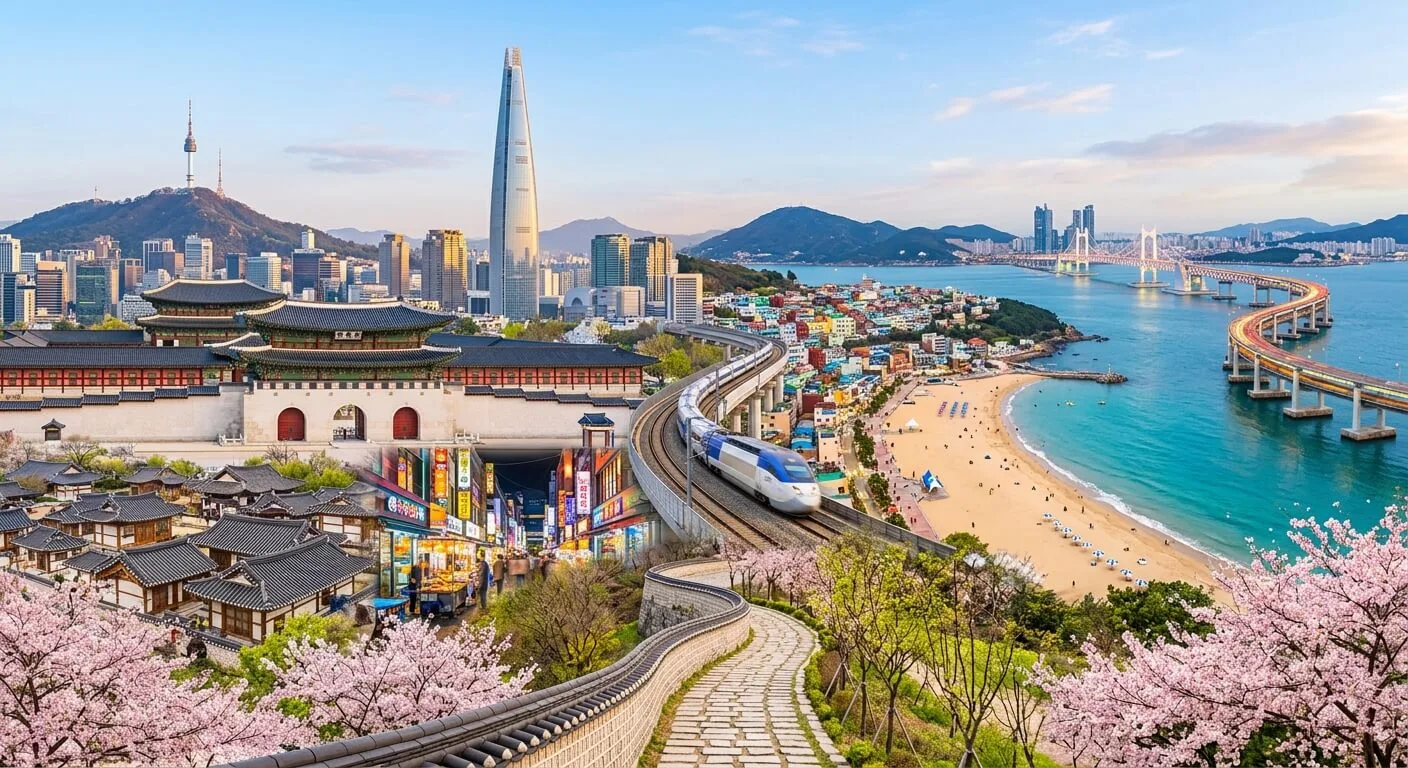

A South Korea 7 day itinerary is enough to enjoy a great first trip if you plan your time well. One week will not let you see the whole country. However, it gives you enough time to experience Korean history, food, modern city life, markets, cafés, and the coast.
For most first-time visitors, Seoul and Busan make a strong combination. Seoul gives you royal palaces, traditional neighbourhoods, shopping, nightlife, and modern Korean culture. Busan adds beaches, seafood, markets, and beautiful coastal views.
This itinerary uses seven calendar days, including arrival and departure. Day 1 is intentionally light because long flights, airport travel, and jet lag can affect your energy. Day 7 stays flexible depending on your flight.
The key is not to pack every famous place into seven days. Instead, focus on a logical route and leave some free time. South Korea is easy to explore, but large cities can take longer to cross than they appear on a map.
This itinerary gives Seoul more time because the capital has more attractions and neighbourhoods to explore. You will then travel south to Busan by train.
If Korean history is more important to you than beaches, you can replace Busan with Gyeongju. However, adding Seoul, Busan, Gyeongju, and Jeju to the same seven-day trip will usually make the journey too rushed.
South Korea 7 Day Itinerary at a Glance
| Day | Base | Main Plan |
| Day 1 | Seoul | Arrival and local neighbourhood |
| Day 2 | Seoul | Historic Seoul |
| Day 3 | Seoul | Modern Seoul |
| Day 4 | Seoul | Hongdae and flexible sightseeing |
| Day 5 | Busan | KTX from Seoul to Busan |
| Day 6 | Busan | Main Busan sightseeing |
| Day 7 | Busan or Seoul | Final sightseeing and departure |
This route keeps hotel changes low while still showing you two very different sides of South Korea.
Seoul and Busan or Seoul and Gyeongju?
There is no single perfect route for one week in South Korea.
This itinerary chooses Seoul and Busan because it gives first-time visitors a mix of history, modern city life, food, shopping, beaches, and coastal scenery without too many hotel changes.
Choose Seoul and Gyeongju instead if Korean history, temples, royal tombs, and traditional culture are more important to you than beaches.
For a slower trip, you could also spend all seven days in Seoul and take one or two day trips.
The best route depends on what you want from your first visit.
Before you book, see the best time to visit South Korea for weather, crowds and festivals by month.
Week in South Korea Itinerary Logistics
Good planning will make your week in Korea much easier.
Before you build a long list of attractions, think about flights, transport, accommodation, weather, and how much energy you will have each day.
A seven-day trip is short. Therefore, every hotel change and long journey matters.
Is a week in Korea enough?
Yes. A week in Korea is enough for a first visit.
However, you should not try to see every major destination.
A seven-day trip works best when you focus on one or two main cities. Seoul and Busan are a good choice because they offer very different experiences.
You can spend the first four days exploring Seoul. Then take the train to Busan for the final part of your trip.
This gives you time for:
- Historic palaces
- Traditional neighbourhoods
- Korean markets
- Shopping
- Cafés
- Modern districts
- Korean food
- Beaches
- Coastal scenery
You could also add Gyeongju, but doing so creates another travel day and hotel change.
If you enjoy slow travel, keep your route simple.
When to Plan your Korea Itinerary
South Korea can be visited throughout the year. However, each season feels different.
Spring is popular because temperatures are often comfortable and flowers begin to bloom.
Summer can be hot, humid, and rainy. Outdoor sightseeing may feel more tiring.
Autumn is another popular season. The weather can be pleasant, and fall colours make parks and historic areas beautiful.
Winter can be very cold, especially in Seoul. However, winter travel may also mean fewer crowds at some attractions.
Check the weather shortly before your trip. Seasonal conditions can affect your daily plans.
It is also smart to check Korean public holidays. Trains and hotels may become busier during major travel periods.
Health and Safety in Korea
South Korea is generally easy to travel around independently.
Still, normal travel safety is important.
Keep your passport and valuables secure. Pay attention to your surroundings in busy stations, markets, and shopping districts.
Travel insurance is also worth considering.
A good policy may help with:
- Medical treatment
- Trip delays
- Lost baggage
- Cancellations
- Emergency support
Save the address of your hotel in Korean on your phone. This can help if you need to show it to a taxi driver.
Internet access is also very useful. You may need it for maps, translation, train information, and restaurant searches.
Visas in South Korea
Entry rules depend on your nationality and travel date.
For U.S. passport holders travelling during 2026, tourist visits of up to 90 days generally do not require a traditional tourist visa.
U.S. passport holders are also temporarily exempt from the K-ETA requirement through December 31, 2026 under the current rules.
Travelers should also check whether they need to complete South Korea’s e-Arrival Card before arrival. The official electronic arrival form is free and can normally be completed shortly before the trip.
Entry rules can change.
Always confirm the latest requirements through official South Korean immigration information and the U.S. State Department before flying.
Make sure your passport is valid for your trip.
Keep digital copies of important travel documents in case something gets lost.
Getting to South Korea: Smart Flight Strategy
Most international visitors begin their trip in Seoul.
Incheon International Airport is the main international gateway for the Seoul area.
There are several ways to travel from Incheon Airport into Seoul.
AREX trains are useful if your accommodation connects easily to the rail and subway network.
Airport limousine buses can be convenient if there is a stop near your hotel, especially when you have luggage.
Taxis are usually the easiest door-to-door option but can cost more.
Your best choice depends on:
- Your arrival time
- Your hotel location
- Your luggage
- Your budget
- How tired you feel
After a long flight from the United States, avoid planning a full sightseeing schedule on arrival day.
Immigration, baggage collection, airport transport, and hotel check-in can take time.
Use your first evening to settle in.
Walk around your neighbourhood. Have a Korean meal. Visit a convenience store. Then get some rest.
This will make your next day much more enjoyable.
Another useful flight strategy is to check whether you can arrive in Seoul and leave from Busan.
An open-jaw flight may reduce backtracking.
However, many international flights are easier to book as a round trip through Seoul. If you fly home from Seoul, leave enough time to return from Busan.
Avoid planning a long train journey immediately before an important international flight.
How to get around South Korea
You do not need to rent a car for this itinerary.
Public transport is the easiest option for most first-time visitors.
Seoul and Busan both have large subway and bus networks. Intercity trains also connect major parts of the country.
For local transport, consider getting a T-money card.
A T-money card can be used on many buses and subway systems. It is especially useful for a multi-city route such as Seoul and Busan.
Seoul also has the Climate Card for frequent public transport use within the city. However, T-money is usually the simpler choice for this itinerary because you will travel beyond Seoul.
Essential Apps for South Korea
A few apps can make independent travel much easier.
Naver Map is useful for walking directions and public transport.
Kakao Map is another good navigation option.
Kakao T can help you request taxis.
Papago is useful for Korean translation.
Google Maps can still help you find locations. However, Korean navigation apps usually provide better local routing information.
Download important apps before your trip and make sure you have mobile data.
How to travel between cities in South Korea
Train travel is one of the easiest ways to move between major Korean cities.
High-speed KTX trains connect Seoul and Busan. They can save a lot of time compared with slower transport.
However, do not look only at the train journey itself.
A train ride can take much more of your day once you include:
- Hotel checkout
- Travel to the station
- Waiting time
- Finding your platform
- The train journey
- Travel from the arrival station
- Hotel check-in
This is why you should avoid changing cities too often during a seven-day trip.
Book important train journeys ahead when your travel dates are fixed, especially during busy periods.
How to get around in Korean cities
Seoul has an excellent public transport network.
The subway is often the fastest way to move between major neighbourhoods. However, some stations are very large.
Check the correct station exit before leaving the platform. The wrong exit can add a long walk.
Buses are also useful, but they may feel more difficult for first-time visitors.
Taxis can help when you have luggage or when several people are travelling together.
Busan also has good public transport. Still, the city is spread out.
Haeundae, Gamcheon, Nampo, and other attractions may look close on a map. In reality, moving between them can take time.
Group nearby attractions together whenever possible.
What Should You Book Before Your Trip?
You do not need to reserve every part of your South Korea itinerary.
However, some bookings are worth making early.
Book in advance:
- International flights
- Accommodation
- Important KTX journeys
- Popular tours
- Timed attractions or experiences
Keep flexible:
- Subway journeys
- Local buses
- Most restaurant meals
- Markets
- Neighbourhood walks
- Regular sightseeing
If you are travelling during a Korean public holiday or busy weekend, book important train journeys earlier than usual.
The Best One Week in Korea Itinerary
This South Korea 7 day itinerary gives you four days in Seoul and the final part of your trip in Busan.
The goal is to see the highlights without making every day feel rushed.
Korea Itinerary Day 1: Neighborhoods of Seoul
Your first day should be easy.
After arriving in Seoul, check into your hotel and explore the area around you.
Myeongdong is a convenient choice for first-time visitors. It has shops, restaurants, street food, and useful transport connections.
Hongdae is another good option if you prefer cafés, nightlife, music, and a younger atmosphere.
Insadong has a more traditional feel and works well for travellers interested in culture and crafts.
Do not try to cross Seoul several times on your first day.
Instead, stay near your accommodation.
Walk around. Try Korean food. Visit a café. Buy any basic travel items you need.
Then get a good night’s sleep.
Your first day should help you adjust to Korea, not exhaust you.
Week in Korea Day 2: Traditional Seoul
Today focuses on Seoul’s historic heart.
Start early because this area has several important attractions.
Before fixing your schedule, check palace opening days. Seoul’s major palaces do not all close on the same day.
If one palace is closed, switch your Seoul days instead of removing the entire historic route.
Stop 1: Gyeongbokgung
Gyeongbokgung Palace is one of Seoul’s most famous historic sites.
Give yourself enough time to walk through the palace grounds.
Do not visit only for a quick photo.
Take time to notice the buildings, gates, courtyards, and mountain views around the complex.
Some visitors rent a traditional hanbok before visiting the palace. This can be a fun experience if photography is important to you.
However, it is optional.
Stop 2: Bukchon Hanok Village
After the palace, continue towards Bukchon Hanok Village.
The area is known for traditional Korean houses called hanok.
It is also one of Seoul’s most photographed neighbourhoods.
However, remember that people still live in this area.
Keep your voice low and follow local signs.
Do not block entrances or private homes for photos.
Stop 3: Insadong for Lunch
Insadong is a good place to stop for lunch.
The area has restaurants, tea houses, shops, galleries, and traditional souvenirs.
Try a Korean dish that you have not eaten before.
You could choose bibimbap, dumplings, noodles, or another local meal.
After lunch, walk through the main streets and smaller lanes.
Stop 4: Changdeokgung
If you still have enough energy, continue to Changdeokgung Palace.
Check its opening schedule before your visit because the palace normally has a weekly closing day.
Avoid rushing through several palaces just because they appear on a checklist.
If you are tired, choose one major palace and spend more time there.
A good itinerary should be flexible.
Stop 5: Deoksugung from Above
If time and energy allow, you can add the Deoksugung area before dinner.
If the day already feels full, skip this stop.
It is better to enjoy four places properly than rush through six.
Stop 6: Dinner at Gwangjang Market
Finish your day at Gwangjang Market.
This is a good place to experience Korean market food.
Walk around before choosing what to eat.
You can share several small dishes instead of ordering one large meal.
Food markets can become crowded, so keep your bag secure and be patient when moving through busy areas.
South Korea Itinerary Day 3: Modern Seoul
After a day of traditional Seoul, explore the modern side of the city.
Choose areas that match your interests.
If you enjoy shopping, fashion, and nightlife, spend more time in popular commercial districts.
If cafés and design interest you, explore neighbourhoods known for independent shops and coffee culture.
You could also visit Gangnam.
However, Gangnam is large.
Do not travel there without deciding what you want to see first.
Another option is to spend part of the day around the Han River.
A slower afternoon can be useful after two busy sightseeing days.
This is also a good day to enjoy Korean food beyond the main tourist markets.
Look for:
- Korean barbecue
- Fried chicken
- Tteokbokki
- Gimbap
- Noodles
- Mandu
Do not fill every hour of the day.
Leave space for unexpected places.
Some of the best travel memories come from a café, neighbourhood, or restaurant you did not plan.
7 Days in Korea Day 4: Day in Hongdae
Use Day 4 to explore Hongdae and nearby areas at a slower pace.
Hongdae is known for shopping, food, cafés, entertainment, and nightlife.
It has a younger atmosphere than Seoul’s palace districts.
Start later if you want.
Browse shops. Stop for coffee. Try local food. Explore side streets instead of staying only on the busiest road.
You can also adjust this day to match your interests.
If you enjoy shopping or K-pop culture, spend more time in Hongdae.
If you prefer a slower day, combine Hongdae with a walk around nearby green spaces and cafés.
Beauty and skincare fans can use part of the day for a beauty experience or shopping.
If a DMZ tour is one of your main priorities, you could replace part or all of Day 4 with a tour instead.
This is also a useful shopping day.
If you want souvenirs, Korean skincare, fashion, or small gifts, you can buy them here.
However, avoid carrying heavy shopping bags across the country if you are travelling to Busan the next day.
Keep your evening relaxed.
You need to pack and prepare for your train journey.
Day 5 in Korea: KTX to Busan
Today, leave Seoul and travel to Busan.
Try to choose a morning train that does not force you to wake up extremely early.
Check out of your hotel and leave enough time to reach the station.
Keep your train ticket easy to access.
Remember that moving cities takes longer than the train journey alone.
You also need time for hotel checkout, transport to the station, waiting, the train ride, travel to your new hotel, and check-in.
When you arrive in Busan, travel to your accommodation and leave your luggage.
Where you stay can strongly affect your Busan experience.
Haeundae is useful if beaches and the coast are your main priority.
Seomyeon can work well if you want a more central transport base.
Nampo is convenient for markets, older neighbourhoods, and food.
After checking in, do not rush to the other side of Busan.
Spend the rest of the day near your hotel.
You could explore a market, walk near the waterfront, or enjoy dinner.
Busan has a different pace from Seoul.
Use your first evening to enjoy that change.
7 Days in Korea Day 6: Highlights of Busan
Day 6 is your main Busan sightseeing day.
Busan is too large to cover every famous attraction in one day.
Choose a route that matches your interests.
Coastal Route
Haedong Yonggungsa → Haeundae → coastal sightseeing → Gwangalli
This option works well if beaches, ocean views, and coastal scenery are important to you.
Spend time around Haeundae instead of treating it as a quick photo stop.
End the day around Gwangalli if you want another coastal atmosphere in the evening.
Culture and Food Route
Gamcheon Culture Village → Nampo → Jagalchi area → BIFF Square
Choose this route if you prefer colourful neighbourhoods, markets, street food, and local city life.
Gamcheon Culture Village is hilly, so wear comfortable shoes.
Busan is also well known for seafood. However, you can also find noodles, hotteok, snacks, and many other local dishes.
Trying to complete both routes in one day will mean spending too much time travelling across Busan.
Choose one and enjoy it properly.
Korea Itinerary Day 7: Busan
Your final day depends on your flight.
If you are leaving from Busan, use the morning for one final walk, breakfast, or nearby attraction.
Keep enough time for airport travel.
If you are flying home from Seoul, your schedule needs more care.
Returning from Busan to Seoul uses a large part of the day.
Do not plan an early international flight from Seoul after spending the previous night in Busan.
A safer option is to return to Seoul earlier and spend your final night there.
If your flight is late enough, you may be able to travel north on Day 7. However, always leave a large time buffer.
Flights are more important than squeezing in one extra attraction.
Where to stay in South Korea
For a short trip, hotel location matters.
A cheap hotel far from useful transport can cost you hours across the week.
Choose accommodation based on your daily route, not only the room price.
Where to stay in Seoul
First-time visitors should stay near a subway station.
A central location makes palace sightseeing, shopping, food, and train travel easier.
The best area depends on your travel style.
Where to stay in Myeongdong
Myeongdong works well for first-time visitors.
It is convenient for shopping, food, and central Seoul sightseeing.
You can reach many popular areas without complicated transport.
It can also feel busy, especially in the evening.
Where to stay in Insadong
Insadong is a good choice if you prefer traditional Seoul.
It places you close to palaces, hanok areas, tea houses, and cultural attractions.
The atmosphere is different from Hongdae and Gangnam.
It can work especially well for travellers who enjoy history.
Where to stay in Hongdae
Hongdae suits travellers who enjoy nightlife, cafés, fashion, and a lively atmosphere.
It is popular with younger visitors.
The area can stay busy late into the evening.
If you want quiet nights, check hotel reviews carefully.
Where to stay in Gangnam
Gangnam may suit travellers interested in shopping, modern Seoul, nightlife, and business districts.
However, it is farther from some major traditional attractions.
Think about what you want to see before choosing it as your base.
Where to stay in Gyeongju
Gyeongju is not part of the main seven-day route in this itinerary.
However, history lovers may want to replace part of their Seoul or Busan time with one night in Gyeongju.
If you visit, staying near the main historic area can save time.
Gyeongju works best for travellers interested in temples, royal tombs, traditional architecture, and Korean history.
Do not add it only because another itinerary tells you to.
Every extra hotel change makes your trip busier.
Where to stay in Busan
Busan does not have one perfect hotel area for everyone.
Choose based on your priorities.
Haeundae works well for beaches and coastal experiences.
Seomyeon gives you useful transport connections.
Nampo is a strong choice for markets, food, and older parts of Busan.
Before booking, check how long it takes to reach the attractions that matter most to you.
A hotel that looks central on a map may not actually be convenient for your plans.
How Much Does 7 Days in South Korea Cost?
Your final budget depends on your travel style, hotel choice, shopping, and food preferences.
Instead of relying on one fixed number, divide your budget into major categories.
| Expense | Budget Traveler | Mid-Range Traveler | Comfortable Traveler |
| Accommodation | Hostels or simple rooms | 3-star or boutique hotels | Higher-end hotels |
| Food | Markets and casual restaurants | Mix of casual and sit-down meals | Premium restaurants and cafés |
| Local Transport | Subway and buses | Public transport plus some taxis | More frequent taxis |
| Intercity Travel | Planned standard transport | KTX | KTX with more flexible times |
| Attractions | Mostly free and low-cost sights | Mix of free and paid attractions | More tours and experiences |
International airfare should be calculated separately because prices from the United States vary greatly by departure city, season, and booking date.
Also leave room in your budget for coffee, snacks, skincare, souvenirs, and shopping.
These smaller expenses can add up quickly.
Tipping is generally not expected in South Korea in the same way it is in the United States.
Foreign visitors may also qualify for tax refunds on eligible purchases at participating stores. Keep your receipts when shopping and check the current refund rules.
South Korea Itinerary FAQs
Currency and Exchange Rates in Korea
South Korea uses the Korean won.
Card payments are common in many hotels, restaurants, shops, and larger businesses.
However, it is still useful to carry some cash.
Small food stalls, markets, or local businesses may be easier to use with cash.
Exchange rates change often.
Check the current rate before your trip instead of relying on an old example from a travel article.
Also tell your bank that you will be travelling if required.
Carry more than one payment method in case your main card does not work.
Language in Korea
Korean is the main language.
You can travel through Seoul and Busan without speaking Korean.
English is used in many tourist areas, major stations, hotels, and attractions.
Still, not everyone will speak English.
Papago or another translation app can help with:
- Menus
- Signs
- Taxi rides
- Hotel addresses
- Simple conversations
Learning a few Korean words can also make your trip easier.
Even a basic greeting or thank you can be useful.
Do not avoid local restaurants because you are worried about language.
Technology makes independent travel much easier.
Other Observations and FAQs about Korea
Is 7 days enough for South Korea?
Yes. Seven days are enough for a first look at South Korea if you focus on a small number of destinations. Seoul and Busan make a practical first route.
Can you visit Seoul and Busan in one week?
Yes. Seoul and Busan work well together because high-speed trains connect the two cities. Give Seoul more time if this is your first trip.
Should you add Gyeongju?
Add Gyeongju if history is one of your main interests. Skip it if you prefer slower travel or dislike changing hotels.
Should you visit Jeju during a 7-day trip?
For most first-time visitors, Jeju adds too much extra travel to a one-week trip. Save it for a longer visit unless it is one of your top priorities.
How many days should you spend in Seoul?
Three to four days give first-time visitors a useful introduction. You could easily spend longer if you enjoy shopping, food, nightlife, museums, or neighbourhood exploring.
How many days should you spend in Busan?
Two to three days are enough for a first visit. Busan is spread out, so avoid trying to see every major area in one day.
Do you need a car in South Korea?
No. You can complete this itinerary using trains, subways, buses, taxis, and walking.
Is South Korea expensive?
Your trip cost depends on your hotel, food choices, shopping, and activities. Public transport and casual restaurants can help keep costs lower.
What should you book before the trip?
Book international flights and accommodation first. Once your route is fixed, consider booking important intercity train journeys. Popular tours may also need advance reservations.
What should you skip during a one-week trip?
Avoid adding too many distant destinations. Jeju, several long day trips, and frequent hotel changes can make seven days feel rushed.
What Not to Add to a 7-Day South Korea Trip
One week passes quickly.
Avoid adding destinations only because they are famous.
For most first-time visitors, it is better to skip:
- Jeju Island
- Too many Seoul day trips
- Several overnight cities
- Frequent hotel changes
- Long attractions that are not major priorities
- Seoul, Busan, Gyeongju, and Jeju all in one week
These places can all be worth visiting on a longer trip.
For seven days, the goal should be to enjoy the places you choose rather than spend most of your trip moving between them.
Map of our trip to South Korea (save it to your Google account)
Save your important locations before your trip.
Your map should include:
- Incheon International Airport
- Your Seoul hotel
- Seoul Station
- Gyeongbokgung Palace
- Bukchon Hanok Village
- Insadong
- Gwangjang Market
- Hongdae
- Your Busan hotel
- Haeundae
- Gamcheon Culture Village
- Nampo
- Your departure airport or train station
Saving these places before you arrive reduces planning time during the trip.
It also helps you group nearby attractions together.
Do not build each day by choosing places from opposite sides of the city.
A simple route often gives you more actual sightseeing time.
Conclusion
A South Korea 7 day itinerary should give you variety without making every day exhausting.
For most first-time visitors, Seoul and Busan create a strong one-week route.
Spend your first days exploring Seoul’s palaces, markets, modern neighbourhoods, cafés, and food. Then take the train south and finish your trip with Busan’s markets, beaches, coastal views, and more relaxed atmosphere.
Do not worry about seeing everything.
One week is not enough for the whole country, and it does not need to be.
A better trip focuses on fewer places and gives you enough time to enjoy them.
Plan your main transport before you arrive. Choose hotels in useful locations. Keep some free time in each day. Most importantly, build the trip around the experiences that matter to you.
The best South Korea 7 day itinerary is not the route with the most stops. It is the one that makes the best use of your seven days.

1 Comment
Pingback: South Korea 10 Day Itinerary: First-Time Route