
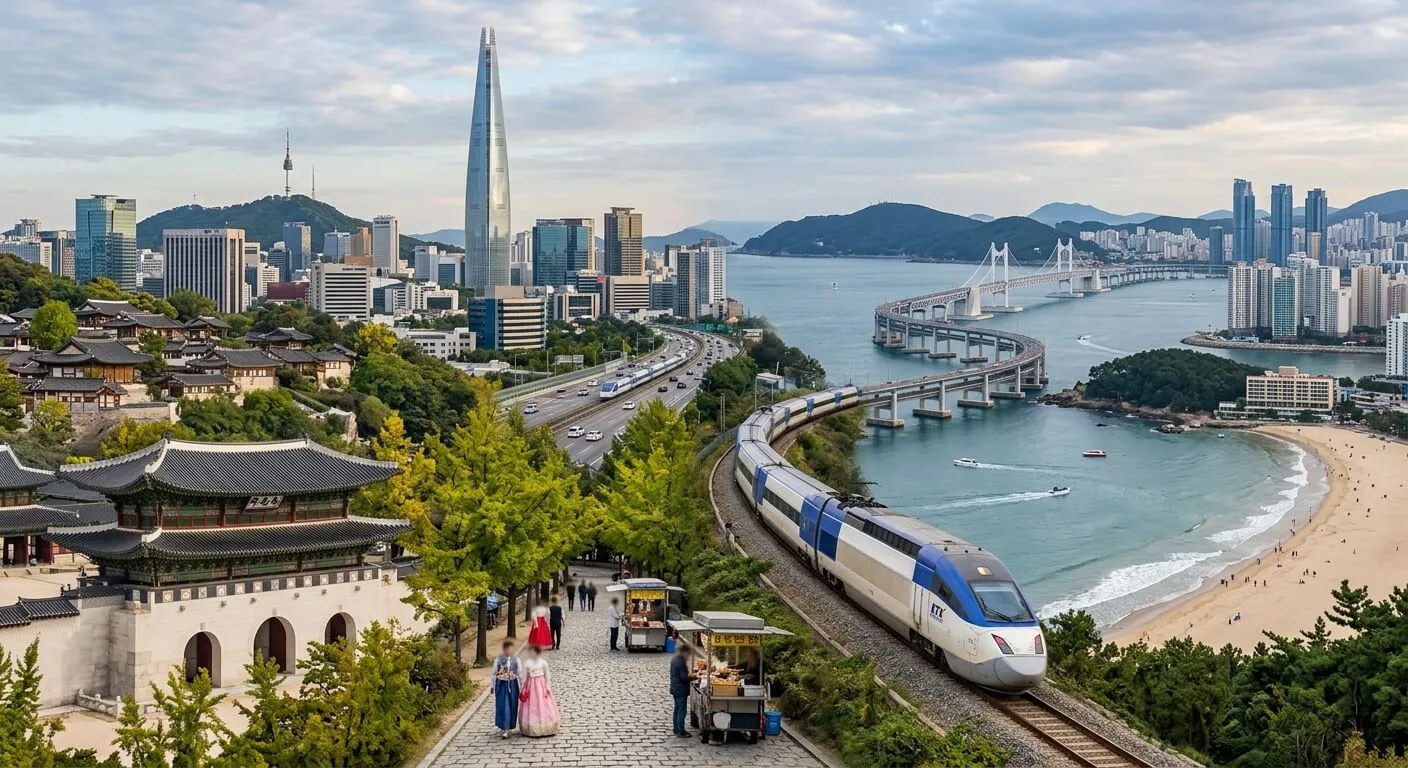

Planning a South Korea 10 day itinerary can feel difficult at first. South Korea has modern cities, royal palaces, beaches, temples, traditional markets, mountain views, and excellent food.
Ten days gives you enough time to see several highlights. However, trying to visit too many places can make your trip feel rushed.
For most first-time visitors, a route through Seoul, Gyeongju, and Busan offers the best balance. You get modern city life, Korean history, traditional culture, local food, and coastal scenery without changing hotels every night. Read our South Korea travel guide to plan the rest of your trip.
This guide shows you how to spend 10 days in South Korea. It also covers transportation, costs, accommodation, entry requirements, route options, and practical planning tips.
Is 10 Days Enough in South Korea?
Yes. Ten days is enough for a first trip to South Korea if you choose your route carefully.
You will not see the whole country. However, you can experience several very different sides of Korea.
For a balanced first trip, spend about:
- 4 days in Seoul
- 2 days in Gyeongju
- 3 days in Busan
- 1 day for arrival or departure travel
Travelers who prefer a slower pace can spend the entire trip between Seoul and Busan.
South Korea 10 Day Itinerary at a Glance
| Day | Base | Main Plan |
| Day 1 | Seoul | Arrival, Myeongdong, easy evening |
| Day 2 | Seoul | Gyeongbokgung, Bukchon, Insadong |
| Day 3 | Seoul | Markets, central Seoul, city views |
| Day 4 | Seoul | Hongdae, Gangnam, or a day trip |
| Day 5 | Gyeongju | Travel, Daereungwon, Cheomseongdae |
| Day 6 | Gyeongju | Bulguksa and Seokguram |
| Day 7 | Busan | Travel and Haeundae |
| Day 8 | Busan | Coastal Busan |
| Day 9 | Busan | Gamcheon, Jagalchi, Nampo |
| Day 10 | Seoul or Busan | Departure |
Which 10-Day South Korea Route Should You Choose?
There is no single route that works for every traveler.
Use your interests to decide where to spend your 10 days.
| What You Want Most | Best Route |
| First-time highlights | Seoul + Gyeongju + Busan |
| History and culture | Seoul + Gyeongju + Busan |
| Beaches and island scenery | Seoul + Busan + Jeju |
| Traditional culture and food | Seoul + Jeonju + Gyeongju |
| Shopping and nightlife | Longer Seoul + Busan |
| Fewer hotel changes | Seoul + Busan |
| Mountains and hiking | Seoul + Sokcho/Seoraksan + Busan |
| Most variety | Seoul + Gyeongju + Busan |
For most first-time visitors, Seoul → Gyeongju → Busan is the easiest route to recommend.
Does a 10-Day Korea Trip Mean 9 Nights or 10 Nights?
This guide assumes 10 calendar days.
You arrive on Day 1 and leave on Day 10. That normally gives you eight full sightseeing days.
If you have 10 complete sightseeing days, you can add another night in Seoul or Busan.
This difference matters when comparing itineraries online. Some travel plans count arrival and departure days, while others do not.
Day 1: Arrive in Seoul
Start your 10 days in South Korea in Seoul.
Most international travelers arrive through the Seoul area. Immigration, luggage collection, airport transport, and hotel check-in can take a large part of the day.
For this reason, keep Day 1 simple.
Check into your hotel and explore the neighborhood around you.
Myeongdong works well for a first evening. It has restaurants, shops, skincare stores, and convenient transport connections.
Try your first Korean meal. Korean barbecue, bibimbap, noodles, or fried chicken are all good choices.
Avoid filling your arrival day with major attractions. A relaxed first evening will make the rest of the trip easier.
Where to Stay in Seoul
Choosing the right neighborhood can save a lot of travel time.
Myeongdong
Myeongdong is a good choice for first-time visitors. It is central and well connected to other parts of Seoul.
It also has plenty of restaurants and shopping.
Insadong and Jongno
Stay here if palaces, traditional streets, temples, and historic Seoul are your main interests.
This area works especially well for Day 2 of this itinerary.
Hongdae
Hongdae is better for nightlife, cafés, shopping, and younger crowds.
It is a good choice for travelers who want active evenings.
Gangnam
Gangnam offers modern hotels, shopping, restaurants, and nightlife.
However, it is farther from many of Seoul’s major historic sights.
For this itinerary, Myeongdong or Jongno is usually the easiest base.
Day 2: Explore Historic Seoul
Use your second day to explore old Seoul.
Start at Gyeongbokgung Palace. Give yourself enough time to explore the palace grounds and learn about Korea’s royal history.
You may also see visitors wearing traditional Korean hanbok.
Next, walk toward Bukchon Hanok Village. This neighborhood is known for its traditional hanok homes.
Remember that Bukchon is also a residential area. Keep noise low and follow local signs.
Continue to Insadong in the afternoon.
Here, you can find tea houses, craft shops, galleries, traditional food, and small streets that are easy to explore on foot.
Finish the day around Jongno or Cheonggyecheon Stream.
This route works well because the main attractions are in the same general area.
Important Planning Tip for Historic Seoul
Check the day of the week before planning Day 2.
Gyeongbokgung Palace is normally closed on Tuesdays.
Bukchon Hanok Village also has visitor restrictions to protect local residents. Tourist access in the main controlled area is limited to daytime hours.
If Day 2 falls on a Tuesday or another restricted day, swap it with Day 3 or Day 4.
Always check the latest palace and Bukchon rules shortly before your visit.
Day 3: Markets and Modern Seoul
Start Day 3 at Gwangjang Market.
It is a good place to see a traditional market and try Korean food.
Visit earlier in the day if you want a calmer experience.
Afterward, explore central Seoul or spend time shopping in Myeongdong.
Later, visit N Seoul Tower or another city viewpoint.
In the evening, try another part of Seoul’s food scene.
You could have Korean barbecue, noodles, fried chicken, dumplings, or visit a smaller local restaurant.
Do not try to fit every famous Korean dish into one day. You still have plenty of meals ahead.
Day 4: Hongdae, Gangnam, or a Seoul Day Trip
Day 4 is your flexible Seoul day.
If you enjoy cafés, shopping, street life, and nightlife, spend more time in Hongdae.
If you want to see modern Seoul, explore Gangnam.
You could also use the day for a day trip.
Popular options include the DMZ or Suwon. However, do not add a day trip only because other itineraries include one.
If you have only four days in Seoul, staying in the city may give you more value.
How Many Days Should You Spend in Seoul?
Four days is a good amount for most first-time visitors.
It gives you time for palaces, markets, neighborhoods, shopping, restaurants, and modern city life.
If Seoul is the main reason for your trip, five or six days can also work.
Day 5: Travel From Seoul to Gyeongju
Check out of your hotel and travel south to Gyeongju.
The KTX journey from Seoul to Gyeongju takes a little over two hours on many services.
However, train time is not your full travel time.
You also need time to:
- Check out of your Seoul hotel
- Travel to Seoul Station
- Wait for your train
- Travel from Gyeongju Station
- Reach your hotel
- Check in
For this reason, keep the sightseeing plan lighter on Day 5.
After arriving, visit the Daereungwon Tomb Complex.
Its large grassy royal burial mounds are among Gyeongju’s most recognizable sights.
Add Cheomseongdae to Your Gyeongju Route
If you still have time, walk toward Cheomseongdae Observatory.
It is close to several major historic attractions, so you do not need another long transfer.
A practical sightseeing order is:
Daereungwon Tomb Complex → Cheomseongdae → historic center → Donggung Palace and Wolji Pond
Visit Donggung Palace and Wolji Pond in the evening if your schedule allows. The area is especially attractive after dark.
Why Visit Gyeongju?
Gyeongju gives this itinerary something Seoul and Busan cannot.
The city was an important center of the ancient Silla Kingdom.
Royal tombs, temples, old structures, and archaeological sites are spread across the area.
If Korean history interests you, Gyeongju deserves at least two days.
Day 6: Bulguksa Temple and Seokguram Grotto
Use Day 6 to explore some of Gyeongju’s most important heritage sites.
Start with Bulguksa Temple.
It is outside the main historic center, so allow enough time for transportation.
Next, visit Seokguram Grotto if your schedule and energy allow.
Return to central Gyeongju later in the day and visit any sites you missed.
Keep the evening relaxed.
After several busy days in Seoul, Gyeongju is a good place to slow down.
Day 7: Travel From Gyeongju to Busan
Continue south to Busan.
The KTX journey between Gyeongju and Busan can take around 30 to 40 minutes, depending on the train.
Again, add extra time for stations, hotel check-in, and local transportation.
Busan feels very different from Seoul.
It has beaches, seafood markets, hills, temples, modern districts, and coastal scenery.
After checking in, head toward Haeundae Beach.
Walk along the beach and explore nearby streets.
Keep your first Busan evening simple.
Where to Stay in Busan
Busan is large, so your hotel location matters.
Haeundae
Choose Haeundae for beaches, modern hotels, coastal attractions, and evening walks.
Nampo
Stay in Nampo for Jagalchi Market, BIFF Square, shopping, and older central Busan.
Seomyeon
Seomyeon is more central and works well for nightlife and transport connections.
For this itinerary, choose Haeundae if coastal scenery matters most.
Choose Nampo if markets and older Busan are your priority.
Day 8: Explore Coastal Busan
Avoid putting attractions from opposite sides of Busan on the same day.
The city is large, and travel between districts can take longer than expected.
Use Day 8 for the coastal side of Busan.
Start at Haedong Yonggungsa Temple.
Its seaside location makes it very different from many temples you may visit elsewhere in Korea.
Continue toward Haeundae.
Spend time around Haeundae Blue Line Park and enjoy the coastal scenery.
End your day around Gwangalli Beach.
The area becomes especially attractive in the evening when city and bridge lights appear across the water.
Grouping nearby sights together helps you spend less time on public transport.
Day 9: Gamcheon, Jagalchi, and Nampo
Use your final full sightseeing day for another side of Busan.
Start at Gamcheon Culture Village.
Its hillside streets and colorful buildings make it one of the city’s most recognizable neighborhoods.
Visit earlier in the day for a calmer experience.
Next, travel toward Jagalchi Market.
Explore the market and the streets around Nampo.
You can also visit BIFF Square and try local street food.
Keep your evening flexible.
If you have an early flight from Seoul the next day, consider returning to Seoul on Day 9.
Day 10: Departure or Return to Seoul
Your last day depends on your flight plan.
If you are flying from Seoul, leave plenty of time for the train journey, airport transfer, luggage, and check-in.
Do not book a tight connection between Busan and an international flight.
For an early flight, return to Seoul on Day 9.
If your flight leaves later, you may be able to travel from Busan on Day 10.
Should You Fly Into Seoul and Out of Busan?
Before booking a normal return ticket, compare a multi-city or open-jaw flight.
You could arrive through Seoul and depart from Busan.
This removes the need to travel back to Seoul at the end of your trip.
For a short 10-day itinerary, saving several hours of backtracking can be valuable.
This option does not work equally well from every U.S. city. Compare the total fare and connection times before booking.
How to Get Around South Korea
You do not need a rental car for this itinerary.
Use high-speed trains for longer journeys between major cities.
Inside Seoul and Busan, subways cover many popular areas. Local buses help with destinations farther from subway stations.
A transport card makes local travel easier.
Download Naver Map before arriving in South Korea. Kakao Map is another useful option.
Both can help with local addresses, public transportation, and route planning.
Always check current train times before your travel day.
Tmoney vs Climate Card vs WOWPASS
Different cards suit different types of travelers.
| Card | Best For |
| Tmoney | Multi-city travelers using public transport |
| Climate Card | Heavy subway and bus use in Seoul |
| WOWPASS | Travelers wanting payment and transit features |
For a route through Seoul, Gyeongju, and Busan, Tmoney is usually the simplest default choice.
The Climate Card is mainly useful during your Seoul stay.
Card prices, products, and coverage can change, so check the latest rules before buying.
Sample 10-Day South Korea Budget for US Travelers
The cost of 10 days in South Korea depends on your accommodation, food, activities, transport, and shopping.
The following is a rough planning range for one traveler. It does not include international airfare or major shopping.
| Expense | Budget | Mid-Range | Comfortable |
| Accommodation, 9 nights | $270–$540 | $720–$1,350 | $1,620–$2,700 |
| Food, 10 days | $200–$350 | $400–$700 | $800–$1,300 |
| Local + intercity transport | $100–$180 | $150–$250 | $250–$400 |
| Attractions and activities | $50–$120 | $120–$250 | $250–$500 |
| Mobile data/eSIM | $15–$40 | $20–$50 | $30–$60 |
| Estimated Total | $635–$1,230 | $1,410–$2,600 | $2,950–$4,960 |
Treat these as planning estimates, not fixed prices.
Accommodation can cost more during busy travel periods, festivals, holidays, and peak spring or autumn weekends.
International airfare from the United States can also make a large difference to your total budget.
Where to Stay During a 10-Day South Korea Itinerary
For a short trip, location often matters more than finding the cheapest hotel.
In Seoul, stay near a subway station and the areas you plan to visit most.
In Gyeongju, staying near the historic center makes evening sightseeing easier.
In Busan, choose your hotel based on the part of the city you want to explore most.
Try to avoid unnecessary hotel changes.
This itinerary uses only three main bases, which helps reduce packing and travel time.
What Should You Book Before Your South Korea Trip?
You do not need to reserve every activity months ahead.
However, some bookings are worth planning early.
Before the Trip
Book:
- International flights
- Main hotels
- Travel insurance if needed
Before Intercity Travel
Check:
- KTX train times
- Seat availability
- Your transfer between stations and hotels
Before Popular Activities
Reserve experiences that require fixed entry times or limited spaces.
Shortly Before Arrival
Check:
- Current entry requirements
- Arrival forms
- Airport transportation
- Mobile data or eSIM
- Transport card options
2026 Entry Update for US Travelers
As of August 2026, U.S. passport holders can visit South Korea for tourism or business for up to 90 days without a tourist visa.
The temporary K-ETA exemption for U.S. passport holders continues through December 31, 2026.
Under the rules currently published, K-ETA is scheduled to become necessary again from January 1, 2027, unless South Korea changes or extends the exemption.
K-ETA-exempt travelers may also need to complete Korea’s e-Arrival Card. The electronic form can be submitted shortly before arrival.
Entry policies can change.
Always confirm the current rules through official South Korean immigration information and U.S. government travel guidance before your flight.
Best Time for a 10-Day South Korea Itinerary
South Korea can be visited throughout the year.
Spring
Spring offers mild weather and flowers.
It is a popular season for palace grounds, parks, and outdoor sightseeing.
Summer
Summer can be hot and humid.
Start outdoor sightseeing earlier and add indoor breaks during the hottest part of the day.
Autumn
Autumn is excellent for walking, historic sites, parks, and mountain scenery.
It is also a good season for this Seoul, Gyeongju, and Busan route.
Winter
Winter can be cold, especially in Seoul and Gyeongju.
Add more cafés, markets, museums, shopping, and indoor attractions.
How This Itinerary Changes by Season
In spring, give yourself more time for parks, gardens, palace grounds, and outdoor neighborhoods.
In summer, avoid planning long outdoor walks during the hottest hours.
In autumn, consider adding nature or hiking if you have extra time.
In winter, reduce long outdoor sightseeing periods and add more indoor stops.
Should You Add Jeju to a 10-Day South Korea Itinerary?
You can visit Jeju during a 10-day trip, but it will change the pace.
Jeju is best for travelers who prioritize nature, volcanic landscapes, waterfalls, beaches, and island scenery.
However, adding Jeju usually means another flight, airport transfer, and hotel change.
For most first-time visitors, Seoul, Gyeongju, and Busan are easier to combine.
If Jeju is a major reason for your trip, consider replacing Gyeongju rather than trying to fit four major destinations into 10 days.
Alternative Stops for Different Travel Styles
The main route works well for first-time visitors, but you can replace one destination if another experience matters more.
Choose Andong for Traditional Korea
Consider Andong if traditional villages, Korean heritage, and Confucian history are major interests.
It can replace part of your Seoul or Busan time.
Choose Sokcho and Seoraksan for Nature
Choose Sokcho and Seoraksan National Park if mountains, hiking, and natural scenery are more important than city sightseeing.
This option is especially attractive in autumn.
Do not squeeze it into an already full route. Replace another stop instead.
Choose Jeju for Island Scenery
Choose Jeju if beaches, volcanic landscapes, waterfalls, and nature are your top priorities.
For a 10-day trip, replace another destination rather than adding Jeju as a fourth major base.
What Should You Skip If You Only Have 10 Days?
Trying to see too much is one of the easiest ways to make your trip stressful.
Skip Jeju if you do not want another flight.
Skip Gyeongju if temples, ancient history, and heritage sites are not important to you.
Skip a Seoul day trip if you only have three or four days in the capital.
Avoid adding a fourth or fifth city just because it appears close on a map.
Ten days gives you enough time for variety, but not enough time for everything.
If You Have More Than 10 Days in South Korea
Extra days give you much more flexibility.
If You Have 11 Days
Add one extra day to Seoul or Busan.
Choose Seoul for more neighborhoods, shopping, museums, or a day trip.
Choose Busan for a slower coastal day.
If You Have 12 Days
Consider adding one or two nights in:
- Andong
- Jeonju
- Sokcho
- Seoraksan
Choose based on your interests.
If You Have 13–14 Days
A two-week trip gives you enough time to consider adding Jeju Island.
A good longer route could be:
Seoul → Gyeongju → Busan → Jeju
You could also skip Jeju and spend more time exploring mainland Korea.
South Korea 10 Day Route Map
The basic route is simple:
Seoul → Gyeongju → Busan
Seoul gives you royal history, markets, shopping, food, nightlife, and modern Korean culture.
Gyeongju adds temples, ancient history, royal tombs, and heritage sites.
Busan finishes the trip with beaches, seafood, coastal scenery, markets, and seaside temples.
Moving mainly in one direction also reduces unnecessary backtracking.
Common Mistakes When Planning 10 Days in South Korea
One common mistake is changing hotels too often.
Another is planning attractions without checking where they are.
This matters especially in Busan, where popular sights can be far apart.
Travelers also sometimes treat train time as the full travel time.
Remember to include hotel checkout, station transfers, waiting, local transportation, and check-in.
Finally, do not plan every hour.
Leave time for cafés, food, shopping, rest, and unexpected discoveries.
South Korea 10 Day Itinerary FAQs
Is 10 days enough for South Korea?
Yes. Ten days is enough for a first visit if you focus on two or three main destinations. Seoul, Gyeongju, and Busan provide a good mix of city life, history, culture, food, and coastal scenery.
What is the best 10-day South Korea route for first-time visitors?
For most first-time travelers, the best route is Seoul → Gyeongju → Busan. It offers variety without requiring too many flights or hotel changes.
How many days should I spend in Seoul?
Four days is a good starting point. This gives you enough time for palaces, markets, neighborhoods, shopping, food, and modern Seoul.
How many days should I spend in Busan?
Two to three full days work well. Busan is large, so group attractions by area instead of traveling from one side of the city to the other several times per day.
Is Gyeongju worth visiting?
Yes, especially if Korean history interests you. Gyeongju has royal tombs, temples, ancient sites, and strong links to the Silla Kingdom.
Should I visit Jeju during a 10-day Korea trip?
Choose Jeju if nature and island scenery are top priorities. Otherwise, Seoul, Gyeongju, and Busan offer an easier first-time route.
Can I travel around South Korea without a car?
Yes. This entire itinerary can be completed using trains, buses, subways, and occasional taxis.
Is Seoul or Busan better for first-time visitors?
Spend more time in Seoul on a first trip because it has more major attractions and neighborhoods. Busan adds beaches, seafood, coastal views, and a different city atmosphere.
How much does 10 days in South Korea cost?
A budget traveler may spend roughly $635 to $1,230 before international flights. A mid-range trip may cost around $1,410 to $2,600, while a more comfortable trip can cost considerably more.
Do US travelers need a visa for South Korea?
As of August 2026, U.S. passport holders can visit South Korea for up to 90 days for tourism without a tourist visa. Current K-ETA exemptions and arrival requirements should still be checked before travel because policies can change.
Final Thoughts
A good South Korea 10 day itinerary should give you variety without making you rush.
For most first-time visitors, Seoul, Gyeongju, and Busan are a strong combination.
Seoul gives you palaces, markets, shopping, food, nightlife, and modern Korean culture.
Gyeongju adds ancient history, temples, royal tombs, and heritage sites.
Busan finishes the trip with beaches, markets, seafood, temples, and coastal scenery.
More importantly, this route keeps your trip manageable.
You use only three main bases and spend several nights in each place. That means less time packing and more time enjoying South Korea.
Use this itinerary as your starting point. Then adjust it around your interests, season, flight times, and preferred travel pace.

1 Comment
Pingback: South Korea 7 Day Itinerary: Seoul & Busan Guide