
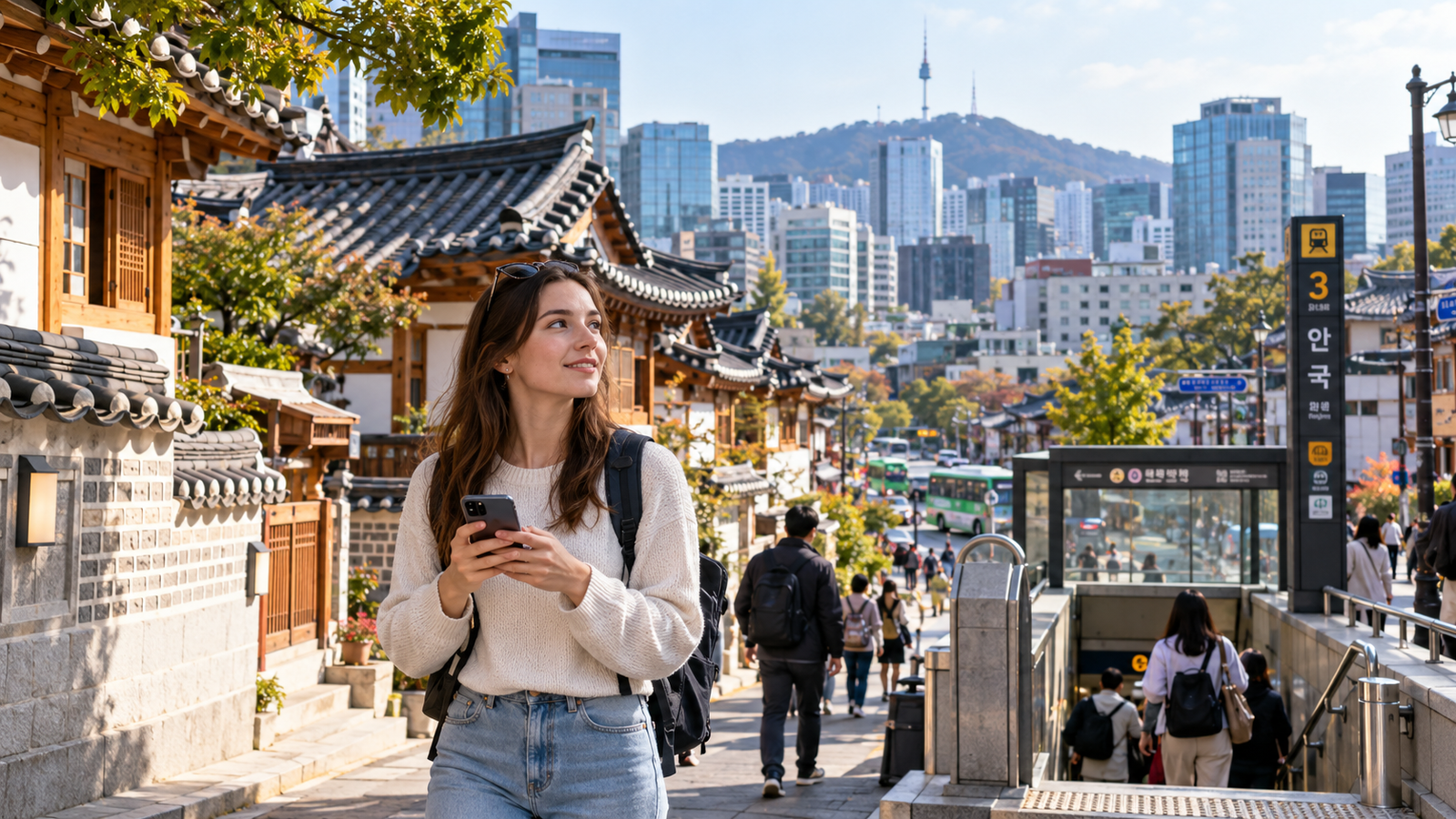

South Korea is easy to travel around once you understand how things work. However, your first visit can still bring a few surprises.
Google Maps may not work the way you expect. Some transport cards need cash to recharge. Korean restaurants also have their own customs. In addition, entry rules and travel systems can change.
South Korea Travel: Quick Takeaways
- Check your K-ETA and entry requirements before flying.
- Download Naver Map and Papago before arrival.
- Keep some Korean won for T-money and small purchases.
- Bring a backup credit or debit card.
- Save your hotel name and address in Korean.
- Get an eSIM, SIM card, or portable Wi-Fi.
- Check the last subway before staying out late.
- Tipping is generally not expected.
- Book popular trains and attractions early.
- Save 112, 119, and 1330 for emergencies.
These are some of the most important things to know before visiting South Korea in 2026.
This guide covers entry rules, money, transport, apps, food, culture, safety, and other practical South Korea travel tips.
It is especially useful if this is your first trip to South Korea.
Planning Your First Trip to South Korea?
Start with our complete South Korea travel guide for practical advice on when to visit, how long to stay, costs, destinations, transport and trip planning.
Explore the South Korea Travel Guide →How to Plan a Trip to South Korea
Start planning your South Korea trip a few months before you travel.
First, decide how many days you have. Then choose the cities you want to visit.
Seoul is the main starting point for many international visitors. However, Busan, Gyeongju, Jeju Island, and other parts of South Korea are also worth considering.
Your travel style will affect your plan.
For example, a Seoul-only trip is very different from a trip across several Korean cities.
Before booking everything, check:
- Entry requirements
- Flight prices
- Hotel locations
- Korean holidays
- Weather
- Train routes
- Airport transport
- Mobile internet options
- Travel insurance
It is also smart to download important Korean travel apps before your flight.
What U.S. Travelers Should Know Before Visiting South Korea
U.S. passport holders can generally enter South Korea without a tourist visa for short tourism visits.
However, entry rules depend on your passport, travel purpose, and length of stay.
South Korea has extended its temporary K-ETA exemption for eligible countries through December 31, 2026. Travelers covered by the exemption do not need to apply for K-ETA during that period.
Entry rules can change.
Therefore, check the official Korean immigration or K-ETA website shortly before your flight.
Keep these details easy to access:
- Passport
- Flight information
- Accommodation address
- Return or onward ticket details
- Travel insurance information
- Required entry documents
Do not assume that U.S. residency gives you the same entry rules as a U.S. passport. Entry requirements are normally based on your nationality and passport.
Before You Fly to South Korea
| Task | Done? |
|---|---|
| Check visa and K-ETA requirements | ☐ |
| Complete e-Arrival Card if required | ☐ |
| Check passport validity | ☐ |
| Save hotel address in Korean | ☐ |
| Install Naver Map | ☐ |
| Install Papago | ☐ |
| Arrange eSIM, SIM, or Wi-Fi | ☐ |
| Bring a backup payment card | ☐ |
| Plan Incheon Airport transport | ☐ |
| Check major Korean holidays | ☐ |
| Save travel insurance details | ☐ |
Complete Your Arrival Requirements Before You Fly
South Korea uses an electronic arrival declaration system for travelers who are required to submit an arrival card.
The official e-Arrival Card is free.
It can be completed online starting three days before you arrive in South Korea.
You will normally need information such as:
- Passport details
- Arrival information
- Departure information
- Accommodation details
- Contact information
Travelers with a valid K-ETA are exempt from submitting the arrival card.
Be careful with fake websites.
The Korean government warns that the official e-Arrival Card does not require payment. Any website asking you to pay for the official arrival declaration should be treated with caution.
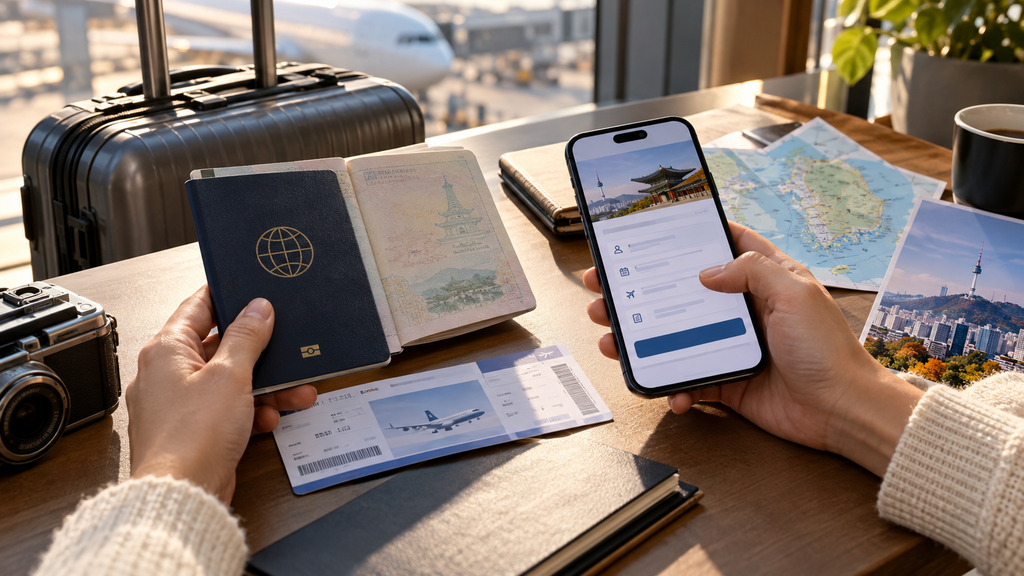
Consider Travel Insurance Before Your Trip
Travel insurance is worth considering before visiting South Korea.
A good policy may cover:
- Emergency medical treatment
- Trip cancellation
- Lost luggage
- Flight delays
- Travel disruption
- Some outdoor activities
Check the policy carefully before buying it.
If you plan to ski, hike, drive, or take part in adventure activities, make sure those activities are covered.
Keep a digital copy of your insurance details on your phone.
Choose the Best Time to Visit South Korea
South Korea has four clear seasons.
Spring and autumn are two of the most popular times to visit.
Spring usually brings mild temperatures and cherry blossoms. However, blossom dates change from year to year.
Autumn brings cooler weather and colorful leaves. It is also a good season for walking and hiking.
Summer can be hot, humid, and rainy.
Winter can become very cold, especially in Seoul and northern parts of the country.
The best time to visit depends on what you want to do.
Pack for the season instead of assuming Korea has mild weather throughout the year.
For a full month-by-month breakdown, see our best time to visit South Korea guide .
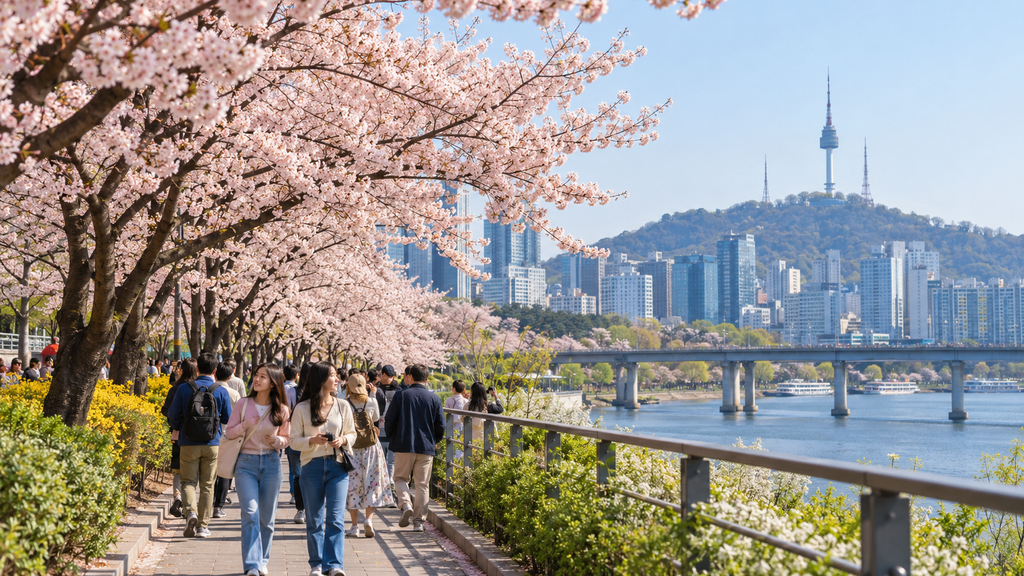
Be Ready for Korea’s Summer Rainy Season
South Korea can receive heavy rain during summer.
This may affect outdoor attractions, hiking, transport, and sightseeing plans.
If you visit during the rainy season:
- Check the weather every morning
- Carry a small umbrella
- Wear suitable shoes
- Protect electronics
- Keep some indoor activities as backup options
A flexible itinerary is useful during wet weather.
Mind Major Korean Holidays
Large Korean holidays can affect your travel plans.
Two important holidays are Seollal, the Korean Lunar New Year, and Chuseok, the Korean harvest holiday.
Many Koreans travel to visit family during these periods.
As a result, trains and intercity buses can become busy.
Road traffic may also increase.
Some businesses may close or change their opening hours.
If your trip falls near a major holiday, book long-distance transport early.
You should also check the opening hours of restaurants, attractions, and shops.
Booking Your Flights
Many international visitors arrive through Incheon International Airport near Seoul.
Compare more than the ticket price when booking your flight.
Look at:
- Arrival time
- Baggage allowance
- Airport
- Layover time
- Cancellation rules
- Transport from the airport
A cheap flight may arrive very late at night.
That could make reaching your hotel more difficult.
Therefore, check airport transport before choosing your flight.
Also remember that South Korea uses Korea Standard Time.
Jet lag can affect your first day, especially if you are flying from the United States.
Try not to fill your arrival day with too many activities.
Know Your Accommodation Options
South Korea has accommodation for many travel budgets.
You can find:
- Hotels
- Hostels
- Guesthouses
- Apartments
- Hanok stays
- Resorts
Location matters more than many first-time visitors expect.
In Seoul, staying close to a subway station can save a lot of time.
The city is large, and major attractions are spread across different areas.
Before booking, check the nearest subway station and walking distance.
Also save your accommodation’s:
- English name
- Korean name
- Korean address
- Telephone number
This can help when using a taxi or asking for directions.
How Long Should You Stay in South Korea?
There is no perfect trip length for everyone.
However, seven to ten days gives many first-time visitors enough time to explore more than one place.
A short trip may focus mainly on Seoul.
With more time, you can add places such as Busan, Gyeongju, or Jeju Island.
Try not to change hotels every day.
Travel days take time.
Packing, checking out, using trains, and checking in again can use several hours.
A slower itinerary often gives you a better experience.
Still deciding between one week and a longer trip? Our guide to how many days you need in South Korea compares 5, 7, 10 and 14-day trips.
Choose the Right Trip Length
Budget for a Trip to South Korea
South Korea can work for different travel budgets.
Your main costs may include:
- Flights
- Hotels
- Food
- Public transport
- Attractions
- Shopping
- Mobile internet
Public transport can help keep costs under control.
Food prices also vary.
You can eat at many local restaurants for reasonable prices. However, cafés, nightlife, premium restaurants, and imported products can raise your spending.
Shopping can also become a large expense if you plan to buy Korean skincare, fashion, or souvenirs.
Set separate budgets for basic travel costs and optional shopping.
For accommodation, food, transport and activity estimates, see our complete South Korea trip cost guide .
What to Expect on a Medium Budget
A medium-budget traveler may choose a comfortable hotel, use public transport, eat at regular restaurants, visit paid attractions, and enjoy cafés or shopping.
However, your total cost will depend on your travel season and destinations.
Seoul may cost more than smaller cities.
Instead of depending on one fixed daily number, calculate your budget based on your hotel, food, transport, and activity choices.
Plan the Timing and Budget
Stay Connected With Essential South Korea Travel Apps
Essential Apps for South Korea Travel
| App | Use it for |
|---|---|
| Naver Map | Navigation and public transport |
| KakaoMap | Alternative local navigation |
| Papago | Korean-English translation |
| Kakao T | Booking taxis |
| Korail | Train information and trip planning |
Your phone can make traveling around South Korea much easier.
Install your important apps before your trip.
Useful apps include:
- Naver Map
- KakaoMap
- Papago
- Kakao T
- Korail
- Tourist-friendly taxi apps
Naver Map and KakaoMap are useful for local navigation.
Papago can help with Korean translation.
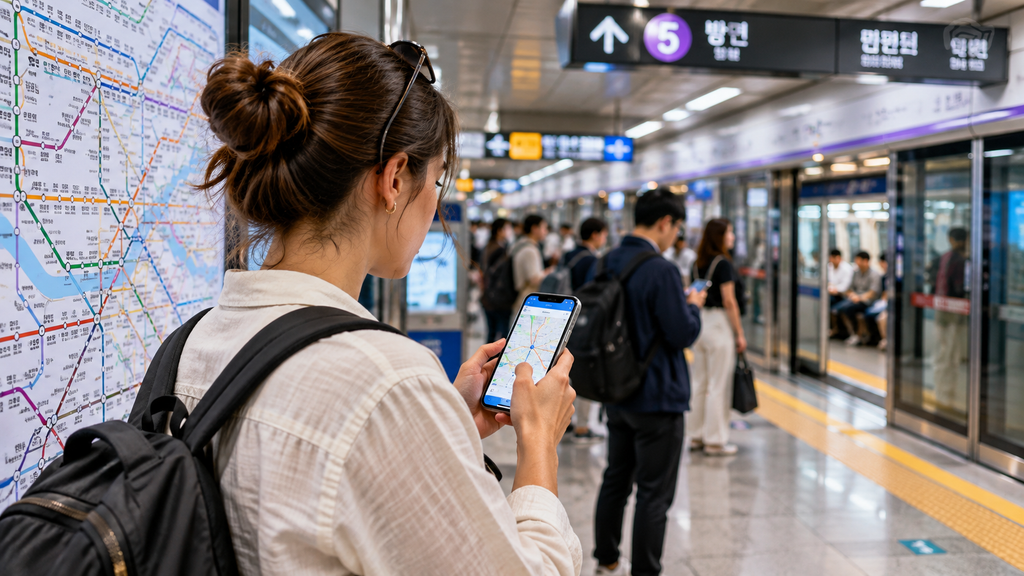
Kakao T can help with taxis.
Korail can help when checking train information.
Some tourist-focused taxi services also support international travelers.
Download important information before leaving your hotel whenever possible.
This gives you a backup if your mobile internet stops working.
Google Maps Works Differently in South Korea
Do not depend only on Google Maps during your trip.
Google Maps can still help with some searches. However, Naver Map and KakaoMap are often more useful for local routes and public transport.
Before leaving your hotel, check:
- Subway route
- Exit number
- Walking route
- Travel time
- Last train time
Exit numbers are especially important.
Large Korean subway stations may have many exits.
Using the wrong exit can add a long walk to your journey.
Save important places in your map app before starting your day.
Get Mobile Data When You Arrive
Reliable internet is useful in South Korea.
You may need it for:
- Maps
- Translation
- Taxi apps
- Train information
- Restaurant reservations
- Messaging
Travelers can choose between:
- eSIM
- Local SIM card
- Portable Wi-Fi
An eSIM can be simple if your phone supports it.
Portable Wi-Fi may be useful for groups sharing one connection.
Choose the option that best matches your phone, travel style, and trip length.
Keep Your Hotel Address in Korean
Save your hotel details before leaving the airport.
Keep:
- Hotel name in English
- Hotel name in Korean
- Korean address
- Telephone number
This is useful if you need to show your destination to a taxi driver or ask someone for help.
Take a screenshot as well.
That way, you can access the address even without internet.
Carry Some Korean Won
South Korea is very card-friendly.
However, you should still carry some cash.
Cash can be useful for:
- Transport card top-ups
- Traditional markets
- Some small shops
- Emergency backup
You do not need to carry your entire travel budget in cash.
Keep a reasonable amount for daily use.
Get a T-money Card for Public Transport
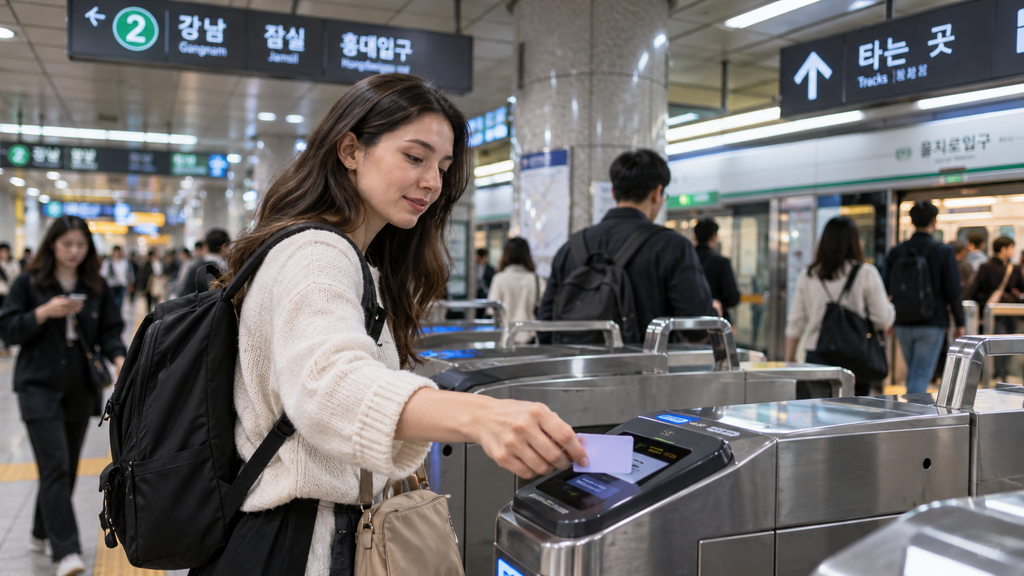
A T-money card is one of the easiest ways to use buses and subways in South Korea.
It can be used across many public transport systems.
You can buy T-money cards at convenience stores and transport locations.
One important point for foreign visitors is that you should keep Korean won available for purchasing and recharging standard transport cards.
When using buses, remember to tap your card when getting on and getting off.
This can be important for correct fares and transfers.
T-money vs WOWPASS vs Climate Card
| Card | Best for | Transport | Payments | Good for tourists? |
|---|---|---|---|---|
| T-money | Most first-time visitors | Yes | Limited | Yes |
| WOWPASS | Transport + prepaid spending | Yes | Yes | Yes |
| Climate Card | Heavy Seoul public transport use | Yes, on eligible Seoul services | No | Yes, for Seoul-focused trips |
T-money is a simple choice for many first-time visitors.
WOWPASS combines travel and prepaid payment features.
The Climate Card Short-Term Pass may be useful if you plan to use Seoul public transport many times.
As of October 1, 2026, the former 30-day Climate Card options have been discontinued. Short-term passes of one to seven days remain available.
Choose a card based on your actual itinerary rather than buying every tourist card available.
Your First Hour in South Korea
Activate your eSIM, SIM card, or portable Wi-Fi.
Keep cash available for T-money top-ups and small purchases.
Buy or prepare your T-money card or another suitable transport option.
Check your airport-to-hotel route and save the destination.
Use AREX, an airport bus, or a taxi based on your hotel location.
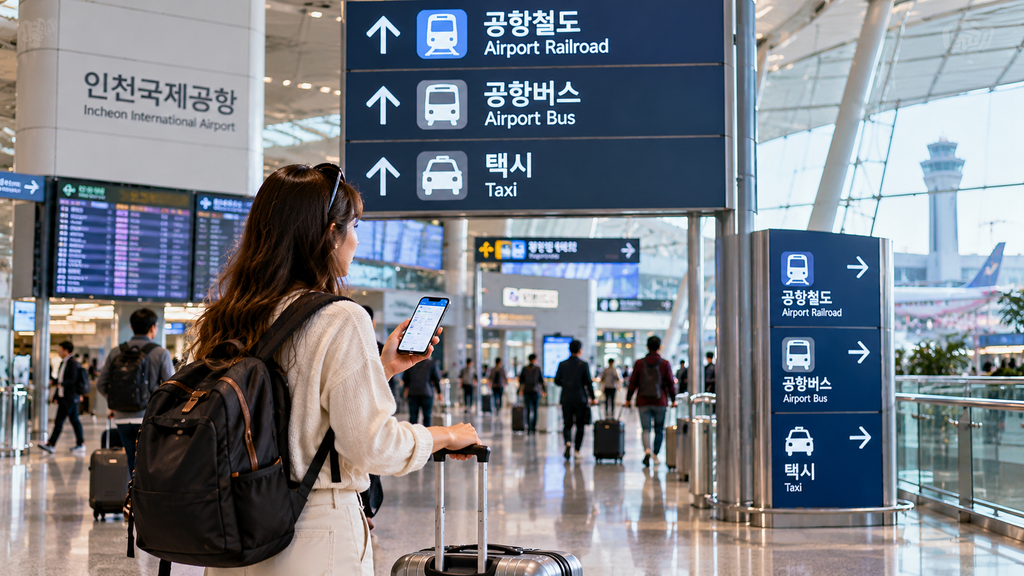
Plan Your Route From Incheon Airport
Do not automatically assume the same airport transport option is best for everyone.
Depending on your hotel, you may use:
- AREX Express
- Airport Railroad regular service
- Airport limousine bus
- Taxi
Check where your hotel is located before buying a ticket.
Sometimes a bus may take you closer to your hotel than the train.
If you have heavy luggage, the easiest option may also be different from the cheapest one.
Take Advantage of South Korea’s Public Transportation
Public transport is one of the easiest ways to travel around South Korea.
Seoul has a large subway and bus network.
Other major cities also have good public transportation.
A transport card makes everyday travel easier.
Always check the last train if you plan to stay out late.
Subway services do not run all night.
Check the Last Subway Before Going Out at Night
Do not assume Seoul’s subway runs 24 hours a day.
Before going to a bar, restaurant, concert, or night market, check:
- Last subway
- Last bus
- Taxi availability
- Distance to your hotel
If public transport has stopped, you may need a taxi or night bus.
Plan your return journey before your evening begins.
Traveling Between Korean Cities
South Korea has several ways to travel between cities.
Your main options include:
- High-speed trains
- Regular trains
- Intercity buses
- Domestic flights
- Rental cars
For many first-time visitors, trains and buses are enough.
A rental car may be useful in some rural areas.
However, driving in major cities can add unnecessary stress.
Booking Train Tickets in South Korea
South Korea’s train network makes traveling between major cities easy.
High-speed KTX trains connect many popular destinations.
Busy routes can sell out during weekends, holidays, and peak travel periods.
Book early if your dates are fixed.
Always check:
- Departure station
- Arrival station
- Train type
- Departure time
- Seat
- Travel date
Some cities have more than one main station.
Confirm the correct station before paying.
KORAIL Pass
A KORAIL Pass may suit some international visitors who plan several train trips.
However, it does not automatically save money.
Compare the pass price with the cost of the individual trips you plan to take.
If you only need one or two train journeys, single tickets may make more sense.
Renting a Car in South Korea
You usually do not need a rental car in Seoul.
Public transport is much easier.
A car can be helpful for rural destinations or certain road trips.
Before renting a car, check:
- International Driving Permit requirements
- Minimum age
- Passport requirements
- Home-country driver’s license
- Insurance
- Parking
- Toll roads
- Navigation
Rental-company requirements can differ.
Confirm the exact documents before arriving at the rental desk.
Best Payment Setup for South Korea
Do not rely on only one card while traveling in South Korea.
1 main card + 1 backup card + Korean won + T-money
Foreign cards work in many places, but some Korean apps, websites, kiosks, and local payment systems may not accept international cards.
Your U.S. Credit Card May Not Work Everywhere
Foreign credit cards work at many hotels, shops, restaurants, and other businesses in South Korea.
However, this does not mean they will work with every Korean website or app.
Some Korean booking and waiting systems may require a Korean phone number or may not support international cards.
This is a real issue with some restaurant reservation systems. VISITKOREA notes that some local services require Korean phone registration or do not accept foreign-issued credit cards.
Therefore, do not travel with only one payment method.
A simple backup setup is:
- Main credit card
- Backup card
- Korean won
- Transport card
Keep your physical card with you as well.
Do not depend only on mobile payments.
Tourist Tax Refunds
Foreign visitors may qualify for tax refunds on some eligible purchases in South Korea.
Some stores offer an immediate refund.
Other purchases may use a different refund process.
If you plan to claim a refund, keep:
- Passport
- Receipts
- Eligible goods
- Refund documents
Look for Tax Refund or Tax Free signs when shopping.
Do not throw away receipts until you know you will not need them.
Book Popular Attractions in Advance
Some popular attractions and experiences can sell out.
This is more common on weekends, holidays, and during busy travel seasons.
Activities that may need advance planning can include:
- Popular palace tours
- Changdeokgung Secret Garden
- Hanbok rentals
- Busan Sky Capsule
- Special exhibitions
- Popular guided tours
Check the official attraction website before your travel day.
Reservation rules and opening days can change.
Is Seoul English Friendly?
You can travel around Seoul without speaking fluent Korean.
Many transport signs include English.
Major hotels and tourist attractions may also provide English information.
However, English is not spoken everywhere.
Smaller restaurants, traditional markets, and areas outside major tourist zones may have less English support.
A translation app can help.
Learning a few basic Korean words can also make everyday situations easier.
Learn a Few Korean Words and Basic Hangul
You do not need to become fluent in Korean before your trip.
However, learning a little Hangul can be useful.
Hangul is the Korean writing system.
Even basic knowledge may help you recognize station names, restaurant signs, and addresses.
Useful phrases include:
- Hello
- Thank you
- Yes
- No
- Excuse me
- How much?
- Where is this?
A small amount of Korean can make your trip easier.
Understand Basic Korean Etiquette
Korean culture has social customs that may feel different from what you know at home.
You do not need to understand every rule.
Knowing a few basics is enough.
Greetings
A small bow is a common polite greeting.
Visitors do not need to make it complicated.
A friendly greeting and respectful tone are usually enough.
Giving and Receiving Things
Using two hands when giving or receiving something can show respect.
You may notice this when paying or exchanging an item.
Foreign visitors are not expected to understand every social rule.
Still, following the custom is polite.
Drinking Manners
Korean drinking culture has several traditions.
People may pour drinks for one another.
Age and social position can also affect traditional drinking etiquette.
You do not have to drink alcohol.
It is fine to decline.
Eating Manners
Many Korean meals include shared dishes.
Side dishes may be placed in the middle of the table.
Some restaurants use call buttons, kiosks, or tablets for ordering.
Watch how the restaurant works before assuming the service is the same as at home.
Removing Shoes
You may need to remove your shoes before entering some:
- Homes
- Guesthouses
- Traditional restaurants
- Cultural spaces
Look near the entrance.
If everyone else has removed their shoes, you should probably do the same.
Some Questions May Feel Personal
Some questions that feel personal in the United States may be more common in Korean conversation.
Someone may ask about your:
- Age
- Job
- Relationship status
- Country
- Family
These questions can sometimes help people understand social relationships.
You do not have to answer anything that makes you uncomfortable.
Wear Comfortable Shoes
South Korea has a strong fashion culture.
You will see many clothing styles, especially in Seoul.
However, comfort matters when sightseeing.
You may walk much more than expected.
Subway stations can be large.
Transfers can involve long walks.
Some neighborhoods are also hilly.
Comfortable shoes can make a major difference.
Be Flexible if You Have Dietary Restrictions
Korean food is one of the highlights of visiting South Korea.
However, travelers with strict diets should plan ahead.
Vegetarian or vegan food can be harder to identify because meat, fish, or seafood ingredients may appear in:
- Broths
- Sauces
- Side dishes
- Seasonings
Travelers with allergies should be especially careful.
Keep your dietary restrictions written in Korean on your phone.
Do not depend only on an English menu.
Research suitable restaurants before you travel.
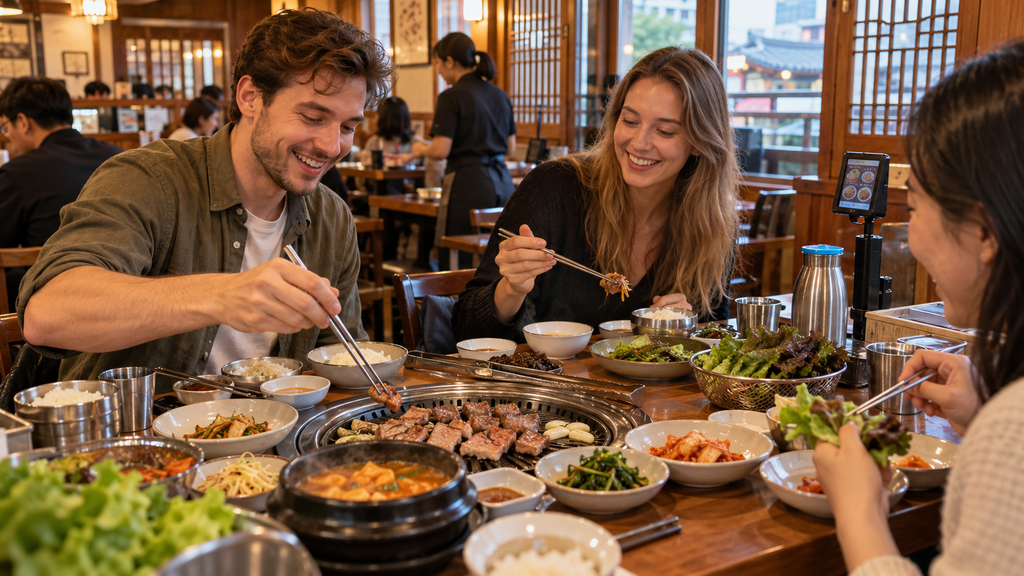
Korean Restaurant Service Works Differently
Restaurant service in South Korea may feel different from service in the United States.
Servers may not visit your table repeatedly.
Some restaurants have a call button.
Others use kiosks or tablets.
You may also pay at the front counter when leaving rather than asking for a bill at the table.
Water and some side dishes may be self-service.
VISITKOREA notes that self-service water and side dishes are common in some restaurants.
The system is simply different.
Tipping Is Not Expected in South Korea
Tipping is generally not required or expected in South Korea.
You usually do not need to leave the standard 15% or 20% tip that is common in the United States.
VISITKOREA states that tipping is not required or expected in Korean restaurants.
In most situations, simply pay the listed price.
This is one of the useful differences for American travelers to know before arriving.
Some Korean Restaurants Are Harder for Solo Travelers
Solo dining is possible in South Korea.
Many casual restaurants are easy to visit alone.
However, some Korean barbecue restaurants and restaurants built around shared meals may expect you to order more than one portion.
Solo-friendly options often include:
- Kimbap restaurants
- Noodle shops
- Rice-bowl restaurants
- Food courts
- Counter-style restaurants
Check recent reviews if you want to visit a Korean barbecue restaurant alone.
Restaurant reservation apps designed for international travelers can also make planning easier.
Get to Know Korean Drinking Culture
Alcohol is part of many social occasions in South Korea.
Soju and beer are common.
However, drinking is always your choice.
If you drink, know your limit.
Also remember to check your last subway before starting a late night.
Once public transport stops, you may need a taxi or night bus.
Public Trash Bins Can Be Hard to Find
One small surprise for some first-time visitors is that public trash bins are not always easy to find.
You may finish a drink or snack and need to carry the empty container for a while.
Keep a small bag in your backpack for temporary trash.
Subway stations, shopping centers, convenience stores, and some public areas may have bins.
Pay attention to recycling labels when different waste types are separated.
Monitor the Air Quality
Air quality can change during your trip.
Some days may have higher levels of fine dust.
Check the local air-quality forecast if you plan long outdoor activities.
This is especially useful for:
- Hiking
- Cycling
- Long walking tours
- Outdoor sightseeing
If air quality is poor, consider moving some activities indoors.
People who are sensitive to pollution may also choose to carry a suitable mask.
Is North Korea a Concern?
Many first-time visitors think about South Korea’s relationship with North Korea.
Daily life in Seoul, Busan, and other parts of South Korea usually continues normally.
However, political and security conditions can change.
Check your government’s latest travel advice before your trip.
Also pay attention to local emergency alerts.
Do not treat emergency messages as tourist entertainment.
Follow official instructions when necessary.
South Korea Is Generally Safe, but Use Normal Precautions
South Korea is generally easy for tourists to navigate.
However, normal travel precautions still matter.
Keep track of your:
- Passport
- Phone
- Wallet
- Cards
- Luggage
Be careful in crowded nightlife districts and transport areas.
Also watch for fake travel websites and unofficial booking services.
For example, the Korean government has warned travelers about fake e-Arrival Card websites. The official e-Arrival Card is free.
Save Important Emergency Numbers
Save important Korean emergency numbers before your trip.
112
Call 112 for police.
119
Call 119 for fire or medical emergencies.
1330 Korea Travel Helpline
The 1330 Korea Travel Helpline provides travel information and assistance for international visitors.
VISITKOREA lists 112 for police, 119 for fire and medical emergencies, and 1330 for tourist help.
Save these numbers on your phone.
Also keep your hotel’s contact information somewhere you can access without internet.
Quick South Korea First-Time Visitor Checklist
Before leaving for South Korea, make sure you have:
- Checked your visa and K-ETA requirements
- Checked whether you need an e-Arrival Card
- Saved your hotel address in Korean
- Bought travel insurance if needed
- Installed Naver Map
- Installed Papago
- Installed your preferred taxi app
- Planned your mobile data
- Brought more than one payment card
- Planned to carry some Korean won
- Checked transport from Incheon Airport
- Checked major Korean holidays
- Checked the weather
- Booked important trains and attractions
- Saved 112, 119, and 1330
A few minutes of preparation can prevent many common problems after you arrive.
Frequently Asked Questions About Visiting South Korea
Do Americans need a visa to visit South Korea?
U.S. passport holders can generally visit South Korea without a tourist visa for short stays.
Always check the latest official entry rules before departure because requirements can change.
Do Americans need K-ETA in 2026?
Eligible travelers, including travelers from countries covered by South Korea’s temporary exemption, are exempt from K-ETA through December 31, 2026.
Check the official K-ETA website before your flight to confirm the rule that applies to your passport.
Do I need an e-Arrival Card for South Korea?
It depends on your immigration status and entry documents.
Travelers who are required to submit an arrival declaration can use South Korea’s free e-Arrival Card.
It can be completed starting three days before arrival. Travelers with a valid K-ETA are exempt from submitting an arrival card.
Do I need cash in South Korea?
Yes.
Cards are widely used, but cash is still useful for transport card top-ups, traditional markets, small purchases, and emergencies.
Do not depend on one payment method.
Does Google Maps work in South Korea?
Google Maps can be useful for some searches.
However, Naver Map and KakaoMap are usually more useful for local navigation and public transport.
It is a good idea to install at least one of them before arriving.
Can I use my U.S. credit card in South Korea?
Foreign cards work at many Korean businesses.
However, some Korean websites, apps, and reservation platforms may require a local phone number or may not accept international cards.
Bring a backup card and some cash.
Is tipping expected in South Korea?
No.
Tipping is generally not required or expected in South Korea.
You normally pay the amount shown on the bill.
Do I need a T-money card?
You do not have to buy one.
However, a T-money card makes using buses and subways much easier for many tourists.
Can I visit South Korea without speaking Korean?
Yes.
Many tourist areas and transport systems provide English information.
Apps such as Papago can also help with translation.
Still, learning a few Korean words can make your trip easier.
What apps should I download before visiting South Korea?
Useful apps include Naver Map, KakaoMap, Papago, Kakao T, and train or taxi apps that match your itinerary.
Download them before your flight so you do not have to set everything up after landing.
Is South Korea good for first-time international travelers?
South Korea has modern transport, large cities, tourist infrastructure, and many services for international visitors.
However, first-time travelers should prepare for differences in navigation, payment systems, restaurant service, transport cards, and local apps.
Knowing these details before you arrive makes the trip much easier.
Final Thoughts
South Korea is not difficult to visit, but a little preparation goes a long way.
The most important things to know before visiting South Korea are practical.
Check your entry requirements. Set up mobile data. Download local map apps. Carry more than one payment method. Learn how transport works. Save your hotel address in Korean. Understand a few local customs.
Most importantly, check official information again shortly before you travel.
Rules, transport systems, prices, and tourist services can change.
Once the basics are ready, you can spend less time solving problems and more time enjoying South Korea.