
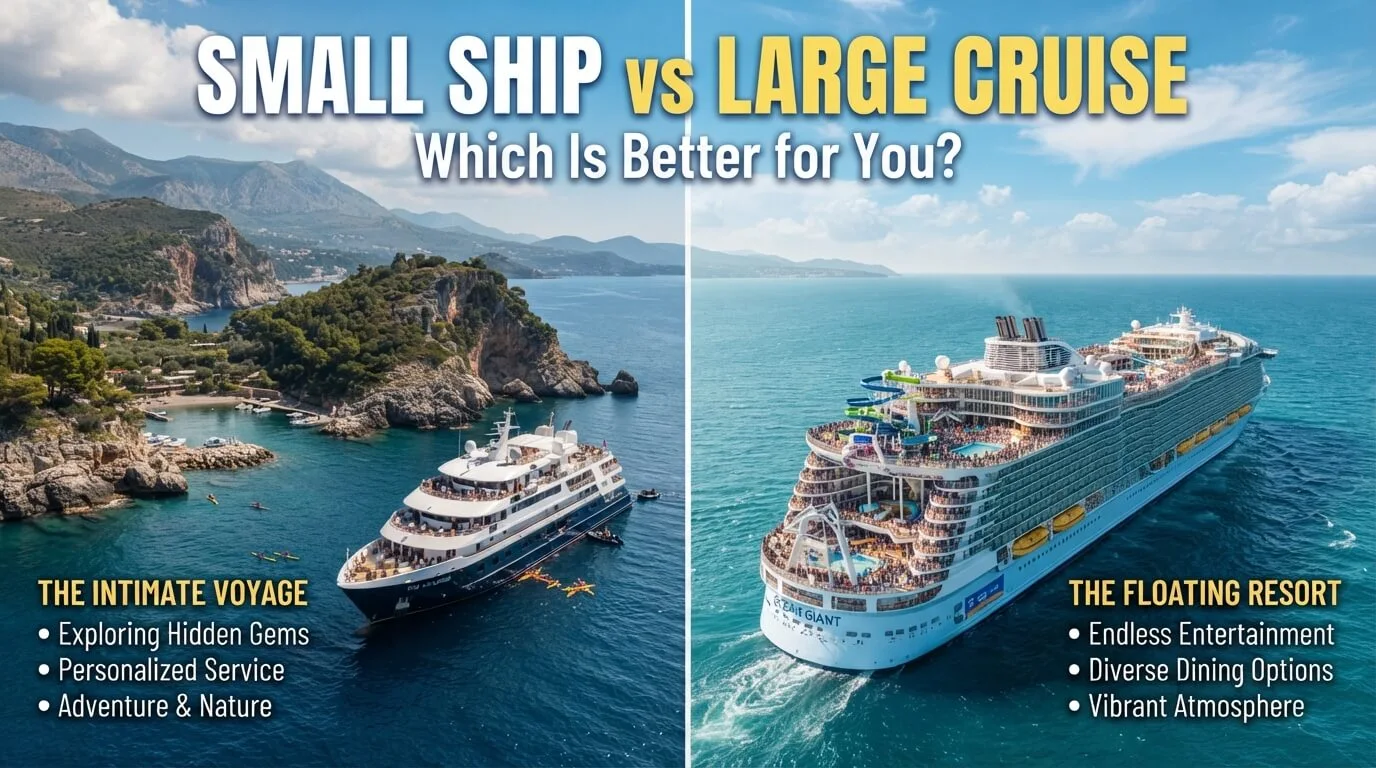

Choosing between a small ship vs large cruise can change your whole vacation.
A small ship can feel quiet, personal, and focused on the destination. A large cruise ship can feel like a floating resort. It may offer more restaurants, shows, pools, and activities.
Neither option is better for everyone.
The best choice depends on your budget, travel style, destination, and who you are traveling with.
In this guide, we compare small and large cruise ships. We cover crowds, cabins, dining, entertainment, cost, ports, seasickness, accessibility, shore excursions, service, and more. Browse all our cruise travel guides for first-time cruisers.
By the end, you should know which cruise ship size fits you best.
Key Takeaways
A small ship cruise may be better if you want fewer crowds, personal service, quieter spaces, and more focus on ports and destinations.
A large cruise ship may be better if you want more entertainment, restaurants, pools, nightlife, and family activities.
Small ships often visit ports that larger ships cannot reach. However, large ships usually offer more things to do during sea days.
Large ships may also feel more stable in rough seas. Small ships can offer shorter walking distances, but accessibility depends on the individual ship.
Most importantly, compare the actual ship and cruise line. Ship size alone does not tell you everything.
Cruise Type
Cruise ships come in many sizes.
There is no single industry rule that defines a small or large cruise ship. However, travelers can usually divide ships into three broad groups.
Small ships carry fewer passengers and focus more on destinations.
Mid-size ships offer a balance between onboard activities and a quieter atmosphere.
Large ships can carry thousands of guests. Many have water parks, theaters, shopping areas, casinos, sports zones, and several restaurants.
Therefore, think about what you want from the cruise.
Do you want the ship to be part of the destination?
Or do you want the ship to help you explore the destination?
That question can make your decision much easier.
Ships & Capacity
Passenger capacity is one of the biggest differences between small and large cruise ships.
A small cruise ship may carry a few hundred passengers. Some expedition and yacht-style ships carry even fewer.
Large cruise ships may carry several thousand guests.
However, passenger numbers do not tell the whole story.
A large ship also has more space. Therefore, some large ships may not feel as crowded as their passenger numbers suggest.
It is useful to consider the ship’s space per passenger, not only its total capacity.
Number of Passengers
Passenger numbers affect almost every part of your cruise.
On a small ship, you may see the same guests often. You may quickly recognize other passengers and crew members.
This can create a more social and personal atmosphere.
Large ships offer a different experience.
You may meet new people every day. However, popular areas can become busy during meals, shows, port arrivals, and sea days.
If you dislike crowds, a smaller ship may suit you better.
If crowds do not bother you and you enjoy an active atmosphere, a large ship may be a good choice.
Arrival at Port & Check-In
Cruise check-in can feel different depending on ship size.
Small ships have fewer passengers to process. As a result, the check-in area may feel calmer.
Large ships need to move thousands of passengers through the terminal. Cruise lines often use scheduled arrival times and organized boarding groups to manage this.
The system may still work well. However, peak periods can feel busy.
If you value a simple arrival experience, smaller ships can have an advantage.
Embarkation & First Impressions
Your first few hours onboard can shape how you feel about the cruise.
On a small ship, learning the layout is usually easy. There are fewer decks, restaurants, and public spaces.
You may know your way around within a few hours.
Large ships can take longer to understand.
You may need time to find restaurants, theaters, pools, elevators, and entertainment areas.
However, exploring a large ship can also be part of the fun.
For some travelers, seeing everything a mega-ship offers is exciting.
Staterooms and Suites
Cabin size does not depend only on ship size.
Some small luxury ships offer large suites. Other small vessels have compact cabins because more space is used for expedition equipment or public areas.
Large ships usually offer more cabin categories.
You may find:
- Interior cabins
- Ocean-view rooms
- Balcony cabins
- Family cabins
- Suites
- Connecting rooms
Therefore, do not assume a larger ship always means a larger cabin.
Compare the actual cabin size before you book.
Also consider location.
A cabin near the center of the ship may feel more comfortable for travelers who are worried about movement.
Public Spaces
Small ships often have fewer public spaces.
However, those spaces may feel quieter and more relaxed.
You may find lounges, observation areas, libraries, restaurants, and outdoor decks.
Large cruise ships offer much more variety.
Some include shopping streets, multiple pools, casinos, sports areas, theaters, bars, lounges, and adults-only spaces.
The right choice depends on how you like to spend your day.
If you enjoy simple and peaceful surroundings, choose small.
If you enjoy having many options, choose large.
Can You Get a Small-Ship Feel on a Large Cruise Ship?
Yes, in some cases.
Some large cruise ships offer private premium areas within the ship. These spaces can include private restaurants, lounges, pools, and dedicated service.
This gives travelers a quieter experience while still providing access to the entertainment and activities of a large ship.
This option may suit you if you want:
- More privacy
- Personal service
- Quiet dining
- Exclusive lounges
- Large-ship entertainment
- More onboard activities
However, these premium areas usually cost more.
Therefore, travelers who like the features of a large ship but dislike crowds may want to compare premium suite areas before choosing a smaller vessel.
Pools
Large ships usually offer more pool choices.
Many have several pools, hot tubs, splash areas, and water attractions.
This can make them attractive to families and active travelers.
Small ships usually have fewer pools. Some may only have one small pool or hot tub.
For many small-ship travelers, this is not a problem.
They may care more about scenery, ports, and shore activities than pool time.
Dining Options
Dining is an important part of any cruise.
Small ships usually have fewer restaurants.
However, dining may feel more personal. Guests may also see the same crew members and fellow travelers each day.
Premium small ships sometimes include specialty dining in the cruise fare.
Large ships usually offer much more variety.
You may find:
- Main dining rooms
- Buffets
- Steakhouses
- Italian restaurants
- Asian restaurants
- Cafes
- Pizza
- Burger venues
- Seafood restaurants
- Room service
However, some specialty restaurants may cost extra.
If dining variety matters most, a large ship often has the advantage.
If you prefer a quieter dining experience, a small ship may suit you better.
Service and Crew Interaction
Service can feel different on small and large cruise ships.
On a small ship, there are fewer passengers. As a result, you may see the same crew members throughout your trip.
Crew members may learn your name, dining preferences, or daily routine. This can make the experience feel more personal.
Large ships can also provide excellent service. However, thousands of passengers may make the overall experience feel less personal in busy areas.
Premium cabins and private suite areas on large ships may offer more dedicated service.
If personal attention is important to you, compare the service level and guest experience of the specific cruise line before booking.
Activities
Large cruise ships are designed to keep guests busy.
Depending on the ship, activities may include:
- Water slides
- Rock climbing
- Mini golf
- Sports courts
- Surf simulators
- Fitness classes
- Trivia
- Games
- Shopping
- Kids’ clubs
Small ships usually offer fewer onboard activities.
Instead, they may focus on:
- Lectures
- Local culture
- Wildlife
- Destination talks
- Photography
- Cooking
- Wine
- Nature
This difference is important.
Large ships focus more on the onboard experience.
Small ships often focus more on the destination experience.
Entertainment & Activities
Large cruise ships are usually stronger when it comes to entertainment.
Many offer large theater shows, live music, comedy, parties, casinos, and nightlife.
Some ships have entertainment running from morning until late at night.
Small ships usually offer simpler entertainment.
You may find live music, guest speakers, destination talks, or small evening performances.
Therefore, ask yourself how important entertainment is.
If you want something different to do every night, a large ship may be better.
If you enjoy quiet evenings after a day of exploring, a small ship may be enough.
Does Ship Size Affect Dress Code and Atmosphere?
Ship size can influence the atmosphere, but the cruise line usually matters more.
Some small luxury ships have an elegant but relaxed style.
Other cruises may include formal evenings or dressier restaurants.
Large cruise ships also vary.
Some are casual and family-focused. Others offer upscale restaurants, formal nights, and premium areas.
Before booking, check the cruise line’s dress code and onboard style.
This is especially important if you prefer either a relaxed vacation or a more traditional cruise experience.
Passengers
Different cruise ship sizes can attract different types of travelers.
Small ships often appeal to:
- Couples
- Mature travelers
- Luxury travelers
- Adventure travelers
- Destination-focused travelers
- Retirees
Large ships often appeal to:
- Families
- Groups
- First-time cruisers
- Couples
- Multigenerational families
- Travelers who enjoy entertainment
However, these are general patterns.
Cruise line, itinerary, price, and travel season can also change the passenger mix.
Small Ship vs Large Cruise Cost
Price is one of the most important factors when comparing a small ship vs large cruise.
Small ships often have a higher starting fare.
There are fewer cabins to sell, and many small ships focus on premium, luxury, or expedition travel.
Large cruise ships often offer lower starting prices.
Because they carry more passengers, cruise lines may offer a wider range of cabin prices.
However, the cheapest fare does not always mean the cheapest trip.
You should compare the total vacation cost.
What Is Actually Included in the Fare?
This is where cruise prices can become confusing.
A large ship may offer a low starting fare. However, you may pay extra for:
- Wi-Fi
- Drinks
- Specialty dining
- Shore excursions
- Gratuities
- Premium activities
Some small or luxury cruise lines include more of these items.
For example, the fare may include drinks, Wi-Fi, dining, or selected excursions.
However, every cruise line is different.
Therefore, compare what is included before deciding which cruise offers better value.
Small Ship vs Large Cruise for Seasickness
Many travelers wonder if ship size affects seasickness.
Larger cruise ships often feel more stable, but ship design, stabilizers, sea conditions, route, and cabin location also affect how much motion you feel.
A small ship may move more noticeably in rough seas.
However, size is not the only factor.
If you are very sensitive to motion, research the exact vessel before booking.
A cabin near the middle of the ship and on a lower deck may also feel more stable.
Ports and Destinations
One of the biggest advantages of small ships is destination access.
Large ships need ports that can handle their size, or they may have to anchor offshore and use tender boats to take passengers ashore.
Small ships can often reach smaller harbors, remote ports, and destinations that may not accommodate large cruise ships.
This can be especially useful in places where the destination is the main reason for cruising.
Examples may include remote islands, smaller European ports, nature destinations, and expedition areas.
Large ships still visit many excellent destinations.
However, their itineraries often focus on major cruise ports.
Tendering, Docking, and Time Ashore
Not every cruise ship can dock directly at every port.
Sometimes passengers use smaller boats called tenders to travel between the ship and shore.
Tendering can take extra time.
Large ships may also create longer lines when thousands of passengers want to go ashore at the same time.
Small ships may have fewer people to move.
They can also fit into some ports that cannot handle large vessels.
Therefore, when comparing itineraries, do not only look at the port names.
Check how the ship reaches each destination.
This can affect how much time you actually spend ashore.
Shore Excursions: Small Groups vs Large Groups
The shore excursion experience can also change with ship size.
Small ships often focus heavily on destinations. Their excursions may include wildlife, history, culture, nature, or local experiences.
Fewer passengers may also mean smaller tour groups in some destinations.
Large cruise ships usually offer a wider range of shore excursions. Popular ports may have several tours and departure times to choose from.
However, thousands of passengers can arrive in the same destination at once.
This may create busier meeting areas and larger tour groups.
Private tours can be an option on both types of cruises.
If exploring the destination is your main goal, compare the actual shore excursions before choosing your ship.
Which Is Better for Sea Days?
Sea days are days when the ship does not visit a port.
If your itinerary includes many sea days, onboard activities become more important.
Large ships usually have an advantage here.
You can choose from pools, shows, restaurants, sports, games, shopping, and other activities.
Small ships may feel quieter on sea days.
That is perfect for travelers who enjoy reading, relaxing, looking at the scenery, or attending lectures.
However, travelers who need constant entertainment may get bored.
Accessibility and Mobility
Ship size can also affect travelers with mobility needs.
A small ship usually means shorter walking distances.
This may help travelers who find it difficult to walk long distances.
However, some small ships have fewer elevators or more difficult boarding areas.
Expedition ships may also use smaller boats for shore landings.
Large ships require more walking.
On the other hand, many modern large ships offer accessible cabins, elevators, ramps, and other facilities.
Therefore, never choose a cruise based on ship size alone if accessibility is important.
For travelers with mobility needs, the individual ship matters more than ship size alone.
Small Ship vs Large Cruise for Families
Large cruise ships are usually the stronger choice for families.
They often offer:
- Kids’ clubs
- Teen clubs
- Water parks
- Family pools
- Sports
- Games
- Family cabins
- Entertainment for different ages
This makes it easier to keep children and adults happy.
Small ships may offer fewer family facilities.
However, some families may prefer a quieter trip focused on culture, wildlife, or exploration.
The best option depends on your children and their interests.
Small Ship vs Large Cruise for Couples
Both ship sizes can work well for couples.
A small ship may suit couples looking for:
- Quiet spaces
- Romance
- Personal service
- Unique destinations
- Relaxed dining
Large ships may suit couples looking for:
- Nightlife
- Shows
- Restaurants
- Bars
- Activities
- More entertainment
Think about what kind of holiday you enjoy together.
Small Ship vs Large Cruise for Solo Travelers
Solo travelers should look beyond ship size.
Large ships may offer more social events and entertainment.
This can make it easier to stay busy.
Some also have solo cabins.
Small ships may create a more personal environment.
Because there are fewer passengers, you may see the same people often and build connections more easily.
However, solo fares can vary.
Always check the single supplement and cabin options before booking.
Small Ship vs Large Cruise for Seniors
Both ship sizes can work for seniors.
Small ships offer shorter walking distances and quieter surroundings.
Large ships often offer more dining, entertainment, cabin, and activity choices.
However, large ships can involve a lot of walking.
Small ships can also have challenges if they use stairs, tenders, or expedition boats.
Therefore, seniors should compare the exact ship and itinerary.
Which Is Better for First-Time Cruisers?
There is no perfect ship size for every first-time cruiser.
A large ship may be easier if you want many activities and dining choices.
It can show you how much modern cruising has to offer.
However, the size can feel overwhelming.
A small ship may be easier to navigate.
It may also offer a calmer introduction to cruising.
However, you will have fewer entertainment options.
First-time cruisers should choose based on their normal travel style.
If you enjoy resorts, entertainment, and busy vacations, start with a large ship.
If you enjoy boutique hotels, quiet travel, and local experiences, consider a small ship.
Small Ships
Small ships are best for travelers who value the destination more than the ship.
Advantages of Small Ships
Small ships may offer:
- Fewer passengers
- Less crowded public areas
- More personal service
- Easier ship navigation
- Smaller ports
- Unique itineraries
- Quiet surroundings
- Destination-focused activities
Disadvantages of Small Ships
Small ships may also have:
- Higher fares
- Fewer restaurants
- Less nightlife
- Fewer family activities
- Smaller pools
- Less entertainment
- More noticeable movement at sea
Big Ships
Large cruise ships are best for travelers who want the ship to be a major part of their vacation.
Advantages of Large Ships
Large ships may offer:
- More restaurants
- More entertainment
- More pools
- Kids’ clubs
- Sports
- Nightlife
- More cabin choices
- More activities
- Lower starting fares
Disadvantages of Large Ships
Large ships may also have:
- More crowds
- Longer walking distances
- Busy elevators
- Longer lines
- More passengers in port
- Extra charges for some activities or dining
- Less access to smaller destinations
Who Should Avoid a Small Ship?
A small ship may not be right for you if you need constant entertainment.
It may also be a poor fit if your children need large kids’ clubs, water parks, or many activities.
Travelers who love nightlife and many dining choices may also prefer a larger ship.
Finally, motion-sensitive travelers should research the exact vessel carefully.
Who Should Avoid a Large Cruise Ship?
A large ship may not suit you if you strongly dislike crowds.
You may also find it frustrating if you want quiet spaces, personal service, and easy access to smaller ports.
Large ships may also feel tiring if you have difficulty walking long distances.
What About a Mid-Size Cruise Ship?
You do not have to choose between very small and very large ships.
A mid-size ship can offer a useful balance.
You may still get several restaurants, pools, shows, and activities.
At the same time, the ship may feel easier to navigate than a mega-ship.
This can be a good option for travelers who want variety without the largest crowds.
Does the Destination Change the Answer?
Yes.
The destination should play a major role in your choice.
For example, a destination-focused trip may work better on a smaller ship.
You may care more about scenery, wildlife, ports, and shore activities than water slides or nightlife.
On another trip, the ship may matter more.
If you have several sea days or you are traveling with children, a large ship may offer more value.
Therefore, do not choose the ship first.
Look at the ship and itinerary together.
Does the Best Ship Size Change by Destination?
Yes. Your destination can change which ship size makes more sense.
Alaska
Small ships may appeal to travelers who want wildlife, scenery, nature, and destination-focused activities.
Large ships may suit families and travelers who want more entertainment during sea time.
Mediterranean and Europe
Smaller ships may reach some ports that cannot handle the largest cruise vessels.
Large ships can provide more restaurants, pools, shows, and activities between port visits.
Caribbean
Large ships can work well when the ship itself is a major part of the vacation.
Water parks, pools, nightlife, and entertainment may be especially important on itineraries with several relaxing days.
Small ships may suit travelers who prefer quieter islands and a more relaxed experience.
Expedition Destinations
Small expedition ships are often designed for remote destinations and nature-based travel.
These cruises may focus more on wildlife, scenery, expert guides, and shore activities than traditional onboard entertainment.
Therefore, choose your destination first and then decide which ship size best supports the experience you want.
Small Ship vs Large Cruise: Which Is Better?
There is no single winner in the small ship vs large cruise debate.
Choose a small ship if you want fewer crowds, quiet spaces, personal service, and destination-focused travel.
Choose a large ship if you want entertainment, dining variety, nightlife, family activities, and many things to do onboard.
A mid-size ship may be best if you want a balance between the two.
Before booking, compare five things:
- Your destination
- Your budget
- Your travel companions
- How much entertainment you need
- How comfortable you are with crowds
The best cruise ship is not always the biggest or smallest.
It is the ship that matches the vacation you want.
Frequently Asked Questions
Are Smaller Cruise Ships Better Than Large Cruise Ships?
Smaller ships are better for travelers who want fewer crowds, personal service, and more focus on destinations. Large ships are better for travelers who want more entertainment, restaurants, pools, and activities.
Are Small Cruise Ships More Expensive?
Small ships often have higher starting fares. However, some include more items in the fare. Compare drinks, Wi-Fi, dining, excursions, and gratuities before deciding which offers better value.
Are Large Cruise Ships Better for Seasickness?
Large ships often feel more stable. However, sea conditions, ship design, route, stabilizers, and cabin location also affect motion.
Are Small Cruise Ships Better for Seniors?
They can be because walking distances may be shorter. However, accessibility varies by ship. Travelers with mobility needs should check elevators, accessible cabins, tender use, and boarding arrangements before booking.
Which Cruise Ship Size Is Best for Families?
Large ships are usually better for families because they offer more kids’ clubs, pools, sports, entertainment, and family activities.
Which Is Better for Couples, Small or Large Cruise Ships?
It depends on the couple. Small ships suit couples seeking quiet, romance, and destination experiences. Large ships suit couples who enjoy nightlife, shows, dining choices, and activities.
Do Small Cruise Ships Visit Better Ports?
Not always. However, small ships can often visit smaller or more remote ports that cannot accommodate the largest cruise ships.
Are Large Cruise Ships Too Crowded?
They can feel crowded during popular times, such as meals, shows, port arrivals, and sea days. However, ship design and space per passenger also affect how crowded a vessel feels.
Is a Mid-Size Cruise Ship Better Than a Small or Large Ship?
For some travelers, yes. Mid-size ships can offer more dining and entertainment than small ships while feeling less overwhelming than mega-ships.
What Is the Main Difference Between Small and Large Cruise Ships?
The biggest difference is travel style. Small ships usually focus more on destinations and personal service. Large ships usually focus more on onboard entertainment and variety.