
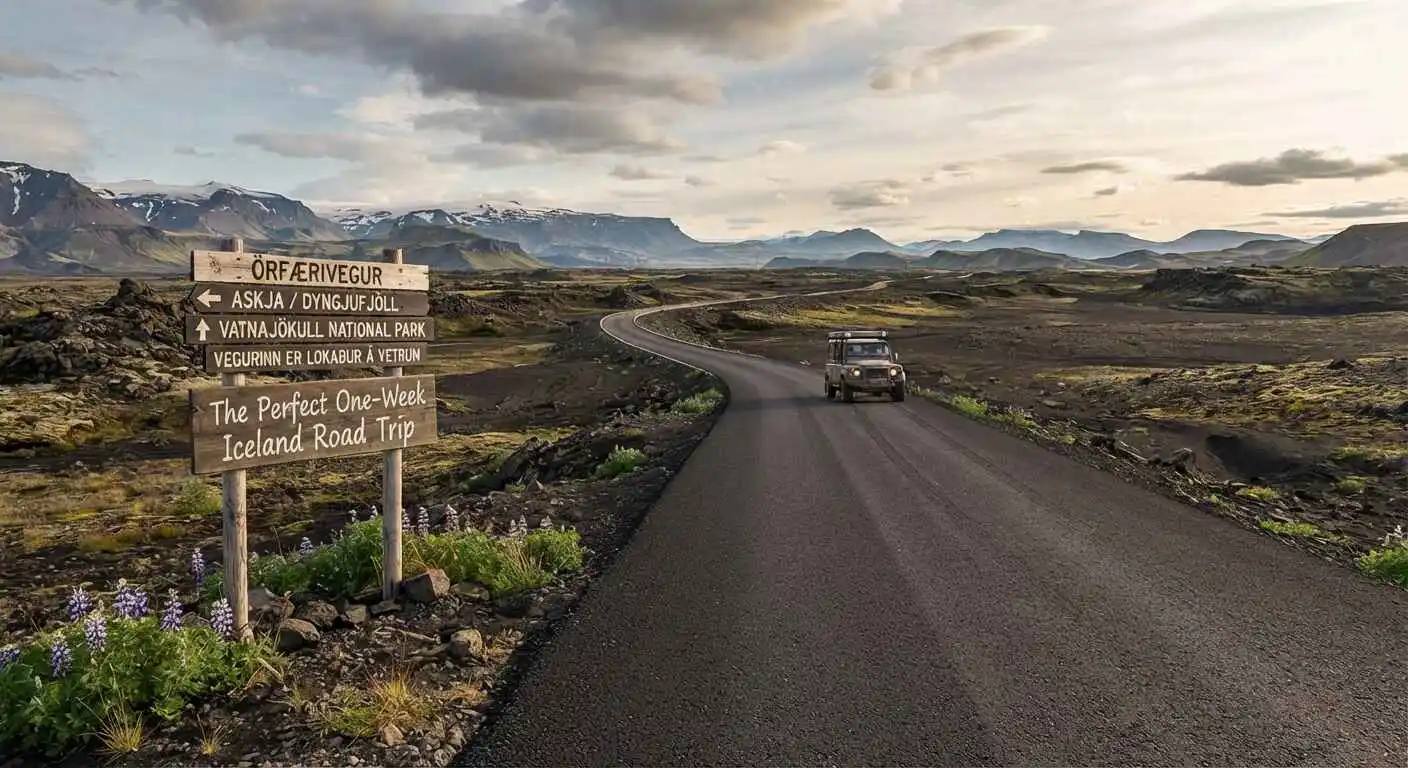

An Iceland 7 day itinerary gives you enough time to see many of the country’s most famous landscapes.
In one week, you can explore Reykjavík, drive the Golden Circle, see huge waterfalls, walk on black sand beaches, visit glacier lagoons, and relax in geothermal water.
However, Iceland is larger than it looks on a map. Weather can also change fast. For this reason, choosing the right route is important. Browse all our Iceland travel guides for more road trip ideas.
This 7 day Iceland itinerary focuses on Reykjavík, the Golden Circle, and South Iceland. It works well for first-time visitors who want a balanced road trip without rushing around the full country.
This itinerary counts your arrival day as Day 1 and your departure day as Day 7.
Iceland 7 Day Itinerary at a Glance
| Day | Route | Main Highlights | Pace | Overnight |
| Day 1 | Keflavík → Reykjavík | Reykjavík city sights | Easy | Reykjavík |
| Day 2 | Reykjavík → Golden Circle | Þingvellir, Geysir, Gullfoss | Moderate | Golden Circle or Selfoss |
| Day 3 | Golden Circle → South Coast | Seljalandsfoss, Skógafoss | Moderate | Vík |
| Day 4 | Vík and South Coast | Dyrhólaey, Reynisfjara, glacier views | Moderate | Vík or farther east |
| Day 5 | Vík → Skaftafell → Jökulsárlón | Glacier lagoon, Diamond Beach | Heavy | Höfn or Jökulsárlón area |
| Day 6 | Southeast → South Iceland | Glacier stops, canyon, return west | Heavy | Selfoss or Hveragerði |
| Day 7 | South Iceland → Keflavík | Reykjavík or geothermal spa | Easy to Moderate | Departure |
Driving times can change because of weather, road conditions, fuel stops, and sightseeing.
Do not plan your trip based only on Google Maps.
What You Need to Know Before Your Iceland Itinerary
Good planning can make your Iceland road trip much easier.
Distances between attractions may look short. Still, sightseeing, meals, photography, weather, and parking can turn a short drive into a full travel day.
Avoid adding too many attractions to one day.
It is better to enjoy fewer places than rush through everything.
Iceland Ring Road
Iceland’s Ring Road, also called Route 1, circles most of the country.
It connects many major towns and popular attractions.
You can complete the Ring Road in about one week. However, the trip will be fast-paced.
You may spend several hours driving every day.
For most first-time visitors, Reykjavík, the Golden Circle, and the South Coast offer a better balance.
You still see waterfalls, glaciers, black beaches, geothermal areas, and glacier lagoons, but you spend less time racing around the country.
Ring Road vs South Coast: Which Is Better for 7 Days?
Both options are possible.
The best choice depends on your travel style.
| Factor | South Coast Route | Full Ring Road |
| Driving | Moderate | High |
| Pace | More balanced | Fast |
| Best for | First-time visitors | Road-trip lovers |
| Main benefit | More time at each stop | More regions |
| Winter travel | Easier to adjust | More difficult |
| Long activities | Easier to include | Harder to fit |
| Weather flexibility | Better | Lower |
Choose the South Coast route if you want more time at each attraction.
Choose the Ring Road if seeing more regions matters more than having a relaxed schedule.
Driving in Iceland
A rental car is one of the easiest ways to follow an Iceland 7 day road trip itinerary.
It gives you freedom to stop at viewpoints and change your schedule.
Most major attractions on this route are reached from main roads.
Still, weather can change quickly.
Strong wind, rain, snow, and ice may affect your journey.
Check current road and weather conditions every morning.
Slow down when conditions are poor.
Never stop your car in the road to take photographs. Use a safe parking area.
Vehicle lights should also be on while driving in Iceland throughout the year.
Do You Need a 4WD?
Not always.
A standard car may be suitable for many main-road trips in good conditions.
A 4WD can be useful during winter or on more difficult routes.
However, a 4WD does not make dangerous roads safe.
If you plan to drive on Highland or F-roads, check the rules carefully.
F-roads require a suitable 4WD, and not every 4WD is suitable for every route.
Some roads may also be closed for part of the year.
Always check your rental agreement before driving on special roads.
Expect Different Weather Conditions
Iceland can have several types of weather in one day.
You may start with sunshine, drive through rain, and later experience strong wind.
Winter adds more challenges because daylight is limited and roads may become icy.
Summer offers much longer daylight hours.
Even so, keep your itinerary flexible.
If the weather becomes unsafe, change your plans.
No attraction is worth taking unnecessary risks.
Iceland 7 Day Road Trip Route
The main route for this itinerary is:
Keflavík Airport → Reykjavík → Golden Circle → South Coast → Vík → Skaftafell → Jökulsárlón → Höfn area → South Iceland → Reykjavík or Reykjanes → Keflavík Airport
Save the route on your phone before starting the trip.
Mark:
- Accommodation
- Fuel stations
- Main attractions
- Supermarkets
- Parking areas
- Food stops
Offline maps are also useful.
Mobile coverage is good in many areas, but remote sections may have weaker service.
Daily Driving Time and Pace
Driving time is one of the most important parts of this itinerary.
A route showing three hours of driving can easily become a seven or eight-hour travel day after you add waterfalls, meals, walks, parking, and photo stops.
Use these pace levels:
Easy: Less than about two hours of direct driving.
Moderate: Around two to four hours of direct driving.
Heavy: More than about four hours of direct driving.
Always leave extra time.
If You Are Running Late
Do not try to complete every stop.
Choose your must-see attractions first.
Skip optional attractions if you are behind schedule.
Long walks, repeated glacier stops, and smaller viewpoints should usually be removed before major highlights.
A flexible trip is better than a stressful one.
Research and Planning Tips
You do not need to plan every minute.
Still, you should know where you will sleep and which activities require reservations.
Activities
Many natural attractions do not require a tour.
You can visit waterfalls, beaches, viewpoints, and many walking areas on your own.
Some activities should only be done with professional guides.
These may include:
- Glacier hiking
- Ice cave tours
- Silfra snorkelling
- Whale watching
- Snowmobiling
Book important activities early during busy travel periods.
Accommodation
Your hotel location has a major effect on your road trip.
Avoid returning to Reykjavík every night.
Instead, move forward with the route.
A practical accommodation plan may include:
- Reykjavík
- Golden Circle or Selfoss
- Vík
- Jökulsárlón or Höfn area
- Selfoss or Hveragerði
Booking early is important during popular travel months.
Car Rental
Choose your rental car based on your season and route.
Check the insurance carefully.
Ask about coverage for:
- Gravel damage
- Wind damage
- Sand and ash
- Tyres
- Windscreen damage
Always follow the rental company’s rules.
Packing
Pack for changing weather.
Useful items include:
- Waterproof jacket
- Warm layers
- Waterproof trousers
- Comfortable walking shoes
- Gloves
- Warm hat
- Sunglasses
- Reusable water bottle
- Small daypack
- Phone charger
- Swimwear
Layers are useful because conditions can change throughout the day.
Iceland 7 Day Itinerary
Day 1: Reykjavík and Icelandic Culture
Start your Iceland trip in Reykjavík.
After arriving at Keflavík International Airport, collect your rental car and drive toward the city.
Use your first day to recover from your flight.
You do not need a packed sightseeing schedule.
Top Things to Do in Reykjavík
Start with Hallgrímskirkja.
It is one of Reykjavík’s best-known landmarks.
Next, walk through the city centre.
Explore Laugavegur, one of the main shopping streets.
You can also visit the waterfront and see the Sun Voyager sculpture.
Continue toward Harpa Concert Hall.
Its modern glass design makes it one of Reykjavík’s most recognisable buildings.
If you enjoy food, try an Icelandic meal in the evening.
Keep the night relaxed because the road trip begins the next morning.
Where to Stay in Reykjavík
Stay near the city centre if possible.
This makes restaurants and major sights easy to reach.
If you already have a rental car, choose accommodation with practical parking.
Today’s pace: Easy.
Day 2: Golden Circle
Day 2 takes you through the famous Golden Circle.
The three main attractions are Þingvellir National Park, the Geysir geothermal area, and Gullfoss.
Start early so you can enjoy each stop.
Þingvellir National Park
Begin at Þingvellir National Park.
The area is important for Icelandic history and geology.
You can see a rift landscape where the North American and Eurasian tectonic plates are slowly moving apart.
The park also has walking trails, viewpoints, and historic sites.
Give yourself enough time to walk rather than only stopping for a quick photograph.
Geysir Geothermal Area
Next, drive toward the Geysir geothermal area.
The original Geysir is famous around the world.
Today, nearby Strokkur is usually the main attraction.
It regularly sends hot water into the air.
Stay behind marked barriers.
The ground around geothermal areas can be very hot.
Gullfoss
Continue to Gullfoss.
It is one of Iceland’s best-known waterfalls.
Large amounts of water drop into a canyon.
There are several viewing areas.
Paths may become wet or slippery, so wear suitable shoes.
Where to Stay Around the Golden Circle
Stay around the Golden Circle or continue toward Selfoss.
Selfoss offers more restaurants, shops, and services.
Avoid returning to Reykjavík because this creates unnecessary driving.
Today’s pace: Moderate.
If running late: Keep your focus on Þingvellir, Geysir, and Gullfoss.
Day 3: Waterfalls and the South Coast
Day 3 begins your drive along Iceland’s South Coast.
This region has some of the country’s most famous waterfalls.
Your main goal is to reach Vík.
Urriðafoss
Urriðafoss can be a useful first waterfall stop.
It is less famous than many South Coast attractions.
This may make the visit feel quieter.
Treat it as optional if your day is already busy.
Seljalandsfoss and Gljúfrabúi
Continue toward Seljalandsfoss.
This narrow waterfall drops from a high cliff.
When conditions allow, a path takes visitors around the waterfall.
You may get wet.
Waterproof clothing is helpful.
Nearby Gljúfrabúi is partly hidden behind rock walls.
It is easy to combine with Seljalandsfoss when conditions are safe.
Eyjafjallajökull
Continue along the South Coast.
You will pass landscapes shaped by Eyjafjallajökull.
The volcano became known around the world after its 2010 eruption disrupted air travel.
Enjoy the views, but avoid turning every viewpoint into a long stop.
Seljavellir
If you have enough time, consider visiting the Seljavellir area.
It offers a scenic walk through a mountain valley.
This should remain an optional stop.
Skip it if weather conditions are poor or you are already behind schedule.
Skógafoss
Finish the main sightseeing part of the day at Skógafoss.
It is one of Iceland’s most impressive waterfalls.
You can see it from below.
You can also climb the staircase for a view from above.
Expect spray near the waterfall.
Then continue to Vík.
Where to Stay in Vík
Vík is a practical base for the South Coast.
It has accommodation, restaurants, fuel, and basic services.
It also puts you in a good position for the next day’s attractions.
Today’s pace: Moderate.
If running late: Skip Urriðafoss or Seljavellir before cutting Seljalandsfoss or Skógafoss.
Day 4: Black Beaches, Cliffs and Glacier Views
Day 4 focuses on the coastal landscape around Vík.
Do not rush east too early.
This area deserves time.
Sólheimajökull
Visit the Sólheimajökull glacier area if it fits your route.
You can see the glacier from nearby walking areas.
If you want to walk on the glacier, book a guided tour.
Never walk onto a glacier without proper safety equipment and professional guidance.
Sólheimasandur Plane Wreck
The Sólheimasandur plane wreck is one of the area’s well-known sights.
However, it is not a quick roadside attraction.
Reaching it requires additional time.
If your day is already busy, this is one of the easiest stops to remove.
Dyrhólaey
Next, visit Dyrhólaey.
The area offers wide coastal views, cliffs, and black beaches.
It is also known for birdlife at certain times of the year.
Strong winds are common.
Stay away from cliff edges.
Reynisfjara
Continue to Reynisfjara.
The black sand, basalt columns, and sea stacks make it one of Iceland’s most recognisable beaches.
The ocean here is dangerous.
Reynisfjara is known for sneaker waves that can travel much farther up the beach than expected.
Follow warning signs.
Keep a safe distance from the sea.
Never turn your back on the waves.
Vík
Stop in Vík for food, fuel, and a short rest.
You now have two choices.
Relaxed option: Stay in Vík and visit Skaftafell the next morning.
Faster option: Continue farther east and stay near Kirkjubæjarklaustur or the Skaftafell area.
Do not drive all the way to Skaftafell and then return to Vík just for accommodation.
That creates unnecessary backtracking.
Today’s pace: Moderate.
If running late: Skip the Sólheimasandur plane wreck.
Day 5: Skaftafell, Jökulsárlón and Diamond Beach
Day 5 takes you into Iceland’s glacier region.
This can be one of the longest and most memorable days of the trip.
Skaftafell, Vatnajökull National Park
Start with Skaftafell, which is part of Vatnajökull National Park.
The area has glaciers, hiking trails, and mountain scenery.
Choose a walk that fits your schedule.
If you want a glacier experience, book a guided activity in advance.
Do not spend too long here if you still need to continue toward Jökulsárlón.
Jökulsárlón Glacier Lagoon
Continue toward Jökulsárlón Glacier Lagoon.
Large pieces of ice break away from the glacier and float through the lagoon.
Some eventually move toward the ocean.
The landscape changes constantly.
Take time to enjoy the view rather than treating it as a short photo stop.
Diamond Beach
Across the road, pieces of ice can wash onto the black sand of Diamond Beach.
The contrast between ice and dark sand creates one of Iceland’s most unusual landscapes.
Visit both the lagoon and the beach.
Höfn
Continue toward Höfn if this is where you booked your accommodation.
Höfn is an important service town in southeast Iceland.
It has fuel, food, and accommodation.
The surrounding mountain and glacier views can also be impressive.
Where to Stay
You can stay in:
- Jökulsárlón area
- Southeast Iceland
- Höfn
Remember that the farther east you sleep, the longer your return journey will be.
Today’s pace: Heavy.
If running late: Keep Skaftafell shorter and prioritise Jökulsárlón and Diamond Beach.
Day 6: Return West Through South Iceland
Day 6 begins your return toward western South Iceland.
This is a long driving day.
Do not try to repeat every attraction.
Choose only a few stops.
Fjallsárlón Glacier Lagoon
Fjallsárlón is smaller than Jökulsárlón.
It offers another view of the glacier landscape.
Visit it if you have enough time.
Skip it if weather or driving delays are already affecting the day.
Svínafellsjökull
You may also stop near Svínafellsjökull if conditions and access allow.
Respect all barriers and safety signs.
Do not enter closed areas.
Fjaðrárgljúfur Canyon
Continue toward Fjaðrárgljúfur Canyon.
The canyon is known for steep walls and dramatic scenery.
Stay on marked paths.
Some areas may close to protect the landscape.
Continue Toward Selfoss or Hveragerði
After the canyon, focus on travelling west.
Avoid adding too many extra stops.
Staying in Selfoss or Hveragerði places you in a good position for the final day.
This is already a long route.
If the weather is poor, start the return drive earlier.
Today’s pace: Heavy.
If running late: Skip repeated glacier stops and go west.
Day 7: Reykjavík, Geothermal Spa or Departure
Your final day should depend on your flight time.
Do not try to fit Reykjavík, Reykjadalur, Kerið, Brúarárfoss, Blue Lagoon, and the airport into one departure day.
Choose one realistic plan.
If You Have an Early Flight
Go directly toward Keflavík International Airport.
Return your rental car and leave enough time for check-in and security.
If You Have an Afternoon Flight
Spend a short time in Reykjavík or choose one attraction near your route.
Do not schedule a long hike.
If You Have a Late Flight
You may have time for Reykjavík or a geothermal spa before going to the airport.
The Blue Lagoon can work well because it is closer to Keflavík Airport than many other major attractions.
Book your visit in advance.
Also, check its current operating status and road access before travelling because conditions on the Reykjanes Peninsula can change.
Reykjadalur
If your flight is very late and conditions are good, you could instead visit Reykjadalur near Hveragerði.
The hike takes time.
Do not add it if your schedule is tight.
Keflavík Airport
Finish your road trip at Keflavík International Airport.
Allow enough time to:
- Return your rental car
- Check in
- Drop luggage
- Go through security
Your 7 days in Iceland are now complete.
Bad-Weather Backup Plan
Weather can change your Iceland itinerary at any time.
Build a backup plan before travelling.
Day 2: Golden Circle
Plan A: Þingvellir, Geysir, and Gullfoss.
Plan B: Reduce the number of stops if visibility or roads become poor.
Day 3 and Day 4: South Coast
Plan A: Waterfalls, beaches, cliffs, and glacier views.
Plan B: Focus on attractions close to the main road.
Remove exposed viewpoints and long walks.
Day 5: Glacier Region
Plan A: Skaftafell, Jökulsárlón, and Diamond Beach.
Plan B: Shorten the route if strong wind, snow, or road closures affect travel.
Day 6: Return West
This is already a long driving day.
If conditions become difficult, skip optional stops and travel west earlier.
Never continue driving just because an attraction appears on your itinerary.
How to Adjust This Iceland 7 Day Itinerary by Season
The same itinerary does not work equally well in every season.
Weather, daylight, and road conditions can change your schedule.
Iceland 7 Day Itinerary in Summer
Summer offers long daylight hours.
This makes sightseeing easier.
You may have time for:
- Longer walks
- More viewpoints
- Evening sightseeing
- Extra photography stops
Summer is also busy.
Book rental cars, accommodation, and popular activities early.
Do not use the long daylight as a reason to drive while tired.
Iceland 7 Day Itinerary in Winter
Winter requires a slower plan.
Daylight is limited.
Snow, wind, and ice may also affect roads.
Remove one or two optional stops from busy days.
A South Coast trip is usually easier to manage than a rushed Ring Road itinerary.
Winter may also give you a chance to see the Northern Lights.
However, sightings are never guaranteed.
Iceland in Spring
Spring weather can change quickly.
Some days may feel mild, while others can still bring snow or ice.
Keep your itinerary flexible.
Check roads each morning.
Iceland in Autumn
Autumn has shorter daylight hours than summer.
Weather can also become more changeable.
Visit your most important outdoor attractions during daylight.
Leave extra time for travel delays.
Tips for Driving Safely in Iceland in Winter
Winter driving needs extra care.
Get the Right Vehicle
A 4WD may be helpful for some winter routes.
However, it does not make icy or stormy roads safe.
Choose a vehicle that matches your route and follow local advice.
Limit Daily Driving
Avoid very long winter driving days.
Short daylight hours mean you may spend more time driving in darkness.
Weather can also slow you down.
Do Not Rely Only on GPS
Navigation apps give directions.
They may not tell you whether a road is closed or unsafe.
Always check official road information.
Check Road and Weather Conditions
Check conditions every morning.
Check again later if the weather changes.
Never ignore a road closure.
Monitor Your Fuel
Do not wait until the tank is almost empty.
Fill up when you have a good opportunity.
Do Not Speed
Follow speed limits.
Drive more slowly when roads are wet, icy, snowy, or unfamiliar.
Plan Less
Winter is not the best time to pack every day with attractions.
Choose your most important stops first.
Treat the rest as optional.
Restock Supplies Often
Carry water and basic food.
Restock when you pass towns or supermarkets.
How Much Does 7 Days in Iceland Cost?
Iceland can be expensive.
Your total cost depends on your travel season, accommodation, vehicle, food choices, and activities.
Your budget should include:
- Accommodation
- Rental car
- Fuel
- Food
- Parking
- Visitor fees
- Tours
- Geothermal spas
- Travel insurance
Budget Traveller
You can reduce costs by:
- Staying in hostels or basic guesthouses
- Shopping at supermarkets
- Preparing some meals
- Sharing a rental car
- Choosing fewer paid activities
- Spending more time at free natural attractions
Mid-Range Traveller
A mid-range trip may include:
- Private hotel or guesthouse rooms
- Standard rental car
- Restaurant meals mixed with supermarket food
- One or two paid activities
- One geothermal spa visit
Comfortable Traveller
A more comfortable trip may include:
- Higher-end hotels
- Larger rental vehicle
- More restaurant meals
- Several guided activities
- Premium spa experiences
Prices change by season.
Check current rates for your actual travel dates before setting your final budget.
What to Book Before Your Iceland Road Trip
Some parts of your trip should be booked before arrival.
Book Early
Try to reserve:
- Rental car
- Accommodation
- Glacier hikes
- Ice cave tours
- Silfra snorkelling
- Whale watching
- Popular geothermal spas
- Other guided activities
Usually More Flexible
Many natural attractions do not require advance reservations.
These include:
- Waterfalls
- Beaches
- Viewpoints
- Reykjavík walks
- Many roadside stops
Parking charges or access rules may still apply.
Parking and Visitor Fees
Not every Iceland attraction is completely free.
Some locations charge for parking or visitor services.
Popular places and national park areas may use paid parking.
Keep a payment card and mobile internet available because some systems use apps or online payment.
Before driving, check:
- Parking rules
- Current fees
- Road access
- Opening information
- Toilet facilities
Do not rely on old prices from travel blogs.
Fees can change.
Your Morning Iceland Road Trip Checklist
Before driving each morning:
- Check the weather
- Check current road conditions
- Check safety alerts
- Confirm accommodation
- Confirm booked tours
- Check fuel
- Carry water and food
- Charge your phone
- Save your route offline
- Check daylight hours
- Remove optional stops if conditions are poor
A few minutes of planning can save hours later.
What to Do If You Have Seven Full Sightseeing Days
This itinerary counts arrival as Day 1 and departure as Day 7.
If you have seven full sightseeing days plus separate arrival and departure days, you have more flexibility.
Use the extra time to:
- Add Snæfellsnes Peninsula
- Spend another day in Reykjavík
- Spend more time near Jökulsárlón
- Add a glacier activity
- Add another South Coast night
- Slow down your return drive
- Add a geothermal spa day
Do not simply add more attractions to every existing day.
Use the extra time to make the trip less rushed.
Can You Spend 7 Days in Iceland Without a Car?
Yes.
You can spend seven days in Iceland without renting a car.
Reykjavík works well as a base for organised tours.
A simple no-car itinerary could look like this:
Day 1: Reykjavík
Day 2: Golden Circle tour
Day 3: South Coast tour
Day 4: Reykjavík museums and city sights
Day 5: Snæfellsnes tour
Day 6: Extra South Coast or geothermal experience
Day 7: Geothermal spa and airport transfer
This option works well for travellers who do not want to drive.
However, guided tours offer less flexibility than a self-drive trip.
Where to Stay During a 7-Day Iceland Road Trip
Where you sleep can save or waste hours of driving.
Choose accommodation that moves you forward.
Reykjavík
Stay here on your arrival night.
It gives you easy access to restaurants and city attractions.
Golden Circle or Selfoss
Staying outside Reykjavík after Day 2 avoids unnecessary backtracking.
Selfoss also has useful services.
Vík
Vík is one of the best South Coast bases.
It places you close to Reynisfjara and gives you a good starting point for travelling east.
Skaftafell or Nearby Areas
Staying farther east can reduce your drive toward Jökulsárlón the next morning.
Jökulsárlón or Höfn Area
This works well for exploring southeast Iceland.
Remember that staying near Höfn creates a longer return journey west.
Selfoss or Hveragerði
These towns work well near the end of the trip.
They place you closer to Reykjavík, Reykjanes, and Keflavík Airport.
Iceland 7 Day Itinerary FAQs
Is 7 days enough for Iceland?
Yes. Seven days is enough for a first trip if you focus on a realistic region.
Reykjavík, the Golden Circle, and the South Coast fit well into one week.
Trying to see the entire country will create longer driving days.
Can you drive Iceland’s Ring Road in 7 days?
Yes, but the trip will be fast-paced.
A full Ring Road journey suits travellers who enjoy driving and do not mind shorter sightseeing stops.
Do you need a 4WD in Iceland?
Not always.
Many popular attractions are reached using main roads.
However, season, weather, and road type matter.
Highland and F-road travel requires a suitable vehicle.
How many hours should you drive each day in Iceland?
There is no perfect number.
For a comfortable trip, shorter driving days are usually better.
Two or three hours of direct driving can still become a full sightseeing day.
Is Iceland better in summer or winter?
Both seasons offer different experiences.
Summer provides long daylight hours and easier road-trip planning.
Winter offers snowy landscapes and possible Northern Lights, but the days are shorter and driving can be harder.
Can you see the Northern Lights during a 7-day Iceland trip?
You may see them during the darker months if the sky is clear and aurora activity is strong enough.
Sightings are never guaranteed.
Can you visit Iceland for 7 days without a car?
Yes.
You can stay in Reykjavík and use organised tours for the Golden Circle, South Coast, Snæfellsnes, and other popular areas.
What should you book first for Iceland?
Book accommodation and your rental car first.
Then reserve any must-do activities such as glacier hikes, ice caves, Silfra snorkelling, or geothermal spas.
Should first-time visitors drive the full Ring Road in one week?
It depends on your travel style.
If you enjoy long driving days, it is possible.
If you want more time for walking, photography, and activities, focus on Reykjavík, the Golden Circle, and South Iceland instead.
Conclusion
An Iceland 7 day itinerary is long enough to experience many of Iceland’s most famous landscapes.
For most first-time visitors, Reykjavík, the Golden Circle, and the South Coast offer the best balance.
You can see geothermal areas, waterfalls, glaciers, black beaches, glacier lagoons, small towns, and hot springs in one week.
However, avoid trying to see everything.
Iceland rewards slower travel.
Give yourself time to walk, stop for views, and change your plans when the weather changes.
Most importantly, keep your itinerary flexible.
A realistic route with free time is better than a packed schedule filled with constant driving.
Seven days may feel short, but with the right plan, it can be an excellent first trip to Iceland.

1 Comment
Pingback: Best Things to Do in Iceland: Must-See Places & Experiences