
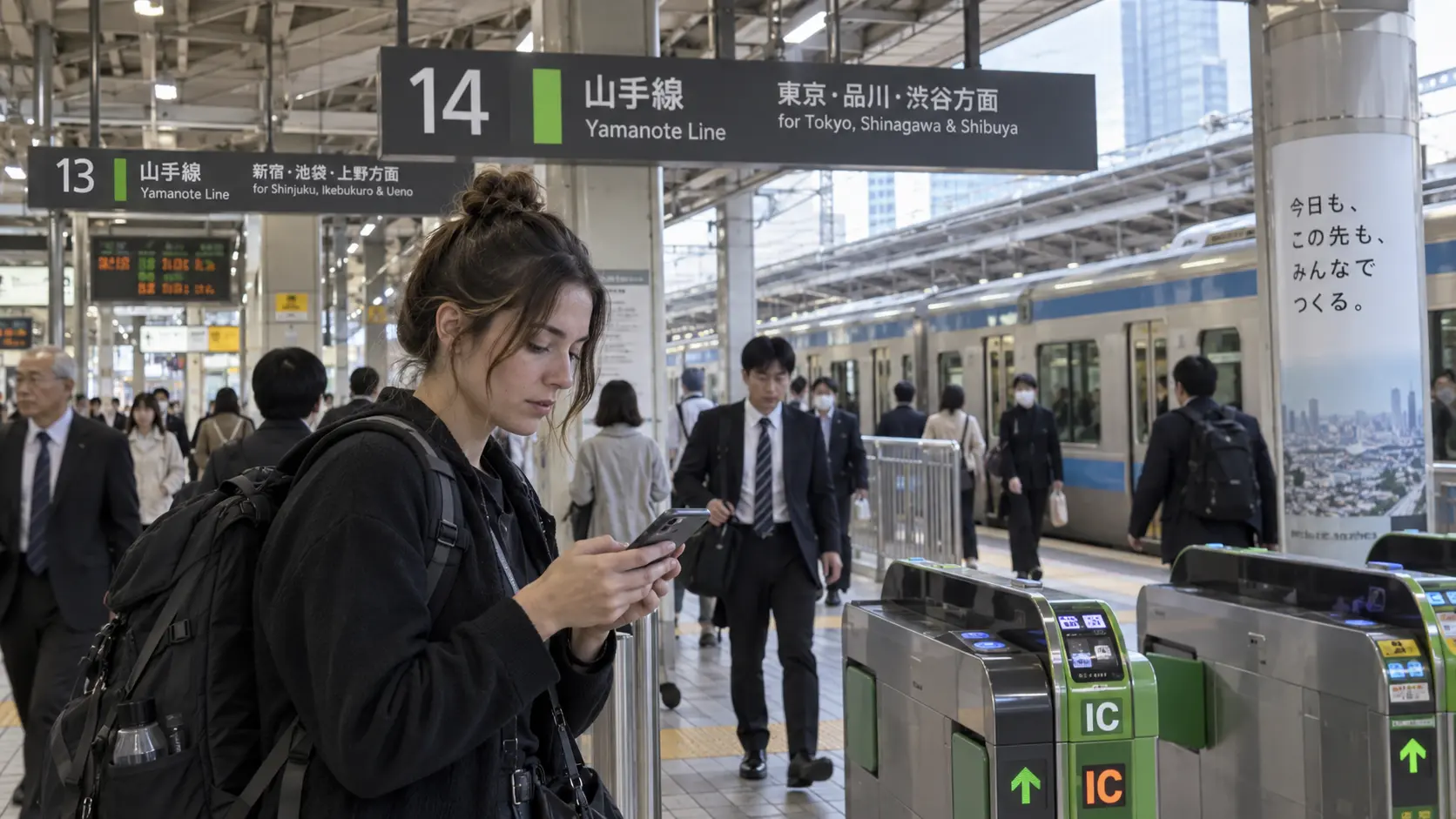

Learning how to get around Japan may feel confusing before your first trip. There are bullet trains, local trains, subways, buses, IC cards, rail passes, and several railway companies.
The good news is that Japan has an excellent public transportation system. Most first-time visitors can travel between major destinations without renting a car.
For a typical Tokyo, Kyoto, and Osaka trip, the system can be kept simple.
Use an IC card for local travel, trains and subways for getting around cities, and the Shinkansen for long-distance trips. Buy a Japan Rail Pass only when the cost makes sense for your route.
This guide explains how transportation in Japan works, what tickets you need, how to use trains, and which option is best for each type of journey.
Key Takeaways
- Trains are the easiest option for most first-time visitors. You rarely need a car on the Tokyo, Kyoto and Osaka route.
- Use an IC card (Suica, PASMO or ICOCA) for city trains, subways and many buses. Tap in, tap out, and the fare is charged automatically.
- Take the Shinkansen between major cities such as Tokyo, Kyoto, Osaka and Hiroshima. Reserved seats are recommended at busy times.
- Fly for long distances such as Tokyo to Sapporo or Okinawa.
- A Japan Rail Pass only pays off with several long Shinkansen trips. Compare it with individual tickets first. See is the Japan Rail Pass worth it.
- Trains do not run all night. Check your last train before a late evening out.
- Avoid weekday rush hour if you are carrying large luggage.
Part of our Japan Travel Guide
First time in Japan? Start with our complete Japan travel guide for first-time visitors.
What Is the Best Way to Get Around Japan?
For most visitors, trains are the best way to get around Japan.
Use local trains and subways inside large cities such as Tokyo and Osaka. Take the Shinkansen for fast travel between major cities. Buses are useful in Kyoto and rural areas. Domestic flights can save time on very long trips.
Here is a simple overview:
| Journey | Best Transport | How to Pay | Book Ahead? |
| Around Tokyo | Train and subway | IC card | No |
| Around Osaka | Train and subway | IC card | No |
| Around Kyoto | Train, subway, bus | IC card | Usually no |
| Tokyo to Kyoto | Shinkansen | Train ticket or pass | Recommended |
| Tokyo to Osaka | Shinkansen | Train ticket or pass | Recommended |
| Kyoto to Osaka | Train | IC card or ticket | Usually no |
| Tokyo to Sapporo | Flight often makes sense | Airline ticket | Yes |
| Rural Japan | Bus or rental car | Varies | Sometimes |
| Budget city-to-city travel | Highway bus | Bus ticket | Yes |
| Islands | Ferry or flight | Separate ticket | Usually |
You do not need to learn Japan’s full transport system before your trip. You only need to understand what works for the places on your itinerary.
Which Transport Should You Use in Japan?
1. Are you moving around inside Tokyo, Kyoto or Osaka?
2. Are you traveling between major cities, such as Tokyo to Kyoto, Osaka or Hiroshima?
3. Are you going very far, such as Tokyo to Sapporo or Okinawa?
4. Are you exploring rural areas where trains are limited?
Understanding Japan’s Transportation System
Japan does not have one single railway company.
This is one reason the transport system can look confusing at first.
You may see JR trains, city subways, private railways, monorails, and local buses during the same day.
For example, Tokyo has JR lines, Tokyo Metro, Toei Subway, and several private railway companies.
You normally do not need to memorize every company.
However, knowing the difference is useful when buying passes.
JR Trains
The Japan Railways Group, usually called JR, consists of several regional railway companies.
Together, they operate a large railway network across Japan.
JR services include:
- Local trains
- Rapid trains
- Limited express trains
- Many major intercity routes
- Shinkansen services
Visitors often use JR trains in Tokyo, Osaka, Kyoto, Hiroshima, and many other destinations.
The Japan Rail Pass mainly covers eligible JR services. It does not automatically cover every subway or private railway in Japan.
Private Railways
Many private railway companies also operate across Japan.
They can be very useful for reaching places that JR lines do not serve directly.
You may use private railways for trips around major cities or to nearby tourist areas.
Do not avoid a train simply because it is not JR. The best route is usually the one that gets you to your destination quickly and easily.
Subways
Subways are especially useful in large cities.
Tokyo has a huge subway network. Osaka also has an excellent metro system.
Kyoto has a smaller subway network, so visitors often combine trains, subways, and buses.
Most tourists can use an IC card instead of buying a separate ticket for each subway ride.
Scenic and Sightseeing Trains in Japan
Some train journeys in Japan are attractions on their own.
Scenic trains travel through mountains, valleys, forests, and coastal areas. They are a good choice if you want to enjoy the journey instead of simply reaching the next city.
Japan has scenic railway experiences across many regions. One well-known example is the Sagano Romantic Train near Kyoto. It follows the Hozu River through scenic countryside.
Some sightseeing trains have limited seats. Others only run on certain days or during certain seasons.
If you want to include one in your itinerary, check the timetable and booking rules before your trip.
These trains are not always the fastest way to travel. However, they can turn a normal travel day into part of your Japan experience.
Types of Trains in Japan
Not every train on the same railway line stops at the same stations.
This can confuse first-time visitors.
You may see terms such as:
Local
Local trains normally stop at every station along the route.
They are useful for short journeys.
Rapid
Rapid trains skip some smaller stations.
They are usually faster than local trains.
Express
Express trains stop at fewer stations.
The exact meaning depends on the railway company.
Limited Express
Limited express trains make even fewer stops.
Some services require an extra limited express ticket in addition to the basic fare.
Shinkansen
The Shinkansen, also called the bullet train, connects many major Japanese cities at high speed.
It is one of the easiest ways to travel long distances in Japan.
Before boarding any train, check:
- Train name
- Line
- Direction
- Destination
- Platform
- Departure time
- Train type
Being on the correct railway line does not always mean you are on the correct train.
Japan Train Types at a Glance
From the most stops to the fewest. Faster trains skip more stations.
How to Take a Train in Japan for the First Time
Taking a train becomes simple once you understand the basic process.
Step 1: Search for Your Route
Use Google Maps or a Japan transport app.
Enter your starting point and destination.
Check the departure time, railway line, platform, transfers, and final destination shown for the train.
Step 2: Go to the Correct Station
Large cities can have several stations with similar names.
Check the exact station before leaving your hotel.
Step 3: Find the Railway Line
Follow signs inside the station.
Many lines use colors, letters, or numbers that make them easier to identify.
Step 4: Enter Through the Ticket Gate
If you are using an IC card, tap it on the reader.
If you have a paper ticket, insert it into the gate and collect it from the other side when required.
Step 5: Find Your Platform
Check the information screens for your train.
Make sure you are going in the correct direction.
Step 6: Board the Correct Train
Check whether it is a local, rapid, express, or limited express service.
Step 7: Follow the Route
Screens and announcements on many trains show upcoming stations.
Step 8: Check Your Exit
Large stations can have many exits.
Choosing the correct exit can save a long walk.
Google Maps often shows which station exit is most useful for your destination.
What If You Get on the Wrong Train in Japan?
Getting on the wrong train can happen, especially during your first few days.
Do not panic.
First, check the next station on your phone or on the train display.
If the train is going in the wrong direction, get off at the next suitable station.
Then search for a new route.
If you are confused, ask station or train staff for help.
Keep your ticket or IC card with you until your journey is finished.
If you miss your stop on a Shinkansen or limited express train, speak with railway staff before buying another ticket.
How IC Cards Work in Japan
An IC card is one of the easiest ways to pay for everyday transportation in Japan.
Popular cards include:
- Suica
- PASMO
- ICOCA
- TOICA
Major IC cards can be used across many transport networks.
They can also be used at many convenience stores, vending machines, station lockers, and other businesses.
However, IC cards are not accepted on every route.
How to Use an IC Card
Using one is simple.
Tap the card when entering a train station.
Tap it again when leaving.
The correct fare is taken automatically.
You can add money to the card at many train station ticket machines.
Suica vs PASMO vs ICOCA
For most tourists, there is no need to worry too much about choosing between the major IC cards.
Suica and PASMO are strongly associated with the Tokyo region.
ICOCA is common in western Japan.
However, the major cards have wide interoperability.
If you start your trip in Tokyo, a Suica or PASMO option may be convenient.
If you start around Osaka or Kyoto, you may come across ICOCA first.
Can You Use One IC Card Across Japan?
You can use major IC cards in many parts of Japan, but they are not a nationwide rail pass.
There is an important restriction.
You usually cannot use an IC card for one continuous train journey that crosses between separate IC-card service areas.
For example, JR East states that Welcome Suica journeys must begin and end within the same compatible area. When crossing into another area, you may need to exit and re-enter or buy the correct ticket in advance.
For long-distance travel, check whether you need a separate ticket.
IC Card Top-Up Tips
IC cards need enough stored value before you can use them for local travel.
You can usually add money at train station ticket machines.
Some machines support several languages.
Keep some Japanese yen available because top-up and payment options can vary by machine and card.
Before entering a station, check your balance if you think it may be low.
If your balance is too small when you reach your destination, fare adjustment machines are available at many stations.
Mobile versions of some IC cards may also be available depending on your phone and payment setup.
IC Card vs Train Ticket vs Japan Rail Pass
Many first-time visitors are unsure which one they need.
The answer depends on the journey.
Use an IC Card For:
- Local trains
- Subways
- Many local buses
- Short city journeys
- Everyday transport
Buy Individual Tickets For:
- Shinkansen journeys
- Some limited express trains
- Routes where IC cards are not accepted
- Special reserved services
- Some journeys between separate IC-card areas
Consider a Rail Pass For:
- Several long-distance JR journeys
- Fast multi-city itineraries
- Routes where normal fares cost more than the pass
You do not have to choose only one.
Many travelers use an IC card for local transport and individual tickets for long-distance trains.
Traveling Around Japan by Shinkansen
The Shinkansen is one of the best ways to travel between major cities.
Popular routes include:
- Tokyo to Kyoto
- Tokyo to Osaka
- Tokyo to Nagoya
- Kyoto to Hiroshima
- Osaka to Hiroshima
The Shinkansen is fast and comfortable.
Major stations are often close to city centers. This can make train travel easier than flying on many medium-distance routes.
How to Buy Shinkansen Tickets
You can buy tickets from:
- JR ticket offices
- Ticket machines
- Official online booking systems
- Authorized sales channels
For the Tokaido, Sanyo, and Kyushu Shinkansen, SmartEX is one of the main online booking services.
Reserved vs Non-Reserved Seats
Some Shinkansen services have both reserved and non-reserved seating.
Other services may have different rules.
A reserved seat gives you a confirmed place on a specific train.
Reservations are especially useful when:
- Traveling with family
- Carrying large luggage
- Traveling during busy holidays
- Traveling as a group
- You have a strict schedule
Is the Japan Rail Pass Worth It?
The Japan Rail Pass, or JR Pass, can be useful.
However, it is not something every visitor should buy automatically.
Whether it saves money depends on your itinerary.
When a JR Pass May Make Sense
A pass may offer value when you plan several expensive JR journeys within a short period.
For example:
Tokyo → Kyoto → Hiroshima → another distant city → Tokyo
may be more suitable for a pass calculation than a simple:
Tokyo → Kyoto → Osaka
trip.
When Individual Tickets May Be Better
If you only make one or two long-distance journeys, individual tickets may cost less.
Always calculate your expected rail fares before buying a national pass.
Regional JR passes may also make more sense when your trip focuses on one part of Japan.
Can You Use Nozomi With a JR Pass?
Do not assume that standard JR Pass coverage automatically includes Nozomi and Mizuho services.
Special rules apply to these trains.
Check the current Japan Rail Pass rules before deciding which Shinkansen service to book.
Getting Around Tokyo
Tokyo’s transport network looks complicated on a map, but it becomes easier after a few trips.
Most visitors use a mix of:
- JR trains
- Tokyo Metro
- Toei Subway
- Private railways
An IC card makes moving between many of these systems much easier.
For most sightseeing days, enter your destination into a route-planning app and follow the suggested journey.
Do not try to use JR trains for every journey just because you have a JR Pass.
Sometimes a subway or private train offers a much easier route.
Tokyo Station Tips
Tokyo’s large stations can take time to navigate.
Shinjuku, Tokyo, Shibuya, and other major stations have many platforms and exits.
Give yourself extra time when making an important transfer.
Also, pay attention to the exit number.
Choosing the wrong exit can place you several blocks away from your destination.
Getting Around Kyoto
Kyoto is different from Tokyo.
Its railway network is useful, but trains do not reach every major sightseeing area.
Visitors often use a combination of:
- JR trains
- Private trains
- Kyoto subway
- Local buses
- Walking
- Taxis
Buses are useful for several temples and attractions.
However, traffic can make them slower during busy periods.
For some journeys, taking a train or subway for most of the route and walking the final section can be faster.
Getting Around Osaka
Osaka is easy to explore by public transport.
Most visitors use:
- Osaka Metro
- JR trains
- Private railways
Popular areas such as Namba, Umeda, Tennoji, and Osaka Castle are well connected.
An IC card is useful for most local journeys.
You normally do not need a rental car to explore central Osaka.
Are Japan City Transport Passes Worth It?
Some Japanese cities offer one-day or multi-day transport passes.
These passes can save money if you plan to take several rides in one day.
However, they are not always cheaper than using an IC card.
Tokyo Transport Passes
Tokyo offers 24, 48, and 72-hour Tokyo Subway Tickets.
As of September 2026, adult prices are ¥1,000 for 24 hours, ¥1,500 for 48 hours, and ¥2,000 for 72 hours. They cover Tokyo Metro and Toei Subway lines.
These passes can be useful if most of your sightseeing stops are close to subway stations.
However, they do not cover every JR or private railway service in Tokyo.
Kyoto Transport Passes
Kyoto also has transport passes for selected subway and bus services.
A day pass may be useful when your sightseeing plan includes several rides.
Still, walking and trains may sometimes be faster than buses during busy periods.
Osaka Transport Passes
Osaka also offers day-ticket options for selected Metro and city bus services.
They can work well on sightseeing-heavy days.
Before buying any city pass, compare its price with the trips you plan to make.
An IC card may still be easier if you only expect to take a few rides.
Should Tourists Avoid Rush Hour in Japan?
Rush hour can make train travel harder.
This is especially true in large cities such as Tokyo and Osaka.
Crowded trains can be uncomfortable if you are carrying:
- Large suitcases
- Backpacks
- Strollers
- Shopping bags
Families and larger groups may also find it harder to stay together.
If your schedule is flexible, avoid the busiest weekday commuting periods.
Traveling slightly earlier or later can make the journey easier.
This is especially useful on days when you are changing hotels and carrying luggage.
Getting Around Japan by Bus
Buses are useful in both cities and rural Japan.
Local buses can reach temples, villages, mountain areas, and attractions that do not have convenient railway stations.
Many buses accept major IC cards.
However, not all services do.
The boarding and payment system can also vary.
If you are unsure, check the instructions near the entrance.
Highway and Night Buses
Highway buses connect many cities.
They are normally slower than the Shinkansen, but they can cost less.
Night buses can also save the cost of one hotel night.
They are useful for budget travelers who value price more than speed.
Getting Around Japan by Taxi
Taxis are widely available in Japanese cities.
They are useful when:
- You have heavy luggage
- Public transport has stopped
- Your hotel is far from a station
- You are traveling in a small group
- A destination has poor public transport
However, taxis usually cost much more than trains or subways for longer journeys.
Use them as a convenient backup instead of your main way of getting around major cities.
Do Trains Run All Night in Japan?
Do not assume trains run 24 hours a day.
Most railway services stop at night.
The exact last train depends on the line, station, and destination.
If you plan to stay out late in Tokyo, Osaka, or another city, check your final train before starting the evening.
Missing it may leave you with a taxi ride or a long wait until morning.
Driving in Japan
Most first-time visitors following the Tokyo, Kyoto, and Osaka route do not need a rental car.
Public transport is usually easier.
However, driving can be useful in rural areas.
When Renting a Car Makes Sense
Consider a rental car for:
- Rural Hokkaido
- Remote countryside
- Mountain areas
- Small towns with limited buses
- Road-trip itineraries
When You Probably Do Not Need a Car
Avoid renting one just to explore:
- Central Tokyo
- Central Kyoto
- Central Osaka
Parking, traffic, tolls, and city navigation can make driving less convenient than public transportation.
Driving in Japan for U.S. Visitors
U.S. visitors who want to drive in Japan need to prepare before leaving home.
Japan’s National Police Agency states that a valid International Driving Permit issued under the 1949 Geneva Convention is one of the accepted ways for foreign visitors to drive in Japan. The United States is listed among the contracting states.
American visitors should carry the correct permit along with the required valid driving documents.
Arrange your permit before arriving in Japan.
Check the latest official requirements before your trip.
For most first-time visitors staying in Tokyo, Kyoto, and Osaka, a rental car is still not necessary.
Domestic Flights in Japan
Japan’s rail network is excellent, but trains are not always the best choice.
Flights can make sense when traveling very long distances.
Examples include:
- Tokyo to Sapporo
- Tokyo to Okinawa
- Osaka to Okinawa
- Long journeys between opposite ends of Japan
For Tokyo to Kyoto or Osaka, the Shinkansen is often more convenient because you travel from city center to city center.
For much longer routes, compare the total travel time and cost of flying.
Remember to include:
- Travel to the airport
- Security time
- Baggage rules
- Travel from the arrival airport
A one-hour flight does not always mean a one-hour journey.
Ferries and Boats in Japan
Japan is made up of thousands of islands, so ferries remain important in some areas.
Tourists may use ferries for:
- Small islands
- Scenic routes
- Coastal destinations
- Places with limited rail access
A ferry can also be part of the experience rather than just transportation.
Check seasonal schedules before traveling to smaller islands.
Cycling in Japan
Cycling is a good way to explore smaller cities, countryside areas, and flat neighborhoods.
Many destinations offer bicycle rental or bike-share services.
However, cycling is not ideal for every city.
Large railway stations and crowded central areas may be easier to explore on foot and by public transport.
Always follow local cycling and parking rules.
Best Apps for Getting Around Japan
A few good apps can make transportation much easier.
Google Maps
For many tourists, Google Maps is the easiest starting point.
It can show:
- Train routes
- Departure times
- Platforms
- Transfers
- Walking directions
- Station exits
Always check the train’s final direction and service type before boarding.
Japan Travel by NAVITIME
Japan Travel by NAVITIME is useful for route planning across the country.
It can help compare train routes and other transportation options.
SmartEX
SmartEX is useful for booking eligible Tokaido, Sanyo, and Kyushu Shinkansen journeys.
Travelers can search trains, choose seats, and manage bookings online.
How to Navigate Large Japanese Train Stations
Major stations can feel like small cities.
Do not worry if a station has many levels and exits.
Use these simple rules:
- Know your railway line.
- Check the train direction.
- Find your platform number.
- Follow station signs.
- Check your exit before leaving the paid area.
- Allow extra time for transfers.
- Ask station staff if you get lost.
Many station signs include English.
Keep the name of your destination ready on your phone if you need help.
Getting Around Japan With Luggage
Large suitcases can make train travel harder.
Japan has several ways to make luggage easier to manage.
Luggage Forwarding
Luggage delivery services can send bags between hotels or between an airport and accommodation.
This lets you travel with a smaller day bag.
It can be especially useful on a multi-city trip.
For example, you could send your large suitcase from Tokyo to Kyoto while carrying only what you need for an overnight stop elsewhere.
Station Lockers
Many major stations have lockers.
They are useful when:
- Your hotel check-in is later
- You want to explore during a transfer
- You are making a short stop between cities
Large lockers can fill quickly at busy stations.
Oversized Luggage on the Shinkansen
Special rules apply to oversized luggage on the Tokaido, Sanyo, and Kyushu Shinkansen.
Baggage with total dimensions from 160 cm to 250 cm requires the correct oversized baggage seating arrangement under the current rules.
If your suitcase is large, check the latest rules before booking.
Do not arrive at the platform with oversized luggage and assume any seat will work.
Getting From Japan’s Airports Into the City
Your first transport decision may happen as soon as you land.
Major Japanese airports have several transport options.
Narita Airport to Tokyo
Common options include:
- Narita Express
- Keisei Skyliner
- Airport buses
- Taxis
The best option depends on where you are staying in Tokyo.
A train may be faster.
A bus may be easier if it stops close to your hotel and you have large luggage.
Haneda Airport to Tokyo
Common options include:
- Tokyo Monorail
- Keikyu Line
- Airport buses
- Taxis
Haneda is closer to central Tokyo than Narita.
The best option depends on your hotel location.
Kansai International Airport to Osaka or Kyoto
Common options include:
- JR Haruka
- Nankai railway services
- Airport buses
- Taxis
Check where your hotel is before choosing.
The fastest service is not always the easiest one when you have large bags.
Shinkansen vs Flying in Japan
Choosing between the Shinkansen and a plane depends on distance.
| Route | Good First Option to Check |
| Tokyo to Kyoto | Shinkansen |
| Tokyo to Osaka | Shinkansen |
| Kyoto to Hiroshima | Shinkansen |
| Tokyo to Hiroshima | Compare both |
| Tokyo to Fukuoka | Compare both |
| Tokyo to Sapporo | Flight |
| Tokyo to Okinawa | Flight |
For medium-distance routes, trains often win because railway stations are in central locations.
For very long trips, flying can save several hours.
Getting Around Japan With Kids
Japan’s public transport can work well for families.
However, plan extra time when traveling with:
- Young children
- Strollers
- Several suitcases
Large stations may require more walking than expected.
Elevators are available in many stations, but finding them may take longer than using stairs or escalators.
Try to avoid crowded commuter periods when traveling with children and luggage.
Reserved Shinkansen seats can also make long-distance travel easier for families.
Accessible Transportation in Japan
Many large railway stations have:
- Elevators
- Accessible toilets
- Staff assistance
- Barrier-free routes
However, accessibility can vary between stations, especially in smaller or older locations.
If you use a wheelchair or have limited mobility, check each important station before travel.
Allow extra time for transfers.
Japan Public Transportation Etiquette
Knowing a few basic rules can make your trip smoother.
Keep Your Voice Low
Japanese trains are usually quiet.
Avoid loud conversations.
Do Not Block Doors
Move away from doors after boarding when possible.
Let Passengers Exit First
Stand aside and let people leave before entering the train.
Follow Queue Lines
Platforms often have marked areas showing where passengers should wait.
Be Careful With Large Bags
Keep luggage out of busy walkways.
Avoid Eating on Local Trains
Eating is more common on long-distance trains than on city commuter trains.
Follow the behavior of passengers around you.
Busy Travel Periods in Japan
Long-distance transportation can become much busier during major Japanese holidays.
Important periods include:
- Golden Week
- Obon
- New Year
- Long holiday weekends
If your trip falls during a busy travel period, book important long-distance journeys earlier.
10 Common Japan Transportation Mistakes
Japan’s transport system becomes easier once you understand it.
Still, first-time visitors often make the same mistakes.
1. Buying a JR Pass Without Checking the Cost
Do the math first.
Individual tickets may be cheaper.
2. Thinking Every Train Is Operated by JR
Japan has many private railway and subway companies.
3. Assuming an IC Card Works Everywhere
IC cards are widely accepted, but they are not universal.
They also cannot always be used for one continuous journey between separate IC service areas.
4. Boarding the Wrong Train Type
A rapid or express train may skip your station.
5. Ignoring Station Exit Numbers
The wrong exit can add a long walk.
6. Underestimating Large Stations
Leave extra time for important transfers.
7. Carrying Huge Luggage Everywhere
Use luggage forwarding or station lockers when useful.
8. Forgetting About Shinkansen Luggage Rules
Large bags may require a specific seat reservation on some routes.
9. Forgetting to Check the Last Train
Urban rail services do not normally operate all night.
10. Renting a Car When You Do Not Need One
A car is usually unnecessary for a standard Tokyo, Kyoto, and Osaka itinerary.
Example: How to Get Around Japan on a First Trip
Imagine you are spending 10 days in Japan.
Your route is:
Tokyo → Kyoto → Osaka
Here is one simple transport plan.
Airport to Tokyo
Take an airport train, monorail, or bus based on your arrival airport and hotel.
Getting Around Tokyo
Use an IC card.
Take JR trains, Tokyo Metro, Toei Subway, or private lines based on the best route.
There is no need to stick to one railway company.
Tokyo to Kyoto
Take the Shinkansen.
Buy an individual ticket unless your wider itinerary makes a rail pass worthwhile.
Reserve a seat if you want more certainty.
Getting Around Kyoto
Use your IC card for eligible trains, subways, and buses.
Walk when attractions are close together.
Kyoto to Osaka
Take a train.
Several railway options connect the two cities.
Choose the route that works best for your hotel and destination.
Getting Around Osaka
Use local trains and the Osaka Metro with your IC card.
Leaving Japan
Travel to your departure airport by rail or airport bus.
That is enough transportation planning for many first-time Japan trips.
You do not need a complex nationwide pass or a rental car just because Japan has many transport options.
How Much Does Transportation Cost in Japan?
Transportation costs depend on how far you travel and how often you use long-distance trains.
A traveler staying in one city will spend much less than someone crossing Japan several times by Shinkansen.
Local Transportation Costs
Tokyo Metro is a useful example.
As of September 2026, regular adult Tokyo Metro tickets cost ¥180 to ¥330, depending on distance. IC-card fares are slightly different and currently range from ¥178 to ¥324 for these distance bands.
This means several short city rides in one day can quickly add up.
City Pass Costs
If you expect to use Tokyo’s subway often, compare individual fares with a visitor pass.
Current Tokyo Subway Ticket prices are:
| Pass | Adult Price |
| 24 hours | ¥1,000 |
| 48 hours | ¥1,500 |
| 72 hours | ¥2,000 |
These passes cover Tokyo Metro and Toei Subway services.
Long-Distance Transportation
Your largest transport costs may come from:
- Shinkansen tickets
- Limited express trains
- Domestic flights
- Highway buses
- Rail passes
Prices vary by route, train type, seat, season, and booking product.
Check current fares for your exact travel dates before buying a rail pass.
Example: Tokyo, Kyoto, and Osaka
For a simple Tokyo → Kyoto → Osaka itinerary, calculate:
- Airport transfer into Tokyo
- Local transport around Tokyo
- Shinkansen from Tokyo to Kyoto
- Local transport around Kyoto
- Train from Kyoto to Osaka
- Local transport around Osaka
- Airport transfer at the end of your trip
Compare that total with any rail pass you are considering.
This is more useful than buying a pass because someone says every visitor needs one.
Frequently Asked Questions About Getting Around Japan
What is the easiest way to get around Japan?
Trains are the easiest way for most tourists to get around Japan.
Use trains and subways inside major cities and the Shinkansen for many long-distance journeys.
Can tourists get around Japan without a car?
Yes.
Most tourists can visit Tokyo, Kyoto, Osaka, Hiroshima, and many other popular destinations without renting a car.
A car becomes more useful in remote countryside and rural regions.
Should I get a Suica or PASMO card?
Either can work well for a visitor starting in the Tokyo area.
Major IC cards can be used across many compatible transport networks.
Can I use Suica in Kyoto and Osaka?
Suica can be used on many compatible transport services outside Tokyo, including many services in Kyoto and Osaka.
However, it is not accepted everywhere.
You also cannot assume that you can use it for one continuous journey across separate IC-card service areas.
Do I need a Japan Rail Pass?
Not necessarily.
Calculate the cost of your planned JR journeys first.
Individual train tickets or a regional pass may offer better value.
Is the Japan Rail Pass worth it for Tokyo, Kyoto, and Osaka?
It depends on your full itinerary.
A simple Tokyo, Kyoto, and Osaka trip does not automatically make the national JR Pass the best option.
Compare individual fares before purchasing.
How do tourists buy train tickets in Japan?
You can buy tickets from station ticket machines and ticket offices.
Some long-distance trains can also be booked through official online services.
Can I use an IC card on the Shinkansen?
Do not assume that a normal IC card balance works like a standard local train ride for every Shinkansen journey.
Long-distance Shinkansen travel requires the correct ticket or linked reservation.
Should I reserve Shinkansen seats?
Reservations are not always required.
However, they are useful during busy periods, when traveling with family, carrying large luggage, or when you want a guaranteed seat.
Can I bring luggage on the Shinkansen?
Yes.
However, oversized luggage on the Tokaido, Sanyo, and Kyushu Shinkansen has special rules.
Bags with total dimensions from 160 cm to 250 cm require the correct oversized baggage seating arrangement.
Does Google Maps work for Japan trains?
Yes.
Google Maps is useful for planning many train and subway journeys in Japan.
It can show lines, times, transfers, platforms, and walking routes.
What is the cheapest way to travel around Japan?
Local trains and highway buses can be cheaper than high-speed rail on some routes.
The best option depends on your destination and how much travel time you can accept.
Is it better to take the Shinkansen or fly?
For routes such as Tokyo to Kyoto or Osaka, the Shinkansen is often more convenient.
For very long trips, such as Tokyo to Sapporo or Okinawa, flying often makes more sense.
Do trains run all night in Japan?
Usually not.
Check the last train for your route if you plan to stay out late.
Is public transportation in Japan difficult for first-time visitors?
It can look difficult before your trip, but it is usually easy after your first few rides.
Use an IC card, follow station signs, and check each route on your phone before boarding.
Final Thoughts on How to Get Around Japan
The easiest way to understand how to get around Japan is to keep your transport plan simple.
For most first-time visitors:
- Use an IC card for eligible local trains, subways, and buses.
- Use the Shinkansen for major intercity journeys.
- Buy individual tickets when a rail pass does not save money.
- Use Google Maps or a Japan transport app to plan each journey.
- Consider buses, flights, ferries, or rental cars when trains are not the best choice.
- Use luggage forwarding if large suitcases make travel difficult.
- Check whether a city transport pass makes sense on busy sightseeing days.
- Confirm current fares and transport rules before your trip.
You do not need to master every railway company before arriving.
Learn how to check your route, identify the correct train, pay the fare, and find the right platform.
Once you understand those basics, traveling around Japan becomes much easier.