
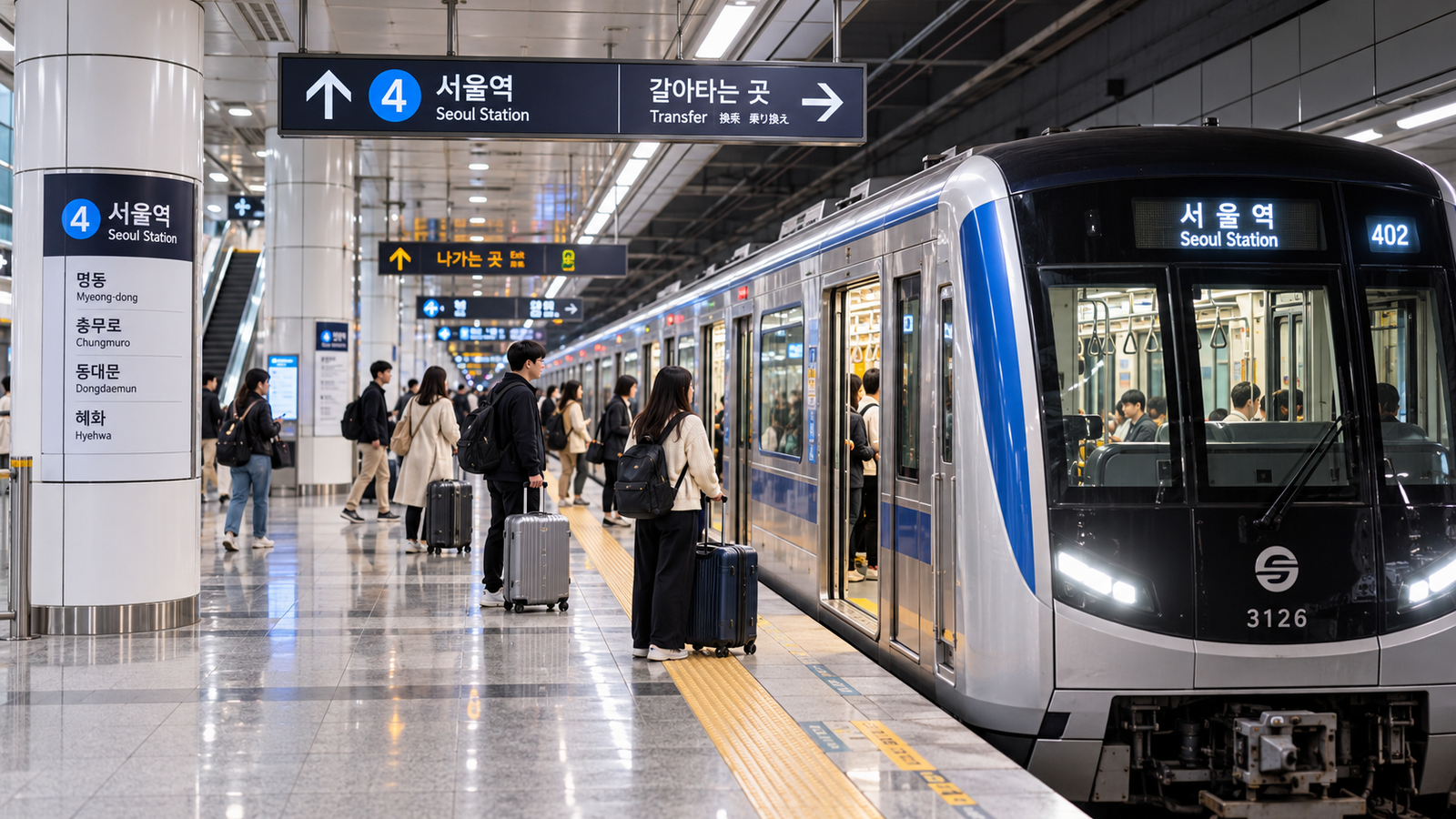

The best way to get around South Korea is by subway and local bus within cities, KTX high-speed trains between major destinations, and express buses for smaller towns. Most tourists can explore South Korea without renting a car. A rechargeable T-money card, a navigation app such as Naver Map, and some basic transportation planning will make your trip easier and more affordable.
Whether you’re visiting Seoul for a few days or traveling across the country, this guide explains which transportation options to use, how much they cost, where to buy tickets, and how to avoid common mistakes.
South Korea Transportation at a Glance
Find the best transportation option for your travel plans.
| Your Travel Situation | Recommended Transport |
|---|---|
| Exploring Seoul | Subway + T-money |
| Exploring Busan | Metro + local buses |
| Seoul to Busan | KTX high-speed train |
| Visiting smaller towns | Express or intercity bus |
| Incheon Airport to Seoul Station | AREX train |
| Airport to a hotel near a direct bus stop | Airport limousine bus |
| Exploring Jeju Island | Rental car or regional buses |
| Late-night travel | Night bus or taxi |
| Traveling with heavy luggage | Direct airport bus or taxi |
| Visiting multiple cities | T-money locally + separate intercity tickets |
What Is the Best Way to Get Around South Korea?
Public transportation is the easiest way for most tourists to travel around South Korea. The country has extensive subway networks, high-speed trains, local buses, express buses, and taxis connecting popular destinations.
However, the best transportation method depends on your itinerary.
If you’re exploring Seoul, the subway is usually the most convenient choice. If you’re traveling from Seoul to Busan, KTX can save time. If you’re visiting smaller towns, an intercity bus may be more practical.
Here’s a comparison of the main transportation options.
Which Transportation Should You Use in South Korea?
Choose your travel situation to find the most practical starting option.
Within a City
Best for sightseeing in Seoul, Busan, and other major cities.
Between Cities
Compare departure stations, total journey time, and fares.
Exploring Jeju Island
A rental car offers flexibility. Buses suit slower-paced trips.
Arriving at an Airport
Choose based on your hotel location, luggage, and available connections.
| Transportation | Best for | Main advantage | Main disadvantage |
| Subway | Seoul, Busan, major cities | Convenient and frequent | Limited coverage in some areas |
| City buses | Neighborhoods and local attractions | Extensive routes | Traffic and unfamiliar routes |
| KTX trains | Long-distance city travel | Fast and comfortable | Can be more expensive |
| SRT trains | Selected high-speed routes | Convenient station options | Limited departure stations |
| Express buses | Budget intercity travel | Wide regional coverage | Longer travel times |
| Taxis | Short trips, late nights, luggage | Door-to-door service | Higher cost |
| Domestic flights | Jeju and selected routes | Convenient for island travel | Airport procedures |
| Rental cars | Jeju and rural areas | Maximum flexibility | Parking and driving requirements |
| Ferries | Island destinations | Access to offshore islands | Weather-related disruptions |
For a first-time visitor traveling between Seoul and Busan, a combination of subways, local buses, and trains is usually enough.
How Does Public Transportation Work in South Korea?
South Korea’s public transportation system combines rechargeable transportation cards, single-use tickets, and advance reservations.
Local subways and city buses generally use transportation cards such as T-money. Long-distance trains and express buses require separate tickets or reservations.
Most major subway stations have English signs, route maps, and announcements, making the system manageable for international travelers.
Step 1: Buy a transportation card
A T-money card is one of the easiest options for first-time visitors.
You can purchase a physical card at participating convenience stores, subway locations, and other authorized sellers.
The Korea Tourism Organization lists a typical general T-money card price of approximately ₩3,000–₩5,000, excluding the balance you load onto it.
VISITKOREA – Imagine Your Korea
Step 2: Recharge the card
Add Korean won to the card before using public transportation.
Many convenience stores and station machines offer top-up services, although payment methods vary.
Keep some cash available because foreign-issued cards are not supported by every recharge location.
Step 3: Tap when entering
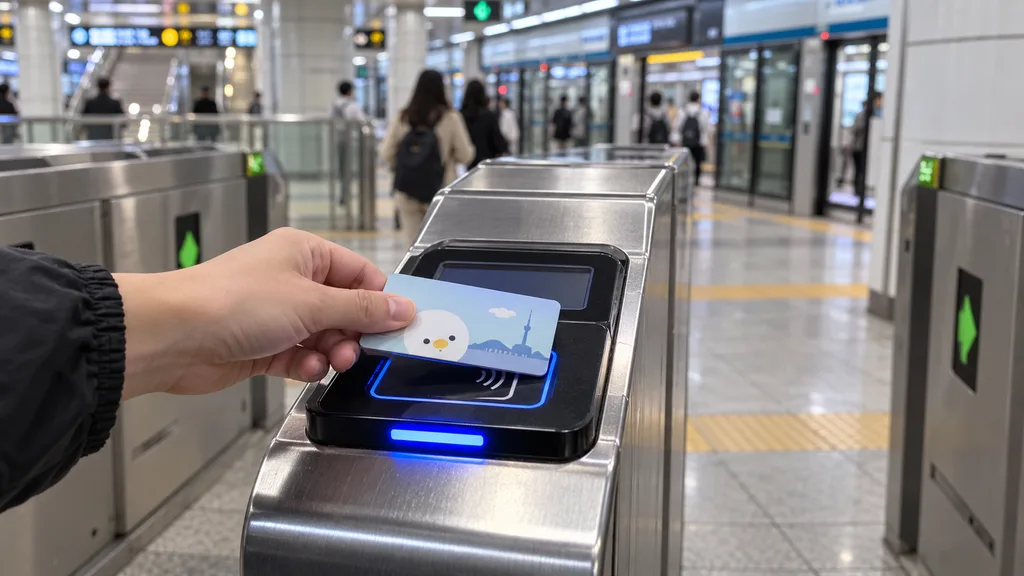
At a subway station, tap your card against the reader at the entrance gate.
For city buses, tap the reader when boarding.
Step 4: Tap when exiting
Tap your card when leaving the subway.
On local buses, tapping out is important for the correct fare calculation and applicable transfer discounts.
Step 5: Purchase separate long-distance tickets
When traveling by KTX, SRT, or intercity bus, check the operator’s booking system.
A T-money balance should not be treated as a replacement for a reserved long-distance train ticket.
T-Money vs Climate Card vs WOWPASS: Which Is Better?
T-money is generally the best transportation card for visitors traveling around multiple South Korean cities. Climate Card is designed for frequent eligible public transportation journeys in Seoul, while WOWPASS offers additional payment and currency-exchange functions for international travelers.
Choosing the right card depends on your travel destinations and daily transportation needs.
| Feature | T-money | Climate Card | WOWPASS |
| Main purpose | Pay-as-you-go public transport | Unlimited eligible rides | Tourist payments and transport |
| Best for | Multi-city travelers | Frequent Seoul transit users | Shopping and transit convenience |
| Coverage | Broad nationwide local transport | Eligible Seoul services | Supported transit and merchants |
| Unlimited rides | No | Yes, within pass rules | No |
| Works outside Seoul | Generally yes | Restricted | Supported transport networks |
| Main consideration | Balance and recharge | Pass cost and coverage | Separate spending and transit functions |
Which Korean Transportation Card Should You Buy?
Choose a card based on your actual itinerary.
| Your Trip | Recommended Card |
|---|---|
| 3 days in Seoul, occasional rides | T-money |
| 3 days in Seoul, frequent eligible rides | Compare Climate Card |
| 7 days in Seoul, frequent eligible rides | Compare 7-day Climate Card |
| Seoul + Busan | T-money |
| Seoul + Jeju Island | T-money for eligible local transport |
| Shopping and local transport payments | Consider WOWPASS |
Important for 2026: Seoul’s Climate Card offers short-term passes from 1 to 7 days. The former 30-day products were discontinued effective October 1, 2026. Climate Card coverage is limited to eligible Seoul services, so it is not a nationwide pass. Check the official transportation card guidance before buying.
T-money Card
T-money is a practical choice if you’re visiting multiple destinations.
It can be used on participating local transportation services throughout much of South Korea, including Seoul and Busan.
Best for: Travelers visiting several cities who want a flexible pay-as-you-go card.
Climate Card
The Climate Card provides unlimited rides on eligible Seoul public transportation services for a selected period.
The official short-term pass prices are:
| Pass duration | Price |
| 1 day | ₩5,000 |
| 2 days | ₩8,000 |
| 3 days | ₩10,000 |
| 5 days | ₩15,000 |
| 7 days | ₩20,000 |
A new physical card costs an additional ₩3,000.
Important 2026 update: As of October 1, 2026, the previous 30-day Climate Card products have been discontinued. Short-term passes remain available, with coverage restricted to eligible Seoul services. Sinbundang Line and GTX are excluded.
VISITKOREA – Imagine Your Korea
The pass generally requires cash or a Korean-issued payment card for purchase or loading through the specified channels.
Best for: Visitors who expect to use eligible public transportation frequently while staying in Seoul.
WOWPASS
WOWPASS is a prepaid card developed for international visitors. It combines payment, currency-exchange, and transportation functions.
According to a Korea Tourism Organization feature published on October 6, 2026, WOWPASS supports top-ups through foreign currencies at its machines and supported payment methods in its app.
VISITKOREA – Imagine Your Korea
Its payment and transportation functions can require separate balances, so check both before traveling.
Best for: Visitors who want a combined shopping and transportation payment solution.
Is the Climate Card Worth It? A Real Cost Comparison
The Climate Card can save money when you take enough eligible public transportation journeys to exceed the cost of the pass.
However, it isn’t always cheaper than T-money.
Consider this example.
A traveler spends three days exploring Seoul and takes four separately charged subway or bus journeys each day.
Assume each journey costs ₩1,550.
Under these assumptions, the Climate Card saves ₩5,600.
South Korea Transport Cost Calculator
Planning a trip to Seoul? Compare estimated pay-per-ride transportation costs with a Seoul Climate Card and see which may save money.
Your Estimated Transportation Costs
Estimated savings: ₩5,600. This assumes all selected journeys qualify for the Climate Card.
Calculation methodology:
Pay-per-ride cost equals travel days multiplied
by separately charged rides per day and the
selected estimated fare. Climate Card cost
includes the selected official short-term pass
price plus ₩3,000 if a new physical card is needed.
This calculator is illustrative. It does not
account for transfer discounts, distance-based
fares, excluded services, or different travel
patterns on individual days. The Climate Card
only covers eligible services within its
designated area.
Verify current transportation card prices
and coverage with VISITKOREA.
This is an illustrative calculation, not a quoted itinerary fare. Real costs depend on transfer discounts, fare supplements, pass coverage, and the number of eligible journeys.
Our recommendation: Choose T-money if you're frequently leaving Seoul or visiting multiple cities. Consider the Climate Card when you expect many eligible journeys within Seoul and can recover the pass cost.
How to Use the Subway in South Korea
The subway is usually the most convenient transportation option for exploring major South Korean cities.
Seoul has an extensive network connecting popular areas such as Myeongdong, Hongdae, Gangnam, and major train stations.
Busan, Daegu, Daejeon, and Gwangju also have urban rail networks.
How to take the subway
- Open Naver Map or KakaoMap.
- Enter your destination.
- Select the recommended public transportation route.
- Check the subway line and direction.
- Tap your transportation card at the entrance.
- Follow the signs to your platform.
- Transfer lines if necessary.
- Tap out when you arrive.
- Follow the recommended station exit.
Why subway exit numbers matter
Large subway stations can have many exits.
Choosing the wrong exit may leave you on the opposite side of a busy road or several minutes away from your destination.
Before exiting, check the exit number suggested by your navigation app.
This is especially useful in crowded areas of Seoul.
Does the Seoul subway run 24 hours?
No. Seoul's subway does not generally operate 24 hours a day.
Operating hours vary depending on the line, station, and day.
Check the last available departure before planning late-night activities.
If public transportation has stopped, you may need a taxi or an available night bus.
How to Travel Between Cities in South Korea
The best way to travel between major South Korean cities is often by KTX or SRT high-speed train. Express and intercity buses provide alternatives, especially for places without convenient rail connections.
KTX High-Speed Trains
KTX is South Korea's best-known high-speed railway service.
It connects Seoul with major destinations, including Busan and other regional cities.
The Seoul-to-Busan journey can take roughly two and a half to three and a half hours depending on the service and stops. Some faster departures take less time, so check the timetable for your specific train.
Advantages of KTX:
- Fast long-distance travel
- Reserved seating
- Convenient connections between major cities
- Less exposure to road congestion
Disadvantages of KTX:
- Tickets can cost more than buses
- Popular departures may sell out
- Not every town has a high-speed railway station
You can check schedules and reservations through the official KORAIL website.
SRT High-Speed Trains
SRT is another high-speed railway option.
It can be convenient for travelers staying near Suseo Station in southeastern Seoul.
Before booking, compare your hotel's location with the departure station.
A train departing from Suseo may be more convenient than one departing from Seoul Station, or vice versa.
Check available routes on the official SRT website.
Express and Intercity Buses
Express and intercity buses are useful for reaching smaller cities and towns.
They can be more economical than high-speed rail and may offer a direct route when railway connections require multiple transfers.
Common booking services include KOBUS and Bustago.
Payment and online booking options vary, so travelers using U.S.-issued cards should confirm the accepted payment methods.
KTX vs Express Bus
| Situation | Better starting choice |
| Limited time | KTX |
| Major cities served by high-speed rail | KTX |
| Smaller destination without a convenient railway | Intercity bus |
| Lower ticket price is the priority | Compare express buses |
| Hotel is near a bus terminal | Direct bus may be easier |
| Avoiding road congestion | Train |
The fastest train isn't always the fastest complete journey.
For example, you might need 30 minutes to reach a train station, followed by another local transfer after arriving.
Compare the entire journey from your accommodation to your destination instead of comparing only the train and bus travel times.
How to Get From Incheon Airport to Seoul
The easiest way to get from Incheon International Airport to Seoul depends on where you're staying.
Your main options are the Airport Railroad Express (AREX), airport limousine buses, and taxis.
AREX Express Train
AREX Express operates between Incheon Airport and Seoul Station.
It is useful when you're staying near Seoul Station or connecting to another rail service.
AREX All-Stop Train
The all-stop airport railroad service serves intermediate stations, making it useful for travelers connecting to several parts of the Seoul metropolitan area.
It may be more convenient than the express train when your destination is near an intermediate stop.
Airport Limousine Bus
Airport limousine buses connect Incheon Airport with various areas of Seoul.
They are particularly useful when a bus stop is close to your hotel.
For travelers with large suitcases, a direct airport bus may be easier than making several subway transfers.
Taxi From Incheon Airport
A taxi provides door-to-door transportation.
It may be worth considering when traveling with family members, children, or substantial luggage.
However, the total cost is generally higher than public transportation and depends on traffic and destination.
| Airport transportation | Best for |
| AREX Express | Seoul Station connections |
| AREX All-Stop | Intermediate railway connections |
| Airport limousine bus | Hotels near a direct bus stop |
| Taxi | Groups, luggage, door-to-door convenience |
Check the latest transport information on the official Incheon Airport website before traveling.
How Much Does Transportation Cost in South Korea?
Transportation in South Korea can be affordable when you rely mainly on local subways and buses.
However, your total budget depends on the cities you visit, the number of daily journeys, and whether you use KTX trains or taxis.
There is no single daily transportation cost that suits every traveler.
Example: Three Days in Seoul
Assume you take four independently charged rides per day and each costs an illustrative ₩1,550.
Your estimated transportation cost would be:
4 rides × ₩1,550 × 3 days = ₩18,600.
Actual fares can differ, and eligible transfers may reduce the total.
Example: Seven Days in Seoul and Busan
For a week-long itinerary, divide your transportation budget into:
| Expense | What to budget for |
| Airport arrival | AREX, airport bus, or taxi |
| Seoul local transportation | Subways and buses |
| Seoul to Busan | KTX or express bus |
| Busan local transportation | Metro and city buses |
| Airport departure | Final airport connection |
| Additional transport | Occasional taxis and unexpected transfers |
The main budgeting mistake is calculating only daily subway fares while forgetting airport transfers and intercity travel.
If you're preparing an overall vacation budget, read our South Korea Trip Cost Guide for accommodation, food, activities, and transportation expenses.
Best Transportation Apps for South Korea
Naver Map and KakaoMap are among the most useful apps for navigating South Korea.
They help travelers find subway connections, bus routes, walking directions, and nearby places.
Other apps make it easier to book taxis, purchase transportation tickets, and translate Korean text.
| App | Best use |
| Naver Map | Public transportation, walking routes, navigation |
| KakaoMap | Local directions and route planning |
| Kakao T | Taxi booking |
| Papago | Korean-to-English translation |
| KORAIL / KorailTalk | Train schedules and reservations |
| SRT | High-speed train reservations |
Does Google Maps Work in South Korea?
Google Maps can help with basic place searches, but it may be less useful than Korean mapping apps for detailed local navigation.
For public transportation and walking directions, Naver Map and KakaoMap are generally better starting points.
Download at least one before arriving in South Korea.
Can You Use These Apps Without Speaking Korean?
Yes. Several Korean travel apps support English interfaces.
However, some station names, business listings, and addresses may still appear in Korean.
Save your accommodation's Korean address and install Papago for translation.
Having mobile data through an eSIM, SIM card, or portable Wi-Fi will make navigation more convenient.
How to Get Around Jeju Island Without a Car
You can explore Jeju Island without renting a car, but it usually requires more careful planning than traveling around Seoul or Busan.
Jeju has public buses, taxis, and organized tours. However, attractions can be widely spread across the island.
Exploring Jeju by Bus
Public buses connect Jeju City, Seogwipo, the airport, and many popular areas.
Buses can be suitable if you're on a budget and don't mind longer journey times.
For a practical bus-based itinerary:
- Stay near useful transport connections.
- Group attractions by region.
- Check the return bus schedule in advance.
- Avoid visiting several distant attractions in one day.
- Leave additional time for transfers.
Exploring Jeju by Rental Car
Renting a car can be more convenient if you plan to explore rural areas, coastal roads, and several attractions in a single day.
However, driving requires appropriate documentation, insurance, and compliance with local rental rules.
Jeju Bus vs Rental Car
| Factor | Public bus | Rental car |
| Cost | Generally lower | Higher |
| Flexibility | Limited by schedules | High |
| Remote attractions | Less convenient | Easier |
| Parking | Not needed | Required |
| Driving license | Not needed | Required |
| Best for | Budget and slower-paced trips | Flexible multi-stop itineraries |
Recommendation: Choose buses if you're following a relaxed itinerary focused on well-connected attractions. Consider renting a car if your plans involve several distant locations on the same day.
Do You Need to Rent a Car in South Korea?
Most tourists do not need a rental car when visiting Seoul, Busan, and other well-connected cities.
Public transportation covers many popular destinations, and taxis can help with occasional journeys that are inconvenient by bus or subway.
Driving may create additional challenges, including parking, traffic, tolls, and unfamiliar road rules.
A rental car becomes more useful when exploring rural regions or Jeju Island.
When a rental car makes sense
Consider driving if:
- Your itinerary includes remote attractions.
- You want to visit multiple rural locations in one day.
- Public transportation requires excessive transfers.
- You have the correct driving documents and suitable insurance.
For most first-time visitors following a Seoul and Busan itinerary, public transportation will be the simpler choice.
How to Pay for Transportation With a U.S. Credit Card
American travelers should not assume that every Korean transportation card reader accepts foreign-issued credit or debit cards directly.
Traditional local transportation card readers generally require a supported Korean transport card, although ticket machines, booking services, and some other payment channels may accept foreign-issued cards.
Payment acceptance depends on the service and transaction method.
To avoid payment problems:
- Bring at least two payment cards.
- Carry some Korean won for transportation card purchases or top-ups.
- Use official booking services for intercity transportation.
- Check the payment requirements before purchasing a travel pass.
- Keep enough transportation balance for your return journey.
A contactless credit card that works at shops may not automatically work as a tap-to-ride card on Seoul's subway.
Is Public Transportation in South Korea Accessible?
Many major stations in South Korea have elevators and other accessibility facilities, although accessibility differs by station, route, vehicle, and region.
Travelers with limited mobility should check individual station facilities before traveling.
A route that appears straightforward on a map may involve transfers, long walking distances, or station exits without the most convenient step-free access.
For wheelchair users, older travelers, or anyone traveling with mobility equipment, confirm:
- Elevator availability
- Accessible station exits
- Vehicle accessibility
- Transfer requirements
- Suitable taxi services where needed
For reliable guidance, consult the appropriate local transit operator before the journey.
How to Travel Around South Korea in Seven Days
A seven-day Seoul and Busan itinerary is a practical introduction to traveling around South Korea without a rental car.
| Day | Destination | Transportation |
| Day 1 | Incheon Airport to Seoul | AREX or airport bus |
| Day 2 | Seoul attractions | Subway and local buses |
| Day 3 | Seoul neighborhoods | Subway |
| Day 4 | More Seoul sightseeing | Subway and occasional taxi |
| Day 5 | Seoul to Busan | KTX or express bus |
| Day 6 | Busan attractions | Metro and city buses |
| Day 7 | Airport departure | Suitable train, bus, or airport transfer |
This itinerary reduces unnecessary hotel changes and allows visitors to experience two major destinations without renting a car.
For a more detailed daily plan, see our South Korea 7-Day Itinerary.
Common Transportation Mistakes Tourists Should Avoid
1. Relying Only on Google Maps
Install Naver Map or KakaoMap for more useful local route planning.
2. Forgetting to Tap Out
Follow local bus and subway card rules to avoid incorrect fares or losing eligible transfer benefits.
3. Buying the Wrong Transportation Pass
Check the Climate Card's coverage and calculate whether the pass is cheaper than individual journeys.
4. Going to the Wrong Train Station
KTX and SRT services may depart from different stations. Check your ticket carefully.
5. Forgetting the Last Train
Always confirm your return journey if you plan to stay out late.
6. Booking Intercity Transportation Too Late
Popular train and bus departures can become difficult to book around holidays and busy travel periods.
7. Underestimating Transfers
A journey may involve walking, waiting, and changing lines. Allow time for the full route.
8. Assuming Every Payment Machine Accepts U.S. Cards
Keep some cash and use official international booking channels when available.
South Korea Transportation Checklist
Complete these steps before your trip. Check off each item as you prepare.
Frequently Asked Questions About Getting Around South Korea
Is South Korea easy to travel around without a car?
Yes. Most tourists can explore major destinations such as Seoul and Busan using trains, subways, and buses. Renting a car is more useful for remote areas and some Jeju Island itineraries.
What is the cheapest way to get around South Korea?
Local buses and subways are usually among the cheapest ways to explore cities. For long-distance trips, compare express bus fares with available train tickets.
Can tourists use T-money in Busan?
Yes. T-money is widely accepted on eligible public transportation services in Busan and many other South Korean cities.
Can I use T-money on KTX trains?
You generally need a separate train ticket for a reserved KTX journey. A standard T-money stored-value balance is not a substitute for the required reservation.
Is Climate Card better than T-money?
Climate Card may be cheaper for frequent eligible rides in Seoul. T-money is generally more flexible when traveling between multiple cities.
Do Seoul subways run all night?
No. Most subway services have scheduled final departures. Check the last train for your specific route and travel date.
How long does it take to travel from Seoul to Busan?
KTX journeys commonly take around two and a half to three and a half hours, depending on the train and timetable. Express buses generally take longer and are subject to traffic.
How do I book KTX tickets from the United States?
Check the official KORAIL website or supported booking channels. Confirm the departure station, travel date, passenger details, payment method, and ticket conditions before purchasing.
Is it difficult to use public transportation without speaking Korean?
Not usually in major cities. English subway signs and navigation apps help international travelers. Keeping your hotel address in Korean is also useful.
Can you get around Jeju Island without driving?
Yes. Jeju has buses, taxis, and organized tours. However, a rental car can provide greater flexibility for distant attractions.
Which app is best for South Korea transportation?
Naver Map and KakaoMap are useful for public transit and local route planning. Papago helps with language translation, while taxi-booking apps can simplify direct journeys.
What is the best transportation for first-time visitors?
For most first-time visitors, the easiest combination is a rechargeable T-money card for local transportation, subways for city exploration, and KTX or intercity buses for longer trips.
Final Thoughts: How Should You Travel Around South Korea?
Getting around South Korea is relatively straightforward when you choose the right transportation method for each part of your trip.
For city sightseeing, rely on subways and local buses. For major intercity routes, compare KTX and express buses. For Jeju Island and remote destinations, decide whether public transportation or a rental car better fits your itinerary.
Before arriving, purchase or plan for a transportation card, install a Korean navigation app, and check important train connections.
Most importantly, compare complete routes, not just ticket prices. The transportation option that saves the most time and effort is often the one that makes your trip more enjoyable.
For more practical planning advice, explore our Things to Know Before Visiting South Korea guide.
How We Researched This Transportation Guide
This guide was researched using official transportation information from the Korea Tourism Organization and relevant South Korean transport operators.
Transportation pass comparisons use published prices. Example budgets use clearly stated assumptions rather than claiming to represent actual purchases or personally tested journeys.
We reviewed the October 2026 Climate Card changes, including the discontinuation of 30-day products and the continued availability of short-term passes.
Travelers should verify route coverage, fares, booking availability, and accepted payment methods before departure because transportation information can change.
Primary reference: Korea Tourism Organization Transportation Cards .
This guide is intended for travel planning. Example savings depend on actual journeys, fare rules, and transportation card eligibility.
Sources and Research Notes
This guide uses official transportation and tourism information reviewed in October 2026. Transportation fares, routes, payment methods, and pass eligibility can change.
Key references include:
- Korea Tourism Organization: Transportation Cards
- Seoul Metropolitan Government: Climate Card
- KORAIL: Official Rail Information
- SRT: Official Train Booking
- Incheon International Airport
- KOBUS: Express Bus Information
Transport cost examples in this article are illustrative calculations, not recorded purchases or firsthand journey results. The source-backed Climate Card prices were checked against Korea Tourism Organization information reflecting the October 2026 changes.